


Grammar Schools in London: Boroughs, Schools and 11+ Tests
Find London's state grammar schools by borough, see which 11+ test applies and follow the right school and council admissions route.
 Elspeth Marlow
- 14 min read
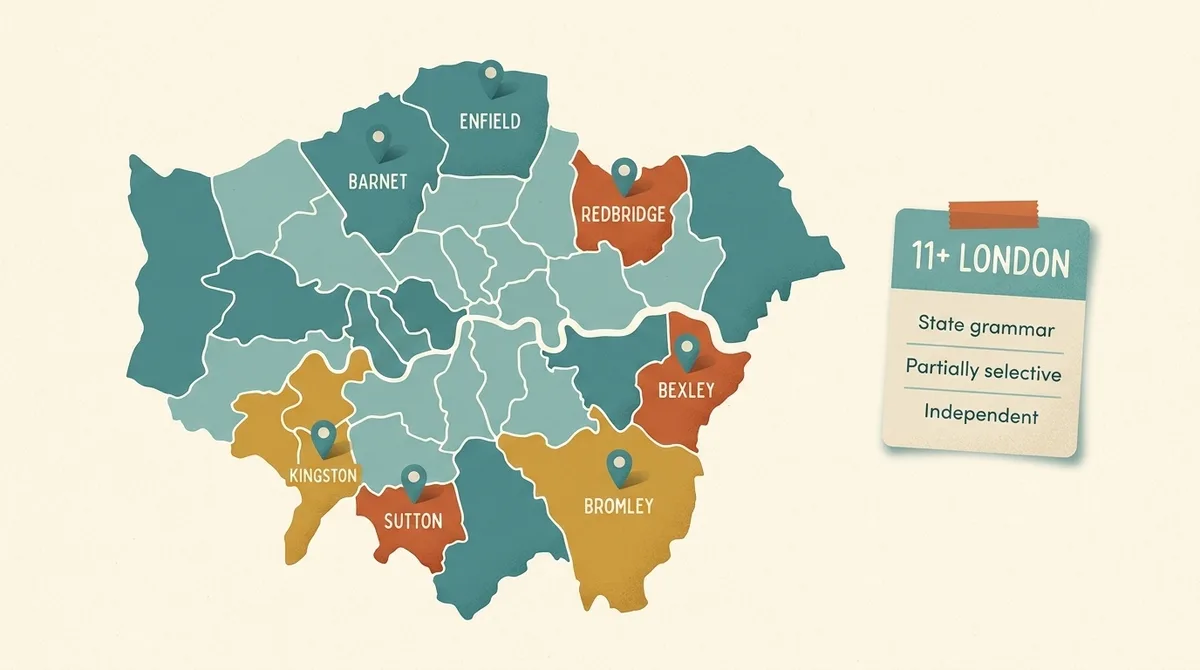
London has 19 state selective grammar schools across seven borough areas in our reviewed directory. There is no single London 11+ exam: Bexley, Redbridge and Sutton have shared first-stage tests, while other boroughs rely on school-run admissions tests. Registration, catchment and later test stages differ by school.
This borough-by-borough guide links the schools and their current admissions routes, then explains how test results fit with the separate local-authority application. It also separates the state grammar routes from the London 11+ Consortium, which is for independent schools.
The routes have different stages and dates. In Sutton, qualifying in the shared first-stage test leads to a school-specific second stage for grammar applicants; the 2027-entry second-stage dates differ for boys and girls. In Kingston, Tiffin School’s second stage follows the 31 October local-authority application deadline. Independent schools also use their own admissions calendars, separate from state offers.
The current examples use published arrangements for September 2027 entry. Most test registrations for this intake have closed; the common application deadline is 31 October 2026, with national offers due on 1 March 2027. Always check the official school page for the year your child will sit the test, because arrangements change and a shared first stage does not guarantee an offer.
The London 11 plus is not one exam
There is no single London 11 plus. State grammar admissions are organised by borough and school, alongside partially selective schools and independent schools with separate admissions. Test content varies. For example, Sutton’s first-stage SET assesses English and maths; Henrietta Barnett’s first round includes verbal reasoning, non-verbal reasoning and English; Tiffin School’s Stage One assesses English and maths. The ISEB Common Pre-Tests are used by some independent schools and cover English, maths, verbal reasoning and non-verbal reasoning. Check the target schools’ current instructions before choosing practice.
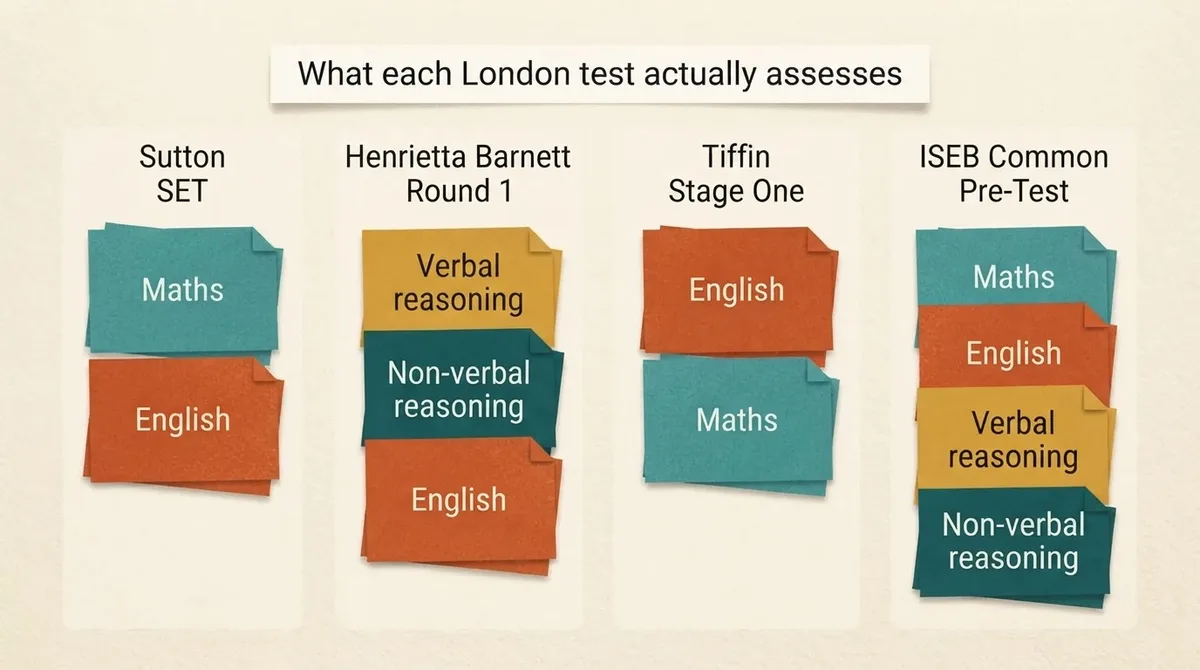
So the first job is not buying practice papers. It is deciding which two or three tests you are actually entering, because that decision determines whether non-verbal reasoning belongs in your child's week at all. Our guide to grammar schools by area is a useful cross-check if you are weighing London against a nearby county system such as Kent or Buckinghamshire.
To see the tests and dates we have checked for a particular borough, pick it below.
This part of the guide looks up which 11+ test your area uses. It works in your browser.
Three selective systems, one city
Fully selective state grammars. Seven London boroughs run them: Barnet, Bexley, Bromley, Enfield, Kingston upon Thames, Redbridge and Sutton. These are free schools with their own entrance tests, and admission is competitive on test performance, sometimes combined with distance or catchment criteria. Crucially, the test is only half the process; the other half is your local authority application.
Partially selective schools. A smaller group admits a proportion of its intake on aptitude or ability while the rest of the intake follows normal comprehensive criteria. Greenshaw High School in Sutton, for example, participates in the shared Sutton test for its selective band. This differs from a fully selective school that uses aptitude within its admissions criteria: Tiffin School’s Sport and Music categories still require its academic test process. Check the policy for the separate aptitude deadlines and eligibility.
Independent schools. These charge fees and set their own admissions arrangements. Some use ISEB Common Pre-Tests; the London 11+ Consortium is a separate shared process used by its member schools. They sit entirely outside the local authority application, and they move on a different and earlier timetable.
Plan ahead: compare tests before registration opens
The Sutton and Tiffin registration windows for September 2027 entry have closed. If you are planning for September 2028 entry, compare the routes before registration opens, because windows vary by school and can open months before the test. Three questions help: which schools are genuinely commutable on a school day, which subjects does each test, and are you considering state schools, independent schools or both?
Answer those, then list the subjects and question formats for each school. If your list includes Sutton or Kingston schools, check their individual later-stage requirements as well as the shared or first-stage test. Barnet schools and independent schools do not all use the same format: for example, Henrietta Barnett includes reasoning, while some independent schools use ISEB tests. Add practice only for skills that appear in your target schools' current published arrangements. If you are unsure how early to begin, our year-by-year preparation plan sets out options.
May to July: the Sutton registration window
Sutton has a shared first-stage test. One registration for the Selective Eligibility Test (SET) covers six schools: Greenshaw High School (selective band), Nonsuch High School for Girls, Sutton Grammar School, Wallington County Grammar School, Wallington High School for Girls and Wilson's School. For September 2027 entry, Sutton Council lists 31 July 2026 as the shared registration deadline and 15 September 2026 as the SET date.
The SET assesses English and maths; it does not assess verbal or non-verbal reasoning. Follow the schools’ current familiarisation information for the paper format and test-day instructions.
September: test day, and what passing actually means
For the 2027-entry cycle, Sutton Council explains that the shared test is a first-stage assessment, not an offer of a place. Passing the SET does not secure a place. It confirms eligibility to progress to a Second Stage Entrance Examination. Sutton Grammar's admissions FAQs are explicit that scores are age-standardised, that each school sets its own pass mark after marking is complete, and that "It is not possible to state a pass mark in advance of the test". Outcome emails go out during the week after the test.
Sutton route at a glance:
- Register once for the Selective Eligibility Test (SET), which covers six participating schools.
- Sit the English and Mathematics first-stage papers.
- If invited, sit the relevant school’s second stage. For September 2027 entry, the girls’ joint second stage for Nonsuch and Wallington High School for Girls was scheduled for 26 September 2026; the boys’ shared stage for Sutton Grammar, Wallington County and Wilson’s was 3 October 2026.
- Each school applies its own admissions arrangements to the results. Passing a test does not secure a place.
The boys’ shared second stage fell on Saturday 3 October 2026, eighteen days after the SET; the girls’ joint second stage is 26 September. The papers and score weightings depend on the school. For example, Wallington County Grammar describes written English and maths papers and a 2:3 weighting of SET to second-stage scores. Check each school’s arrangements, as test formats and decisions differ. You can read the format detail in Sutton Grammar School's admissions FAQs.
The format changes between stages at some schools. Use the current school familiarisation information to understand the relevant second-stage format; do not assume that every school uses the same papers or scoring method.
October: Kingston, and the deadline collision
For September 2027 entry, Tiffin School registration opened on 5 June 2026, and families needed to submit the Stage One SIF by noon on 1 September 2026. Paragraph 7.5 of the determined 2027-entry policy allows late forms only in exceptional circumstances decided by the school, with evidence; ask admissions about any individual case. Stage One, on 2 October 2026, tests applicants in English and Mathematics. Successful candidates are notified by 16 October 2026, and Stage Two follows on 12 November for invited candidates. The school also runs separate Sport and Music aptitude assessments: its early application deadline was 09:00 on 6 July 2026, with music assessments on 8 and 10 July and sport assessments on 13 and 14 July. These routes apply to Tiffin School's own admissions and do not describe other Kingston schools. See the Tiffin Year 7 admissions page for its year-specific sequence.
Now look at the calendar collision. For this Kingston example, the published deadline for the local-authority school application is 31 October 2026. Check your home council’s own opening date and deadline. Tiffin's Stage Two is in mid-November. So a Kingston family must decide where Tiffin sits on their ranked preference list while the Stage Two result does not yet exist. There is no way around this; there is only planning for it. Rank the school honestly against your realistic alternatives, use the preferences available through your home council, and remember that GOV.UK states plainly that listing only one school will not increase your chances of getting a place there.
London grammar schools by borough
Use the area page for the schools and admissions evidence we hold for each borough. The school pages link to each school's own current admissions information. A shared first-stage test can simplify registration, but it does not combine school preferences, catchments or offers.
These are state-funded selective schools. Greenshaw High School in Sutton is partially selective and participates in the Sutton first stage for its selective band; it is not a grammar school. For north London schools, use the individual admissions pages above and check eligibility directly with each school. The London 11+ Consortium is a separate shared admissions process for independent schools, not a state grammar test.
November to February: the independent track
Families considering both state and independent schools need to track two separate admissions calendars.
The ISEB Common Pre-Tests are four online, adaptive multiple-choice assessments covering English, maths, verbal reasoning and non-verbal reasoning. They can be taken on one day or across multiple days at a current school, applying senior school or approved invigilation centre. ISEB says results are available to senior schools immediately through its portal. The 2026–27 session runs from 1 September 2026 to late May 2027. Which schools use the tests and how they use results varies, so check each school’s own admissions information. If this is your route, our ISEB Common Pre-Test guide covers the adaptive format properly, and our comparison of GL, CEM and ISEB explains how the boards differ in practice.
The London 11+ Consortium uses one shared assessment, but families apply to each member school they want considered. Results are shared with the schools where the candidate is registered; interviews are school-specific. Godolphin and Latymer, a member school, publishes the 2027 entry sequence: registration closes at noon on Friday 6 November 2026, the entrance exam is sat on either Friday 27 November or Tuesday 1 December 2026, interviews are held on Friday 15 January 2027 with no alternative dates offered, and offers are made on Friday 12 February 2027. Applicants must be born between 1 September 2015 and 31 August 2016.
For this example, Godolphin and Latymer publishes a 12 February 2027 offer date and a 3 March acceptance deadline. National Offer Day for state secondary places is 1 March 2027. Other schools may set different dates, so check the relevant offer and acceptance terms directly.
The London 11 plus calendar at a glance
- 1 May 2026: Sutton SET registration opened
- 5 June 2026: Tiffin registration opened
- 6 July 2026: Tiffin Sport and Music aptitude early application deadline (09:00)
- 8, 10, 13 and 14 July 2026: Tiffin Music and Sport aptitude assessments
- 31 July 2026: Sutton SET registration closed
- 1 September 2026: State applications opened; Tiffin Stage One registration deadline (submit by noon)
- 15 September 2026: Sutton Selective Eligibility Test
- 2 October 2026: Tiffin Stage One
- 26 September and 3 October 2026: Sutton second-stage assessments, with dates differing by participating schools
- By 16 October 2026: Tiffin Stage One outcomes
- By the end of October 2026: Sutton second-stage outcomes, emailed school by school. Sutton Grammar's FAQ says boys' outcomes come before the October half term break.
- 31 October 2026: Common Application Form deadline
- Mid-November 2026: Tiffin Stage Two; Consortium exams late November and early December
- 15 January 2027: Godolphin and Latymer interviews (the date in this school's published 2027-entry example)
- 12 February 2027: Consortium offer date; check each school’s terms
- March 2027: National offer day for state places
How the CAF interacts with your test results
The test outcome and your application are separate parts of admissions. A school's published admission arrangements say how it uses test eligibility or scores, along with any other criteria such as distance or priority groups. Your Common Application Form, submitted through your home local authority, lists the schools you want. The local authority coordinates those applications and, if more than one can offer a place, gives the highest preference that can offer under its criteria.
Sutton Grammar School explains that boys must name the school on the CAF after passing the two-stage process, and that meeting the required standard does not guarantee admission when the school is oversubscribed. The school's published criteria determine which eligible applicants can be offered places.
Each school applies its published admission criteria to decide whether it can offer a place. Your preference order decides which offer you receive if more than one school can offer you a place.
Three rules follow. Use the preferences available through your home council. Rank in true order of preference, since the system awards the highest-ranked school that will offer you a place. And include at least one school you would be content with and are confident of reaching, because a list of five long shots can resolve to none of them.
What to prepare, and the mistakes to avoid
- Match each school's published format. Do not assume every school in a borough or every independent school tests the same subjects. Check each school's current guide, including later stages.
- Practise written answers early. Multiple-choice fluency will not carry a child through Sutton's second stage or Henrietta Barnett's Round Two.
- Rehearse the mechanics in the official familiarisation material. Some tests use a separate answer sheet, some have timed sections and some include a break. Follow the instructions for the test your child will sit.
- Diarise registration, not just exams. Sutton closes on 31 July; Tiffin’s determined policy gives noon on 2 September; older page and FAQ copy differs, so use the policy and query any uncertainty with admissions. Missing a window ends that application route.
- Plan the February decision. Decide in advance what you will do if an independent offer arrives with a deadline before your state outcome.
Smart Cub Learning’s exam plan can help organise practice around the tests on your list. Check the chosen schools’ own familiarisation materials for the current formats.
Compare the routes in time to meet their individual registration deadlines, and follow each school's current preparation guidance. Treat the CAF as a ranked list of genuine preferences, with the published admissions criteria determining which schools can offer a place.
Topics
- 11 plus london
- sutton set
- grammar schools
- consortium
- admissions