
The ISEB Common Pre-Test: Format, Timing and How to Prepare
A source-led explainer of the ISEB Common Pre-Test: the current timings, how the adaptive engine really works, free sample questions for all four sub-tests, and why parents never see the score.
 Elspeth Marlow
- 13 min read

If your child is applying to a UK independent senior school, the phrase "ISEB Common Pre-Test" tends to arrive in a prospectus with very little explanation attached, and the internet fills the gap unevenly. Search for it and you will find pages that disagree about how long the test lasts, pages that describe adaptive testing in a single vague sentence, and a great many pages that exist mainly to sell you a preparation course.
This guide is deliberately different. Everything below is taken from what the Independent Schools Examinations Board publishes about its own assessment, and where our sources say something reassuring we have not quietly dropped it. ISEB's own line is worth reading before anything else: "The Pre-Tests are based on the national curriculum, so your child will be prepared through their schooling and additional preparation is not a requirement." Registration is also free. Neither of those facts is heavily advertised by the rest of the results page.
We have written this as a walkthrough in the order the process actually happens, from the first letter a senior school sends you to the report that lands somewhere you will never see it. Along the way there are original sample questions for all four sub-tests, on this page, with no sign-up and no email wall.
What the ISEB Common Pre-Test is, and what it is not
The ISEB Pre-Tests are, in ISEB's words, "a series of four online, adaptive and shared entrance assessments" used in independent school admissions. The four papers cover Mathematics, English (reading comprehension and grammar), verbal reasoning and non-verbal reasoning. They are "often taken in Year 6 or Year 7", and they feed either entry into Year 7 or deferred entry into Year 9. They "can be taken together on the same day or split into multiple days", which is a decision for the school administering them rather than for you (iseb.co.uk).
What the Pre-Test is not: it is not a grammar school 11+ paper of the kind we cover in our guide to the 11 plus exam, it is not the Common Entrance exam that comes later at 13+, and it is not a single national test with a published pass mark. It also is not the whole application. Most senior schools use the Pre-Test as one screen among several, alongside a school reference, an interview and sometimes their own written paper. If you are still working out which board and which format applies to your family, our comparison of GL Assessment, CEM and ISEB sets out the landscape, and formats vary considerably by region and by school.
Milestone one: the schools ask for it, and your child sits it once
The first practical thing to understand is that the Pre-Test is a shared assessment. ISEB states that "a child's results can be accessed by all of the senior schools who require them. This means that children only have to take the tests once" (iseb.co.uk).
That single sentence removes a large amount of anxiety. If your child is applying to five schools that use the Pre-Test, they sit one set of four tests, not five. There is a corresponding rule that cuts the other way, and it is rarely mentioned anywhere: "The applicant can only take the tests once in each academic year." There is no retake in the same admissions cycle if the day goes badly, which is a good reason to prioritise sleep, breakfast and a calm morning over one last revision session.
Milestone two: registration, and the testing window
Registration is handled through ISEB's parent portal, and it costs nothing. The testing session "runs from the autumn term to the spring term of each academic year"; for the 2026-27 cycle it runs from 1 September 2026 to late May 2027. Your child's actual sitting date is set by the school or by the invigilation centre, not by you.
The timing of your slot within that window matters less than parents assume. Results are "age-standardised against a sample of pupils applying for independent school admission across the academic year, ensuring that there is no disadvantage for younger children, or those who take the tests earlier." A September sitting is not penalised against a March one, and a child born in August is not compared like for like with a child born in September.
Milestone three: the four sub-tests and exactly how long each one takes
The four tests are "four multiple-choice, adaptive, online tests" totalling 2 hours 15 minutes. Section by section, per ISEB's preparation toolkit:
- English: 40 minutes. Assesses "two distinct areas of knowledge: Reading Comprehension and Grammar."
- Mathematics: 40 minutes. Drawn from "mathematics topics from the National Curriculum Programme of Study up until the end of Year 5."
- Non-verbal reasoning: 30 minutes. Two question types: analysing 2D figures for patterns, and manipulating 3D figures for spatial reasoning.
- Verbal reasoning: 25 minutes. Reasoning with words, meanings and relationships rather than curriculum content.
That is 40 + 40 + 30 + 25, which adds to 135 minutes, or 2 hours 15 (iseb.co.uk). Note the Maths detail, because it is the single most calming fact in the specification: the content ceiling is the end of Year 5, not the end of Year 6.

Why the timings you will see online disagree
If you search for this, you will find well-ranked pages quoting Maths 50 minutes, English 25, verbal reasoning 36 and non-verbal reasoning 32, totalling roughly 2 hours 30. Those numbers were correct once. They describe the pre-2022 specification, before the Pre-Tests moved to their current adaptive delivery, and some of that copy still cites statements from 2016.
So if you have seen two different sets of timings and assumed you misread one of them, you did not. One is simply out of date. The figures to plan around are the current ones: 40, 40, 30 and 25, totalling 2 hours 15. If a preparation resource you are considering still lists the older durations, treat it as a signal about how recently the rest of that resource was checked.
Milestone four: test day, and how the adaptive engine actually works
This is the part parents most often get wrong, and it is worth reading twice. ISEB publishes a dedicated explainer on adaptive testing, and four facts from it should change how you brief your child (iseb.co.uk).
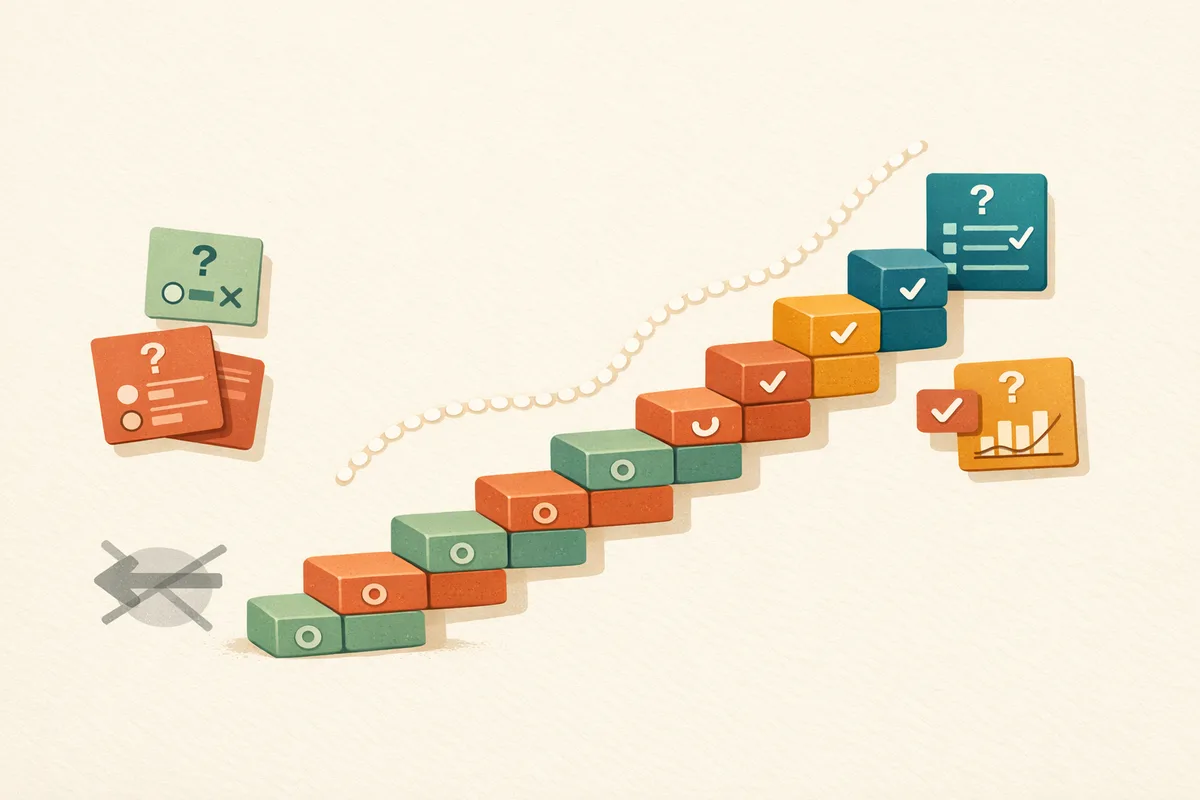
One: the test gets harder when your child does well. "Pupils who answer questions correctly are gradually tracked to harder questions. Those who consistently answer incorrectly are tracked to easier content." The consequence is counter-intuitive but important: a child who is doing well is supposed to reach questions they cannot answer. Coming out saying "some of it was really hard" is evidence the engine was working, not evidence of failure.
Two: children see different numbers of questions. "Pupils may be presented with different numbers of questions than other children, but this ensures the test remains the right length for each child." Comparing question counts with a classmate in the car park tells you nothing at all.
Three: it is not a speed test. "Scores are based on the difficulty of the questions the applicant sees and whether they answered correctly", and "high scores can be achieved without answering the maximum number of questions." ISEB puts it plainly: "The ISEB Pre-Tests are not speed tests; accuracy and consistency are far more important than the number of questions answered." This kills the most common coaching error, which is telling a child to rush in order to get through more.
Four: an early wobble is recoverable. If a child makes an early mistake and then answers consistently accurately, "the adaptive algorithm will gradually overwrite their earlier mistake." A shaky first two minutes does not decide the outcome.
Why your child cannot skip, go back, or finish early
There is one more mechanical rule with real consequences: "There is no 'skip' or 'back button' option when taking the Pre-Tests because the test assesses how consistently your child can accurately answer questions."
Think about how much standard exam advice this invalidates. "Leave the hard ones and come back to them" cannot be done. "Check your answers at the end" cannot be done. "If you finish early, review everything" cannot be done. For a child drilled on paper-paper technique, that is a genuinely disorientating change on the day, and it is the single most useful thing to rehearse.
The workable version of test technique here is: read the question properly the first time, commit to your best answer, then let it go and move on. If your child has practised only on printed papers, one or two on-screen mock tests under a forward-only rule are worth more than another twenty pages of drill, because they train the emotional habit of not looking back.
Sample questions for all four sub-tests, no sign-up needed
These are original examples written for this guide, not extracts from familiarisation materials. Each one is paired with a note on what the adaptive engine is doing at that level.
Mathematics (mid difficulty). A shop sells pens in packs of 6 for £2.40. Rana buys 4 packs and pays with a £10 note. How much change does she get? (A) £0.40 (B) £0.60 (C) £1.60 (D) £2.40. Answer: A. Two steps, both inside the Year 5 programme of study. Answer this correctly and the engine moves you toward multi-step problems with fractions or rates; answer it incorrectly a few times and it steps back toward single-operation questions.
English, grammar (mid difficulty). Choose the correct option: "Neither of the twins ____ finished the puzzle." (A) have (B) has (C) having (D) were. Answer: B. Subject-verb agreement with an indefinite pronoun. Harder items in this strand shift to clause function and punctuation of subordination rather than single-word choice.
Verbal reasoning (higher difficulty). Harbour is to ship as hangar is to: (A) runway (B) pilot (C) aircraft (D) engine. Answer: C. The relationship is "sheltering structure to the vehicle it shelters", and the distractors are all plausible if you match by topic instead of by relationship. At higher difficulty the engine favours items where topical association is a trap. Our guide to verbal reasoning question families covers the recurring shapes.
Non-verbal reasoning (higher difficulty). A shape shows a small filled triangle in the top-left corner of a square and a hollow circle in the bottom-right. In the next figure, the whole square has been rotated 90 degrees clockwise. Where is the filled triangle now? (A) top-left (B) top-right (C) bottom-right (D) bottom-left. Answer: B. Rotation with position tracking rather than pattern completion. The 3D strand pushes further into spatial manipulation, which we unpack in our non-verbal reasoning guide.
If your child wants more untimed practice across the four strands, our free 11 plus practice papers are downloadable without an account.
Milestone five: scoring, and the report you will never see
Here is the fact that almost no page in the search results tells you. ISEB's own support portal states it directly: "Unfortunately, ISEB does not release Pre-Tests' results to parents." Invigilation centres, guardians and agents cannot see them either. Only the senior school can (ISEB support).
What the school receives, through its Senior School Portal, is a Standardised Age Score adjusted for the pupil's age, plus "individual stanine, percentile rank and group rank scores, together with mean SAS". Standardised age scores are benchmarked against "a standardisation sample taken from the independent schools' sector", and the average of that scale is 100. Because the benchmark group is independent-sector applicants rather than the whole population, a score of 100 already means average among a selective cohort.
There is no published pass mark, because there cannot be one: each school sets its own threshold, weighs the Pre-Test differently against interview and reference, and admits against its own applicant pool that year. So the honest advice is uncomfortable but freeing. Stop chasing a target number you will never be shown. If you want context, ask the senior school directly: how heavily do you weight the Pre-Test, what else are you looking at, and what would you like to see from an applicant like mine? Admissions staff answer that question all the time, and their answer is worth more than any number circulating on a forum.

How to prepare without over-preparing
Given all of the above, sensible preparation is narrower than the market suggests.
- Familiarise, do not cram. The content ceiling is Year 5 Maths and national curriculum English. Confidence with what school has already taught beats racing ahead.
- Practise on a screen. Reading comprehension on a monitor, with no annotation and no going back, is a different skill from reading on paper.
- Rehearse the forward-only rule. Decide, commit, move on. Explicitly retire "check your work at the end" for this test.
- Reset the definition of hard. Tell your child before the day that hitting questions they cannot do is the design, not a warning sign.
- Cover reasoning lightly and regularly. Verbal and non-verbal reasoning are not taught in most primary schools, so short and frequent exposure closes most of the gap.
- Protect the week itself. One sitting per academic year makes rest a genuine strategy.
If you would like that shaped into a dated plan around your child's sitting, our exam plan tool does the scheduling so you can stop rebuilding it in a spreadsheet.
ISEB Common Pre-Test: frequently asked questions
What is the ISEB Common Pre-Test?
Four online, adaptive, multiple-choice tests used in UK independent school admissions, covering Mathematics, English, verbal reasoning and non-verbal reasoning, taking 2 hours 15 minutes in total. Results are shared across all participating senior schools, so a child sits them only once.
Is the ISEB test hard?
It is designed to feel hard in places for every child, because difficulty rises as answers are correct. The content itself is national curriculum material up to the end of Year 5 for Maths. Reaching questions your child cannot answer is expected and is not a sign of a poor result.
What is a good ISEB score?
There is no published pass mark. Schools receive a Standardised Age Score where the average is 100, benchmarked against independent-sector applicants, plus stanine and percentile rank. Each school sets its own threshold, so ask the senior school what it looks for rather than targeting a number.
How do you prepare for an ISEB pre-test?
ISEB states that "additional preparation is not a requirement". The most useful preparation is familiarisation: practise on screen, get used to having no back button, keep reasoning practice short and regular, and make sure your child knows that harder questions mean the test is working.
Can I see my child's Pre-Test results?
No. ISEB does not release Pre-Test results to parents, guardians, agents or invigilation centres. Only the senior school can view them, and it decides what, if anything, to share with you.
When you are ready to build regular practice into the week without turning your household into a revision camp, you can start with Trace Learn and keep the sessions short.
Topics
- iseb
- pre-test
- independent schools
- adaptive testing
- 11 plus