


Practice Papers and Mock Tests
Free 11 Plus Practice Papers with Answers
A parent guide to finding free 11 plus familiarisation papers, checking whether answers are supplied and comparing examples with your local test format.
 Elspeth Marlow
- 9 min read

A free practice paper can be useful, but the right resource depends on the test your child will sit. Test names do not guarantee that two areas use the same subjects, timing or answer format. GL Assessment itself warns that local test timings and question counts may differ from its familiarisation and practice materials.
Use this guide to find official familiarisation sources, check whether a resource includes answers, and decide whether an example is relevant to your local test. The official past-paper directory links to materials and identifies their source where known. A listed sample does not necessarily match the complete local test, include a mark scheme, or have an online version. Check the linked provider or school before relying on it.
Step 1: Name the test before you name the paper
Before downloading anything, identify the test and entry year. For example, the test for September 2027 Buckinghamshire entry covered verbal, mathematical and non-verbal skills; the test for September 2027 CSSE entry had English and Mathematics papers. Those test rounds have passed as of October 2026. Check the school or local authority for the cycle that applies to your child.
The target school or local authority’s admissions page is the place to confirm subjects, timing and format. GL Assessment explains that local authorities and schools choose which subjects they assess and that local formats may differ, even when they use GL materials.
If you cannot write that sentence yet, that is your first task, not paper selection. Our parent guide to what the 11+ actually is walks through how to find your area's arrangements, and the section below gives you the current published structure for several major areas.
Step 2: Check the details before you download
Resources do not all publish the same details. When available, check these four things:
- Duration. Compare the published length with the local test, allowing for any separate reading or instruction time. A shorter worksheet can still be useful for practising one skill.
- Question count. Read this alongside the duration and question type. A question count alone does not show how difficult or fast a paper will feel.
- Answers included. Check whether a mark scheme is supplied. If it is not, you can still use the questions for practice, but you may need a teacher or another trusted source to check answers.
- Format. Check whether it is a printable question paper, an online exercise or both. Do not assume a PDF has an online version or that an online exercise reproduces your local exam.
A label such as “GL-style” or “CSSE-style” is a description of a resource, not proof that it matches a current local test. Check the publisher, entry year and actual question format before using it as a mock.
Step 3: Check your area's real format
These are examples for the September 2027 entry cycle, whose tests took place in 2026. They show how formats differ; they are not current dates for a future round. Check your school or local authority’s latest admissions information.
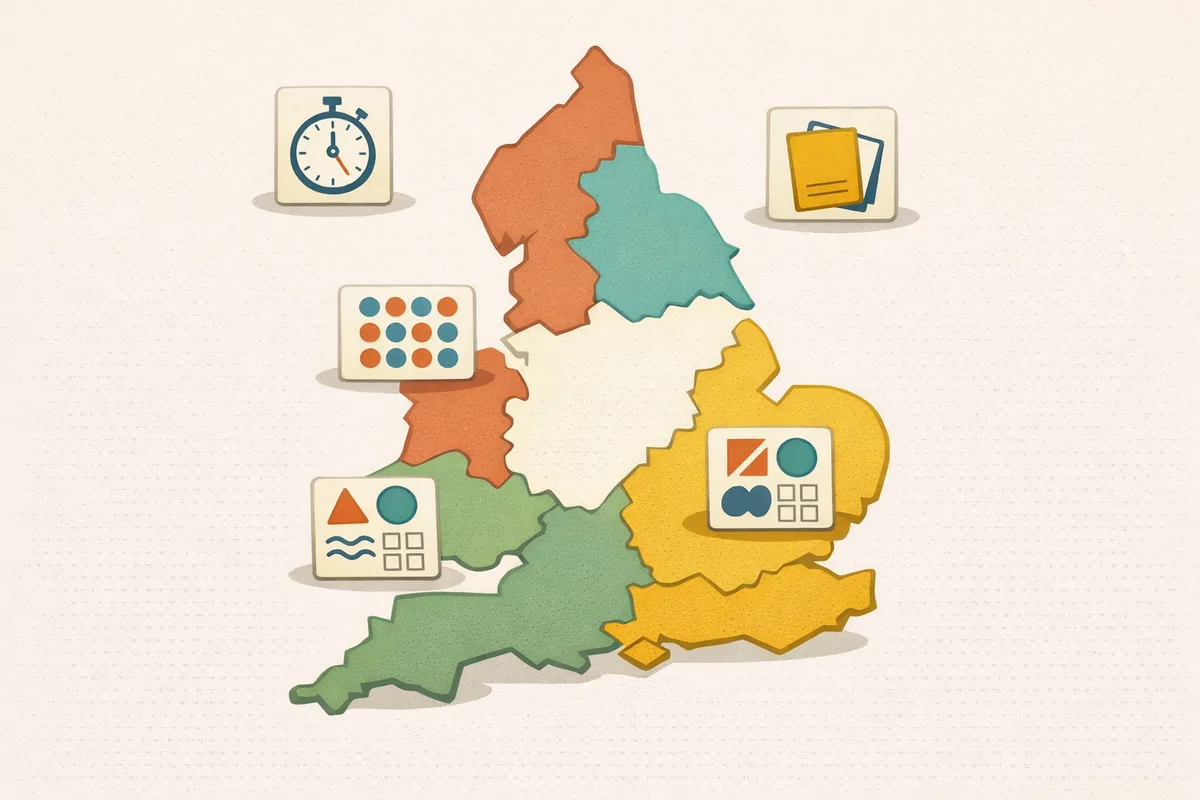
- Essex (CSSE). Candidates sit two tests, one in English and one in Mathematics. The English paper lasts sixty minutes with ten minutes additional reading time, and the Mathematics paper lasts sixty minutes. Crucially, CSSE confirms that with effect from September 2024 (2025 entry) the English paper does not contain Applied Reasoning questions, so pre-2025-entry CSSE English papers no longer match the current format. The 2027-entry test took place on Saturday 19 September 2026. CSSE publishes free downloadable familiarisation papers, and also sells practice packs.
- Buckinghamshire. Buckinghamshire Council states that children sit two papers, each about 45 minutes (about 60 minutes including instructions and examples), covering verbal skills, mathematics and non-verbal skills. A short break separates the papers. There is also a shorter practice test, usually taken two days before the main test, to help children learn what to expect.
- Bexley. The London Borough of Bexley states that Quest Assessments is the Bexley Selection Test provider, and that the assessment comprises two separate booklets testing verbal ability and English comprehension, numerical reasoning, and non-verbal reasoning. The tests are timed and consist of multiple-choice questions. Each paper lasts approximately 50 minutes plus additional time for instructions, with each full session running two and a half to three hours, and the 2027-entry test window at grammar-school centres ran from 7 to 10 September 2026. Those dates have passed.
- Independent schools using the ISEB Common Pre-Test. ISEB describes its Common Pre-Test as four online, adaptive and shared entrance assessments covering mathematics, English (reading comprehension and grammar), verbal reasoning and non-verbal reasoning, often taken in Year 6 or Year 7. The four assessments can be taken together on the same day or split across multiple days (ISEB).
- Sutton and Kent. Both run their own published arrangements, and both have consortium or school-level variations that a summary line would misrepresent. Check your area's current admissions page directly before choosing papers, and confirm the paper structure for the specific schools on your list.
These examples show why families should check their own test route before using a resource. A familiarisation booklet from one area may include a format or subject that another area does not use.
To check your area's real format before you print anything, pick your area below.
This part of the guide looks up which 11+ test your area uses. It works in your browser.
Step 4: Check how the resource is used
Some practice material is printable and some is online. A PDF does not necessarily have an online duplicate, and some resources do not include answer keys.
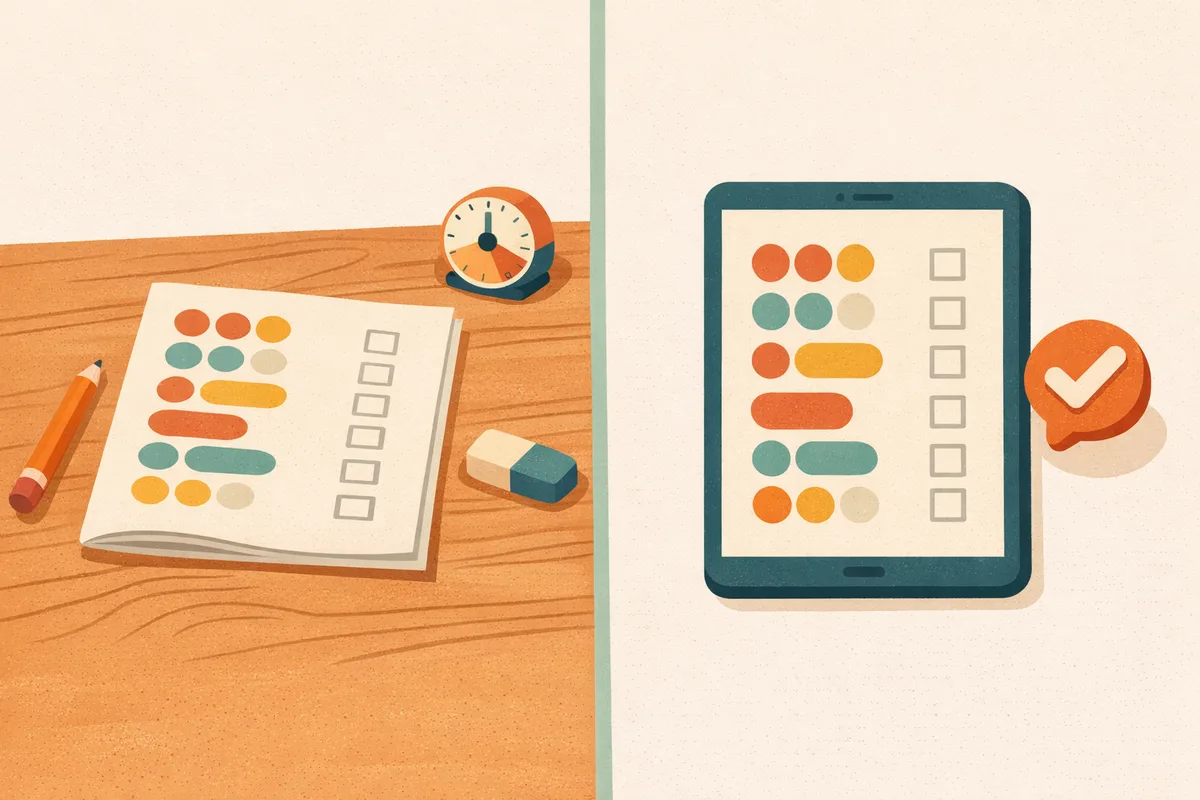
A simple rule for choosing between them:
- Use a printable resource when you want your child to write or work things out on paper. Use an online exercise when its format suits the skill you want to practise. Neither format is automatically closer to a local entrance test; check the local guidance.
To time a paper at home, enter its length and number of questions below. It gives the seconds each question can take, the checkpoints, and a practice clock.
This part of the guide works out seconds per question and checkpoints for a timed paper. It works in your browser.
Step 5: Mark for diagnosis, not for a score
A score on one practice paper does not explain why answers were wrong or predict an admissions outcome. If you review mistakes, note what the question asked, what answer was given and what the mark scheme accepts. Treat any explanation of a pattern as a possibility to check, not a diagnosis.
For example, if several mistakes occur near the end of a timed paper, timing may be one thing to discuss. Check whether the questions were missed, misunderstood or answered incorrectly, and compare another example before deciding what to practise next.
If errors seem to cluster around one question type, review that type’s instructions and a few examples. Our verbal reasoning question families guide and non-verbal reasoning guide describe common formats; local tests vary.
GL Assessment makes the case for timing plainly: "Tackling a practice paper under timed conditions gives children valuable experience of managing their time effectively." Use timed practice only when it reflects the local test format and when your child is ready for that practice. A timed result is one piece of information, not a measure of ability.
Step 6: Build a practice routine that fits your child
There is no single evidence-based schedule for every test and child. A flexible routine might include: reviewing the school’s familiarisation material; practising a topic that needs more work; and, if appropriate, trying a timed section in the published format. Leave space for school, rest and the child’s interests. Reduce or pause practice if it is creating conflict. Check the admissions provider’s own advice about how much familiarisation is needed.
What we left out, and why
Use resources with their source, year and format in view. Pre-2025-entry CSSE English papers may contain Applied Reasoning, which CSSE removed from the English test from September 2024 (2025 entry). An official sample is not necessarily a current full paper, and a paper without a mark scheme cannot provide an official score.
Where to get official papers direct
Go upstream where you can. Our directory of 11+ past papers and sample papers links to materials; check each publisher’s page for its current details, answer keys and reuse conditions.
- GL Assessment's free familiarisation materials include free downloadable familiarisation materials in verbal reasoning, non-verbal reasoning, English and maths. GL says they are generic and local test details can differ. Read the caveat on that page carefully: 11+ tests vary from area to area, and GL recommends contacting your admissions authority for specifics.
- CSSE publishes free downloadable familiarisation papers alongside practice packs that must be purchased.
- Your council's admissions pages carry the arrangements that actually govern your child's test, including registration deadlines. Registration and application dates differ by area and year; use the dates published for your child’s entry round.
Questions parents ask most
Where can I find free 11+ practice papers with answers? Start with the free familiarisation materials offered by the relevant test provider or school. Check whether answers are included; if not, do not assume a paper has an official mark scheme.
What papers are in the 11+? It depends on your area and target school. For the 2027-entry cycle, CSSE used English and maths papers; Buckinghamshire used verbal skills, maths and non-verbal skills; Bexley used verbal ability and English comprehension, numerical reasoning and non-verbal reasoning. ISEB Common Pre-Test schools use four online assessments. Check the named school's current admissions arrangements.
Is 70 percent enough to pass? There is no national raw-percentage pass mark. Some tests use age-standardised scores, and schools may publish qualifying scores or additional oversubscription rules. Check the relevant published admissions arrangements. Treat a raw percentage as a result on that paper, not a prediction.
Where can I find comprehension papers with answers? Use the official past-paper directory to find English examples, then check the source and year. Comprehension format and any writing requirement vary by test.
Start with the admissions information for the schools you are considering. Our year-by-year preparation plan offers broader planning guidance, but the local provider’s current test specification takes priority.
Topics
- 11 plus papers
- practice papers
- mock tests
- gl assessment
- csse
- free resources