


GL Assessment, CEM and ISEB: Which 11 Plus Exam Will Your Child Sit
Compare GL Assessment, Quest, FSCE, ISEB and older CEM references. Check the provider, school and entry year before choosing practice.
 Elspeth Marlow
- 13 min read

The test your child sits depends on the school and entry year. A friend's experience in another county, or an older practice pack with the same provider name, may describe a different assessment.
There is no single national 11+. GL Assessment warns that local timings, subjects and question counts vary. Two children can both sit a GL test with different paper lengths, subject weightings and qualifying rules. Our guide to what the 11 plus exam is and how it works explains the wider process.
GL is one of several providers and test administrators. This guide compares common routes, explains older CEM references, and covers announced changes in Gloucestershire and Kent. It is not an exhaustive list of school entrance tests.
Milestone one: identify the school, provider and entry year
The first useful thing you can do, ideally when your child is in Year 4, is stop thinking in terms of "the 11+" and start thinking in terms of a named provider. Here are some routes you may encounter.
GL Assessment supplies tests used by many grammar schools and consortia, but the provider must be checked for each school and entry cycle. It also supplies the SEAG assessment in Northern Ireland.
Cambridge Insight (formerly Cambridge CEM) offers entrance assessments including Cambridge Select Insight. Older references to CEM need to be checked against the school’s current instructions.
ISEB provides the Common Pre-Tests used by participating independent senior schools. Each school sets its own admissions sequence and deadlines.
CSSE, the Consortium of Selective Schools in Essex, administers English and maths papers for ten Essex and Southend schools. The papers include written responses, so do not assume an all-multiple-choice format.
FSCE, Future Stories Community Enterprise, has been appointed by the Gloucestershire grammar schools for 2028 entry. For Gloucestershire families targeting September 2028 entry, the test moves into Year 5. The planned timetable is covered below.
If you are still working out whether the 11+ is the right route at all, our practical parent guide to the 11+ covers the wider decision before you get into board mechanics.
Quest Assessments will replace GL for the Kent Test taken in 2027 for September 2028 entry. Kent County Council’s announcement says the structure, timing and purpose will stay the same; detailed dates and familiarisation materials will follow. This change does not affect autumn 2026 results.
Milestone two: compare the published formats
The sections below use the same seven questions. Check the local instructions even when two schools name the same provider.
GL Assessment
- Subjects tested: verbal, non-verbal and spatial reasoning, English and maths, in combinations chosen locally.
- Papers and timing: varies by area. For September 2027 entry in Buckinghamshire, the two papers are about 45 minutes each, or 60 minutes including introductions and examples, with a short break. The practice papers are shorter and were taken two days earlier in that cycle.
- Answer format: GL practice packs are multiple choice and include separate answer sheets. Local test answer arrangements should be checked with the authority or school.
- Adaptive or fixed: fixed-form rather than an adaptive question path. Check local arrangements for different sittings.
- Online or paper: varies by local assessment. Check the current arrangements for your school.
- Free official samples: yes. GL publishes what it calls "10 hours of free familiarisation materials", six downloadable resource packs covering verbal reasoning, non-verbal reasoning, English, maths, combined non-verbal reasoning and maths, and verbal skills. The ZIP packs contain papers and supporting answer sheets or guidance.
- Who sets the threshold: the relevant admissions authority or school group, not GL. GL supplies and marks the tests; the qualifying score is an admissions decision.
Cambridge Select Insight
- Subjects tested: numerical, verbal and non-verbal ability.
- Papers and timing: Cambridge gives an average duration of 60 minutes. Schools choose the appropriate assessment version.
- Answer format: digital assessment downloaded to a school computer or local network.
- Adaptive or fixed: Cambridge does not say on its Select Insight page whether the assessment is adaptive, so ask the school.
- Online or paper: a digital download, rather than a conventional paper test.
- Free official samples: Cambridge does not provide commercial practice or past papers; candidates receive standardised familiarisation materials.
- Who sets the threshold: the individual school uses Cambridge's results within its admissions rules.
See Cambridge's entrance assessment specifications and parent guidance. A product specification does not establish which version a particular school uses.
ISEB Common Pre-Test
- Subjects tested: mathematics, English (reading comprehension and grammar), verbal reasoning and non-verbal reasoning, including spatial reasoning.
- Papers and timing: four assessments, often taken in Year 6 or Year 7. They can be taken together on the same day or split across days, subject to each school's deadline.
- Answer format: on-screen.
- Adaptive or fixed: adaptive. Difficulty shifts in response to how the child is answering.
- Online or paper: online.
- Free official samples: ISEB provides preparation information and resources. The tests are adaptive, with each pupil following a different question path, so a past test form would not represent every candidate's test.
- Who sets the threshold: each senior school. Pupils applying to several schools sit the tests once and share results via a unique Applicant ID, so every school sees the same result.
CSSE (Essex and Southend)
- Subjects tested: English and mathematics only. No standalone verbal or non-verbal reasoning papers.
- Papers and timing: the English paper lasts sixty minutes with ten minutes additional reading time; the mathematics paper lasts sixty minutes.
- Answer format: includes written responses. Published specimens also contain selection or tick-box items; check the current familiarisation papers.
- Adaptive or fixed: fixed.
- Online or paper: paper.
- Free official samples: yes, downloadable familiarisation papers via the CSSE 11+ examination section. Note that from September 2024 (2025 entry) the English paper no longer contains Applied Reasoning questions, so older papers overstate what is examined.
- Who sets the threshold: individual schools apply their own published admission rules. CSSE administers the examination for its member schools; its office does not decide school applications, admissions or appeals. Check the member list and school policies.
FSCE (Gloucestershire, from 2028 entry)
- Subjects tested: Gloucestershire schools have published three papers for 2028 entry: two covering English and maths, and a third covering foundation subjects studied at primary school. This is a local format, so follow the schools' current guidance.
- Papers and timing: the school announcement says July 2027; Gloucestershire Council says the schools are planning Saturday 3 July 2027. Paper durations were not confirmed in the guidance reviewed.
- Answer format: the schools describe one English and maths paper with multiple-choice answers, another with short written answers, and a multiple-choice foundation-subject paper.
- Adaptive or fixed: not confirmed in the reviewed school guidance.
- Online or paper: not confirmed in the reviewed school guidance.
- Free official samples: Gloucestershire schools publish familiarisation guides and FAQs. Their announcement says the content is intended to align with primary-school learning; this does not establish that preparation is unnecessary or guarantee a particular outcome.
- Who sets the threshold: the Gloucestershire grammar schools.
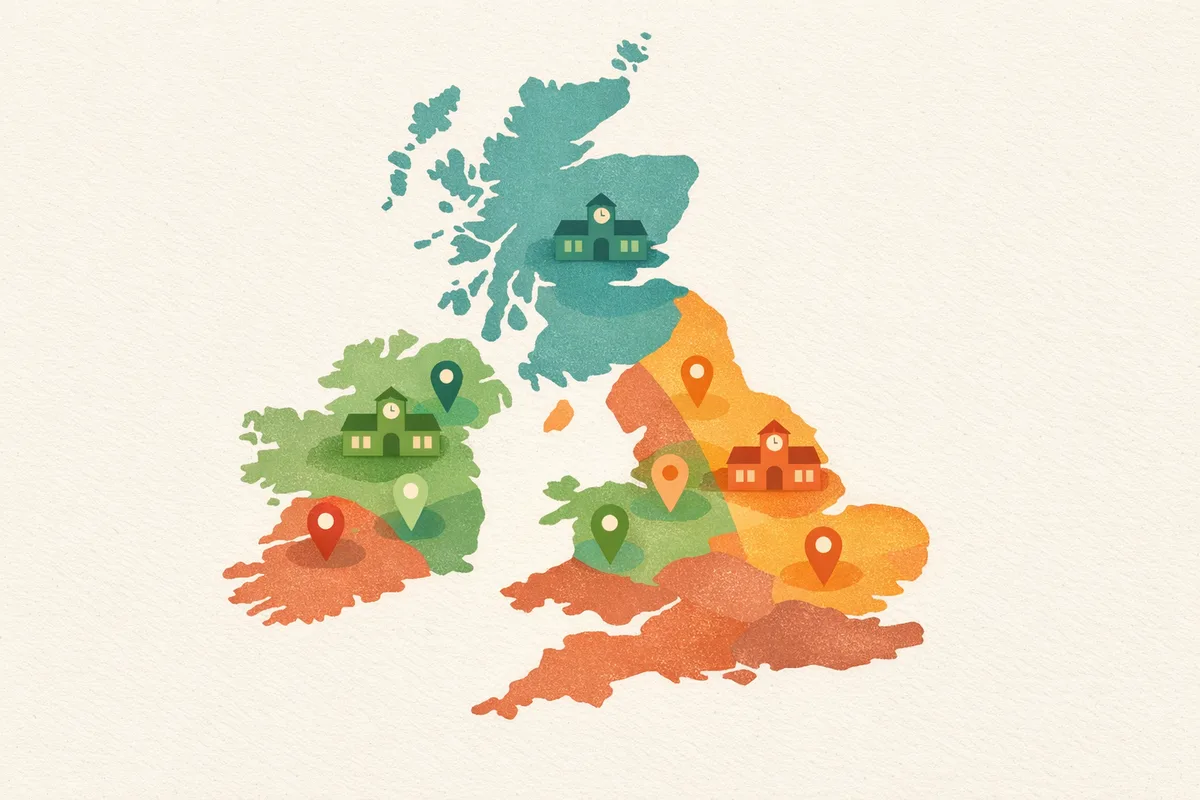
Milestone three, before you buy a single practice paper: confirm your region
Start with the school and entry year before buying practice. A regional pattern can help you find the route, but it does not establish every school’s test.
Buckinghamshire’s reviewed September 2027-entry guidance names GL for its Secondary Transfer Test. Its council pages have a heading/body cohort mismatch for 2028 entry, so this review does not establish the later cohort’s provider. Kent's admissions test has its own published arrangements, including multiple-choice tests and a separate writing exercise; check Kent's current admissions guidance for when that exercise is considered. Northern Ireland's SEAG assessment is set and marked by GL and consists of two papers. A pupil who sits only one paper has not completed the full assessment. CSSE administers the test for its member schools in Essex and Southend. Gloucestershire uses GL for 2027 entry and FSCE for 2028 entry onwards. Many independent senior schools use ISEB, but each school sets its own admissions process.
That list is indicative, not exhaustive, and consortia do change providers. Our guide to grammar schools by area and their entrance tests goes region by region, but the authoritative source is always the admissions page of the specific school you are applying to.
The quickest way to confirm the board: choose your local authority below.
This part of the guide looks up which 11+ test your area uses. It works in your browser.
Milestone four, as soon as you join a parent forum: correct the CEM advice
Some older guides describe GL and CEM as the two main grammar test providers. Cambridge's official timeline says CEM joined Cambridge in 2019 and that Cambridge CEM became Cambridge Insight in 2025.
Cambridge's current product information lists Cambridge Select Insight as a computer-based entrance assessment for selective schools, including grammar schools and independent schools. This is not evidence that it is used across a local authority or county: confirm with the school.
So the useful summary is that the provider name changed, while Cambridge still offers a digital entrance assessment. Older references to CEM may be historical or refer to Cambridge products, so check the named school and test cycle before choosing practice material. See Cambridge's history and entrance assessment information.
Milestone five, if you are in Gloucestershire: recalculate your dates now
This announced change moves the test from September of Year 6 to July of Year 5 for 2028 entry.
The Gloucestershire grammar schools have appointed Future Stories Community Enterprise as their admissions test provider for Year 7 entry from 2028, with the school announcement describing July 2027. The council says schools are planning for Saturday 3 July 2027. Current school guidance describes three papers: English and maths questions in a multiple-choice paper, English and maths short written answers, and a multiple-choice paper covering foundation subjects studied at school. The schools describe the test as aligned with primary-school learning. GL Assessment remains the provider for 2027 entry. See the schools' announcement and Gloucestershire County Council's grammar school information.
If your child is in Year 5 during the 2026-27 school year and you are considering a Gloucestershire grammar school, check the schools' current admissions information for the test date and registration window. The schools are planning a July 2027 test. Do not apply a generic timetable without checking the local cycle.
Milestone six, roughly a year out: let the format choose the habit
Once you know the board, format should drive practice. Different answer formats call for different practice habits. Follow the actual test instructions.
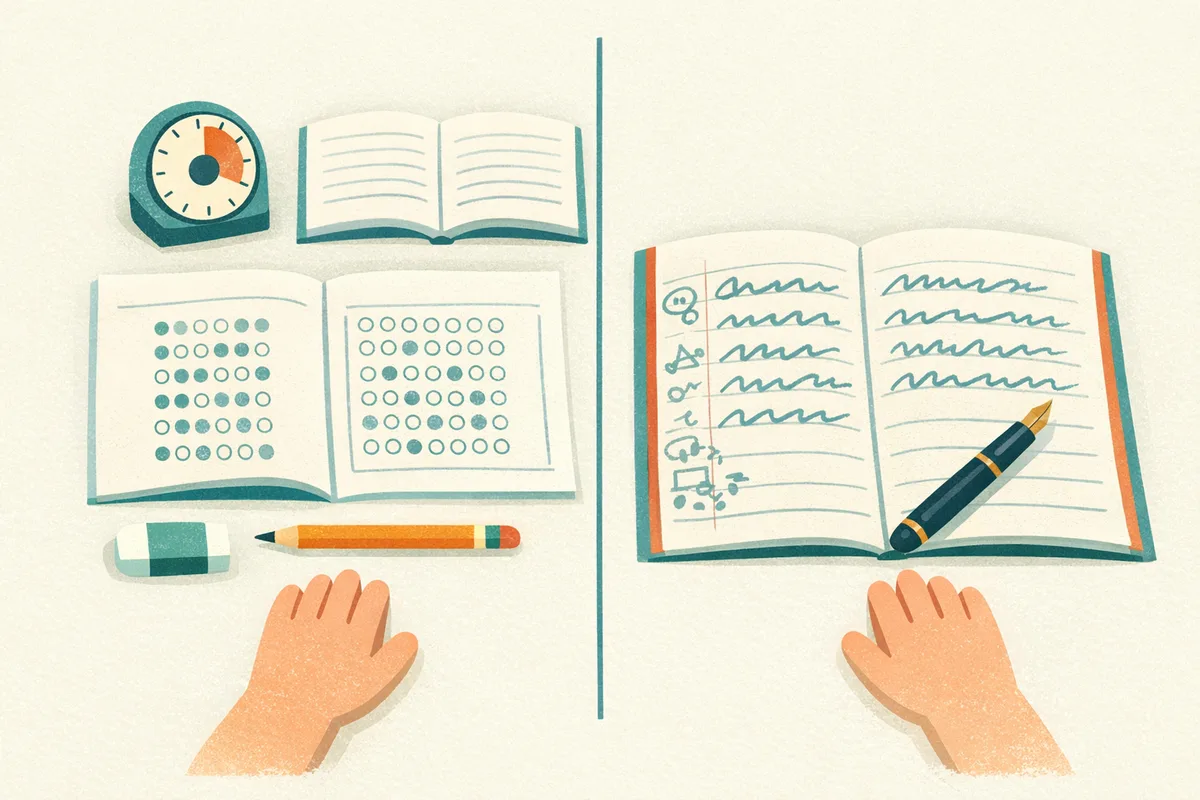
Answer-sheet transfer drill (GL, Kent). When answers go on a separate machine-marked sheet, a child who solves every question correctly can still lose marks by slipping a row. This is a mechanical skill and it needs mechanical rehearsal: work the question in the booklet, transfer immediately, check the number matches. Practising only on worksheets where you circle the answer in place trains the wrong motion entirely.
Written responses (CSSE). Practise recording answers and showing any requested working legibly. Check the official paper and mark scheme before assuming that every question awards method marks.
One-question-at-a-time practice (ISEB). The ISEB tests are adaptive, so each pupil follows a different question path. The practice habit is to read each question carefully before selecting an answer.
Primary learning and the published FSCE format. Gloucestershire schools have published familiarisation materials and an outline of the three papers. Use those materials and the school's current advice; the published outline is not a reason to infer there is one prescribed preparation plan.
One practical note across all of them: if your child's board still includes non-verbal reasoning, it is a subject whose question formats may be unfamiliar. Our non-verbal reasoning question type guide explains common formats; check the local familiarisation materials for what is tested. If your target test does not include it, it need not be part of test-specific preparation. For a first timed practice sample, Smart Cub Learning offers a short GL-style mock with original practice questions. For a full rehearsal, check the local format and use a paper with the required subjects, question styles and timings.
Milestone seven, the final months: understand what a pass mark really is
This is where parents can confuse a local qualifying standard with a universal pass mark, so it is worth being precise.
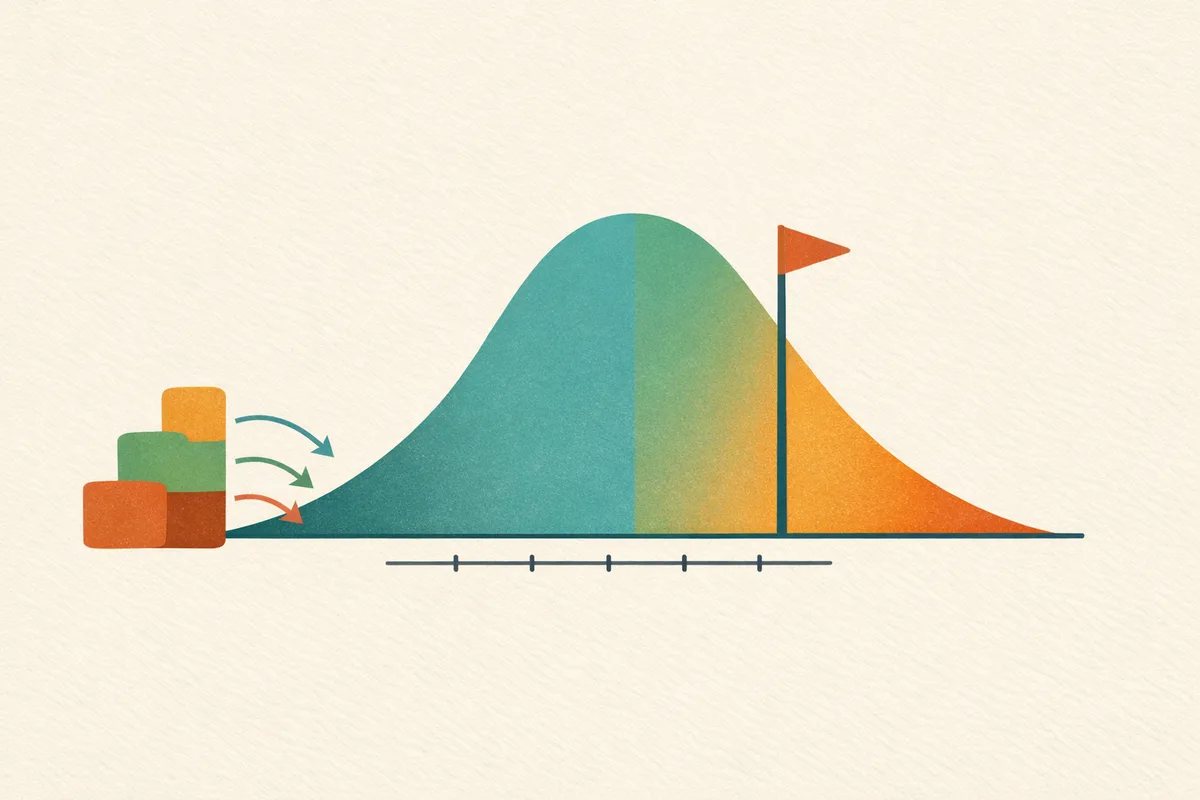
Buckinghamshire is one example of local scoring rules. Its council says GL marks the papers, standardises scores for age in years and months on test day, and combines them as 50% verbal, 25% mathematical and 25% non-verbal. The standardised paper scores range from 60 to 170.
The council's score breakdown explains the local weighting; it does not show that extra preparation time in one component will produce a particular result. A score of 121 is Buckinghamshire's qualifying standard. Qualification is distinct from an offer of a place, which is made under each school's published admissions arrangements. Do not treat 121 or the weighting as applying outside Buckinghamshire.
Those figures describe Buckinghamshire. Other routes may use different standardisation, weighting, ranking and qualifying rules. Do not infer their scoring method from this example. You can read the full Buckinghamshire marking explanation for the detail.
One related caution: no provider, tutor or platform can promise a place. Anyone quoting a guaranteed outcome is selling you something the admissions system cannot deliver.
Milestone eight, this week: confirm the board in writing
Finish the research with three concrete actions.
- Open the admissions page of each school on your list and find the sentence naming the test provider and the test date. Not a forum post, not a tutoring blog, not this article. The school's own page.
- Download the official familiarisation material for that board. GL's free familiarisation materials are the obvious starting point for most families, and CSSE publishes its own downloadable papers. Sit one paper with your child under something close to real conditions before you spend anything.
- Write the format on a sticky note. Multiple choice or written. Separate answer sheet or answers in the booklet. Adaptive or fixed. Paper or screen. Four lines that determine what good practice looks like for the next twelve months.
If that comparison has left you unsure how much preparation your child actually needs, our free practice papers with answers are a low-pressure way to find a baseline before committing to a routine.
Confirm the school, entry year and local test instructions before choosing practice. A provider name alone does not establish the subjects, date, format or qualifying rules.
Topics
- gl assessment
- cem
- iseb
- csse
- exam boards
- grammar schools