

Non-Verbal Reasoning Question Types: Worked Examples
Explore common 11+ non-verbal and spatial reasoning formats with original examples and practical ways to check a visual rule. Test formats vary by school and provider.
 Elspeth Marlow
- 13 min read

This guide gives examples of question formats found in some 11+ materials. It is not an exhaustive list: providers and schools can use different formats, and labels do not always match. Each section describes one format, offers an original example or a practical check, and points out a possible wrong turn.
Last reviewed: 23 October 2026.
Non-verbal reasoning, defined in one paragraph
Non-verbal reasoning is problem solving with pictures instead of words. ISEB defines it as the ability to analyse visual information such as pictures, diagrams and graphs, and to solve problems using visual reasoning. The questions use visual material, though instructions still need to be understood. ISEB says its non-verbal and spatial reasoning tests assess pattern analysis and visualising 3D figures. A practice question can help a child become familiar with a format, but it does not establish how they will perform in an admissions test.
School admission and graduate aptitude tests
School admissions and graduate aptitude tests have different formats and providers. This guide focuses on school-age practice examples, not graduate test preparation.
Examples of non-verbal reasoning question types
Pattern and relationship: odd one out, complete the pair, series and sequences, matrices, belongs with and find the twin, codes.
2D manipulation: rotation, reflection, symmetry, hidden shapes, shape addition and subtraction, layering and overlap, counting and position.
3D and spatial: nets and cubes, rotating 3D shapes, counting blocks, shapes from above, paper folding and hole punch.
Which exams test non-verbal reasoning
Formats vary by region and by school, so check your own target before planning anything.
- ISEB Common Pre-Test. All four tests are online, adaptive and multiple choice. Non-verbal reasoning is allocated 30 minutes as standard, or 37.5 minutes with approved 25% extra time, inside a 2 hour 15 minute battery alongside English (40), Maths (40) and Verbal Reasoning (25). ISEB's 2026-27 framework describes non-verbal reasoning as analysing 2D figures for patterns and spatial reasoning as manipulating 3D figures, and notes that other question types may also appear.
- GL Assessment papers. GL states that 11+ tests vary from area to area and that local authorities or schools decide which subjects are tested. It also warns that exact timings and question counts in your local test may differ from its own free familiarisation materials. Its non-verbal papers cover pattern and rule following, rotation, reflection and symmetry, spatial awareness and logical problem solving.
- Local authority tests. Buckinghamshire Council says its Secondary Transfer Test measures verbal, non-verbal and mathematical skills across two papers, each about 45 minutes (about 60 minutes including instructions and examples), with a break between. For the September 2027 entry cycle, the council describes 121 as a qualifying score; meeting the threshold does not guarantee a place.
If you are still mapping the wider process, our parent guide to the 11+ covers subjects, deadlines and regional differences.
Visual features to notice
ISEB’s family guidance suggests looking for features such as: shape, position, angle, number, size, shading, rotation, overlapping and symmetry.
Not every question uses every feature, and some questions combine changes. Start by describing what is visibly different, then test a possible rule against the other examples.
Pattern and relationship types, with worked examples
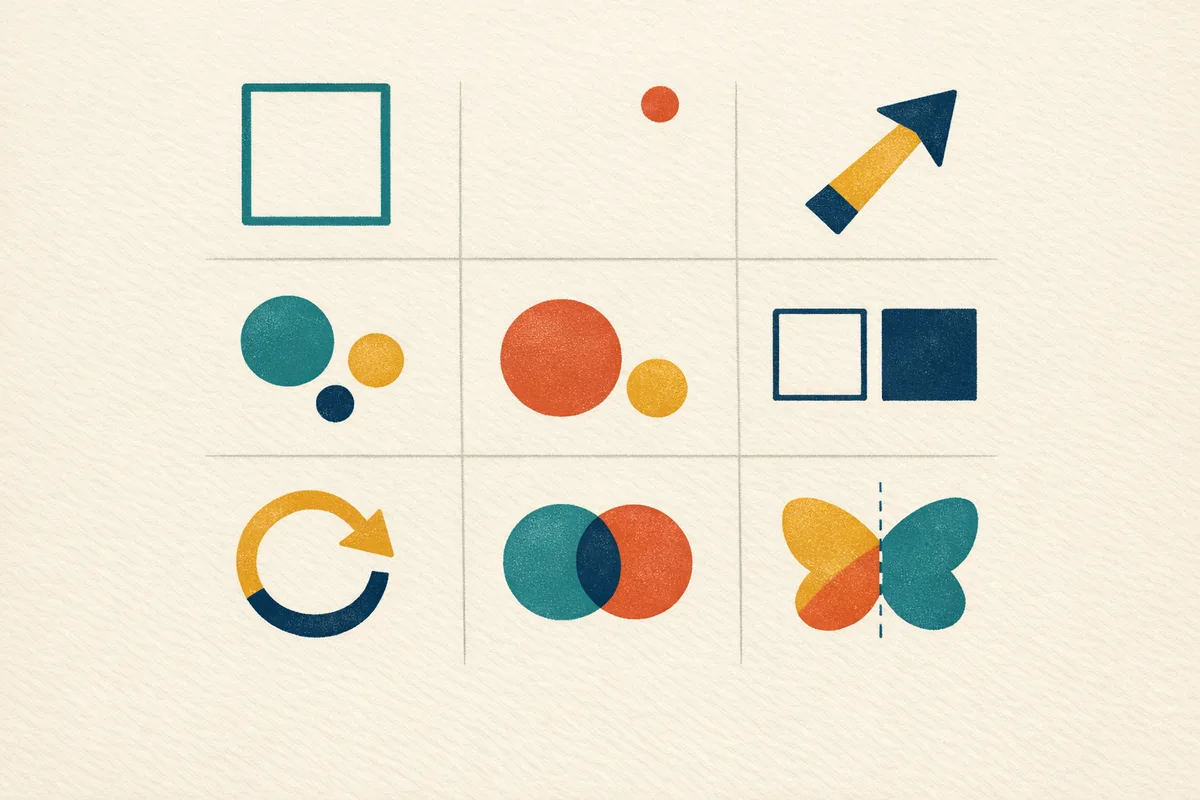
These examples practise finding and applying visual rules. Formats vary between tests.
Odd one out
Four or five figures obey a shared rule and one breaks it. One useful check is to name the property shared by the majority before choosing. Worked example: in four figures the number of dots inside equals the number of sides minus one; the fifth has four dots inside a four-sided shape, so it is the odd one. The planted distractor is a figure that looks obviously different (larger, darker, tilted) while still obeying the rule.
Try an odd one out now: find the rule four of the figures share.
This part of the guide is a short interactive exercise. It works in your browser.
Complete the pair
One analogy format is "A is to B as C is to what?" Describe the change from A to B, then check whether the same change fits C. Worked example: A becomes B by rotating 90 degrees clockwise and swapping black shading for white, so C must do both. A possible wrong option applies one change but misses another.
Series and sequences
A row of figures changes by a fixed rule and you supply the next or the missing one. Try tracking one feature across the row and checking whether the same rule fits each step. Worked example: dots run 1, 2, 3 while the arrow turns 45 degrees clockwise each step, so, if the first arrow points at 0 degrees, the fourth points at 135 degrees and has 4 dots. A possible wrong answer keeps the dot count but leaves the arrow unchanged.
Matrices
A 2x2 or 3x3 grid with one empty cell. The instruction: read across the row to find the rule, then check the same answer down the column; a correct option must satisfy both. Worked example: across the row the inner shape shrinks, down the column the outline changes from solid to dashed, so the missing cell is a small shape in a dashed outline. A plausible wrong answer may fit the row but fail the column.
Try a matrix now. Look for one rule across and one rule down.
This part of the guide is a short interactive exercise. It works in your browser.
Belongs with and find the twin
You are shown a target figure and asked which option shares its defining property. ISEB refers to this format as "Find the Twin". The instruction: state the property that is structural rather than decorative. Worked example: if the target has an odd number of enclosed regions, then colour, size and orientation are all noise. A wrong answer might copy a visible feature without sharing the property that defines the group.
Codes
Figures carry two-letter codes and you must code a new figure. One way to solve a two-letter code is to group the examples by each letter and look for a shared feature. Worked example: if A in the first position means a curved outline and X in the second position means shaded, a curved shaded figure is AX. Check that each letter fits the coding rule shown in the examples.
2D manipulation types, with worked examples
These ask a child to move a flat figure in their head. Compare each option carefully; several may look similar to the target.
Rotation
In a rotation question, a figure turns without being reflected. One way to track it is to follow a marked feature as the figure turns. Worked example: a flag sits top left pointing up; after a 90 degree clockwise turn it sits top right pointing right, and every other feature follows. A possible distractor is a reflection when the instruction asks for a rotation. Checking an asymmetric feature can help distinguish a rotation from a reflection.
Try a rotation question now: turn the shape until it matches.
This part of the guide is a short interactive exercise. It works in your browser.
Reflection
The figure flips across a mirror line. Compare the figure’s position and internal marks against the mirror line. Worked example: across a vertical mirror line, an L shape with its foot pointing right becomes an L with its foot pointing left, and any internal shading flips with it. The distractor is a 180 degree rotation, which looks convincing on figures that are close to symmetrical. Check the whole outline and any internal marks against the stated mirror line.
Symmetry
You count lines of symmetry or complete a figure so it becomes symmetrical. To check a possible line of symmetry, compare the shape and any internal marks on both sides of the line. Worked example: a regular five-pointed star has five lines of symmetry. Shade one whole point symmetrically and one line remains, passing through that point and the centre. One possible distractor has a symmetrical outline but an internal pattern that is not symmetrical.
Hidden shapes
You must find which option contains the target shape concealed inside a busier figure. For a hidden-shape question, check the target’s size and orientation against the stated instructions; some formats allow rotation. Worked example: draw a house with a triangular roof above a horizontal ceiling. A vertical line from the roof peak to the ceiling divides the roof into two right-angled triangles. Count a triangle only if all three of its sides appear as lines in the figure. The distractor contains the shape at a different scale or tilted a few degrees, so check the stated size and orientation rather than relying on a general resemblance.
Shape addition and subtraction
Some visual puzzles ask you to combine or subtract parts of figures. Check the examples or instructions to see how overlapping lines are treated, then apply that rule consistently. For example, a question may tell you that shared lines cancel. A wrong option might keep a shared line, so first identify the convention used in the question.
Layering and overlap
You judge which shape sits in front, or what a stack of shapes looks like. In some drawings, interrupted outlines indicate which shape is behind; follow the drawing’s conventions. Worked example: if a circle's edge runs unbroken across a triangle while the triangle's edge stops at the circle, the circle is on top. The distractor uses the right shapes in the right positions with the stacking order reversed, which is invisible unless you check the interruptions.
Counting and position
You count sides, dots, intersections or enclosed regions, or judge where a marker sits relative to a shape. Count systematically and check whether the question also asks about position or arrangement. Worked example: a dot lies inside the overlap of two circles, so it is inside both, not inside one. The distractor gives the correct total with the marker placed in a neighbouring region, so the count feels verified and the position quietly fails.
3D and spatial types, with worked examples
ISEB treats these as spatial reasoning: manipulating 3D figures to visualise them a different way. They are the types which some children may find unfamiliar.
Nets and cubes
Which cube folds from this net, or which net folds into this cube? For a cube net, identifying opposite faces can help rule out impossible views. Check how the given net folds. Worked example: if the striped face and the dotted face are opposite in the net, a cube showing them as neighbouring faces can be ruled out.
Try a net now: fold it and watch which faces end up opposite each other.
This part of the guide is a short interactive exercise. It works in your browser.
Rotating 3D shapes
The same solid is shown from different viewpoints. Track a distinctive feature and its neighbours to check whether a view could come from rotating the solid. A mirror image is not always reachable by rotation alone, so check the actual shape rather than only its cube count.
Counting blocks
How many cubes are in this stack, including the ones you cannot see? ISEB names this format directly. The instruction: count layer by layer from the bottom and assume any cube that supports another must exist. If a visible cube sits above a column, count any hidden cubes needed to support it when the drawing indicates a stack. A possible distractor is counting only visible cubes.
Shapes from above
You choose a plan or side view of a 3D arrangement. Follow the requested viewpoint and check which parts or heights would be visible from there. A distractor may show the same object from another viewpoint.
Paper folding and hole punch
Paper is folded once or twice, a hole is punched, and you predict the unfolded sheet. To solve a fold-and-punch question, unfold in reverse order and reflect the hole positions across each fold line. Worked example: fold a square in half vertically, then horizontally. Punch once through all four layers, inside the folded paper and away from its edges and both fold lines. Unfolding gives four holes arranged symmetrically about the two fold lines. A distractor may show the right number of holes in the wrong positions.
Some distractor patterns, and a four-step method
These are examples of possible distractors, not a complete or universal list:
- The near miss: correct on one variable, wrong on a second.
- The mirror: a reflection offered where a rotation was required.
- The surface match: copies the eye-catching feature, misses the structural rule.
- The visible-only answer: counts what is shown and ignores what is implied, as in hidden cubes.
- The over-complete option: adds one plausible extra feature the rule never licensed.
These checks can help with several of the examples in this guide:
- Scan the nine variables and say which are changing and which are held constant.
- State the rule in one sentence before you look at any option.
- Predict the answer in your head, or sketch it, and only then read the options.
- Eliminate by variable, not by feel. Reject each option by naming the variable it gets wrong. If you cannot name one, do not reject it.
Some children find it useful to predict an answer before reading the options; others may need to compare options to see the pattern. Our method-led NVR walkthrough drills this sequence in more depth.
A flexible practice plan and common questions

Here is one optional way to organise practice. Adjust it to the school’s guidance, the test date and your child’s needs:
- Begin with a few untimed examples and ask your child to explain a rule.
- If the target test is timed, practise a small set against a suitable time limit after the method is familiar.
- Try mixed practice when it matches the test format, then review any answers that were difficult to explain.
- Near the test, follow the school or local authority guidance and avoid adding unfamiliar materials at the last minute.
What is a non-verbal reasoning example?
For example, an odd-one-out question may show five figures where four have an even number of enclosed regions and one has three. The answer depends on the figures and instructions shown.
How long is the non-verbal reasoning test?
It depends on the exam. ISEB currently lists 30 minutes for non-verbal reasoning and 25% extra time when approved by the senior school. Check its current guidance. Buckinghamshire’s 2027-entry test has two papers of about 45 minutes each, or about 60 minutes including the introduction and examples, covering several skills. GL explicitly warns that local timings and question counts differ from its own materials, so confirm with your school or local authority.
How much should we practise?
There is no universal daily question target. A few examples with time to discuss the reasoning may be more manageable than a long session for some children. This guide does not measure or diagnose a child’s strengths; use the target school’s information and your child’s response to practice to decide what is useful.
Topics
- non-verbal reasoning
- 11 plus
- nvr
- question types
- spatial reasoning