


Buckinghamshire Grammar Schools: Schools, Tests and Admissions
Find Buckinghamshire’s 13 grammar schools, compare their admissions rules, and understand the Secondary Transfer Test, results and review process.
 Elspeth Marlow
- 13 min read

There are 13 grammar schools in Buckinghamshire, all using the Buckinghamshire Secondary Transfer Test. A score of 121 or above means a child is qualified to be considered, but it does not guarantee a place: each school applies its own admission rules. This guide links to each school profile and lays out the test, application, Selection Review and appeal process.
For September 2027 entry, the test has taken place and results were released on 9 October. Families now need to submit the local-authority school application by 31 October 2026; the Selection Review deadline is 30 October 2026. For September 2028 entry, Buckinghamshire Council has published a broad timeline: registration in May to June 2027, testing in early September, results in mid-October, and the school application deadline on 31 October 2027. Exact registration and test dates are not yet listed. Check the Council’s current grammar testing page before acting.
The decisions around the test matter as much as the papers. Buckinghamshire Council publishes the registration, results, Selection Review and appeal rules across several pages, so this guide puts the sequence in one place and links to the official source whenever a date or rule matters.
Three dates matter in particular for September 2027 entry: withdrawal from the test has its own deadline; the Selection Review deadline is one day before the national application deadline; and the Council publishes separate success rates for qualified and unqualified appeals. Dates and processes can change, so use the official links below for the cycle that applies to your child.
Buckinghamshire's 11+ in one minute
Buckinghamshire has a county-wide grammar-school system alongside upper and all-ability secondary schools. Thirteen grammar schools use a shared test, the Secondary Transfer Test, sat at the start of Year 6. There is no separate exam for each school and no consortium-by-consortium variation of the kind you find in Kent or London, so if you are still working out which area and test apply to your family, start with our guide to grammar schools near you and their entrance tests.
The test is produced by GL Assessment and commissioned by The Buckinghamshire Grammar Schools (TBGS), the company the thirteen schools set up to manage and administer transfer testing. Buckinghamshire Council administers the testing on TBGS's behalf under contract, which is why some information sits on the TBGS site and some on the council's. A child who scores at least 121 is considered qualified for a Buckinghamshire grammar school, according to the council's grammar schools and transfer testing page.
Qualifying is not the same as being offered a place. Qualification makes your child eligible to be considered under each school's oversubscription criteria, which typically weigh things such as siblings and distance. You still have to name the grammar schools on your secondary application in October, and a qualified child who does not list a grammar school will not be allocated one.
Spring of Year 5: your child is probably already entered
This is the single biggest structural difference between Buckinghamshire and most other selective areas, and it is where national guides tend to be vaguest. Children who attend a state-funded primary school in Buckinghamshire do not need to register. They are entered for the test automatically. No form, no fee, no action from you.
If you do not want your child to sit the test, use the Council’s withdrawal process by its deadline rather than relying on your child not attending. The Council’s registration guidance explains what to do after the deadline.
Who must actively register
Automatic entry only covers Buckinghamshire state-funded primaries. If your child attends a Partner school, an independent school, or any school outside Buckinghamshire, you must register them yourself.
The detail that catches people out: state-funded schools in Milton Keynes are explicitly excluded from automatic Buckinghamshire registration. Milton Keynes is a separate local authority, and its schools are not Buckinghamshire schools for these purposes, however close they feel geographically. Families there must register in the same way as any other out-of-county applicant.
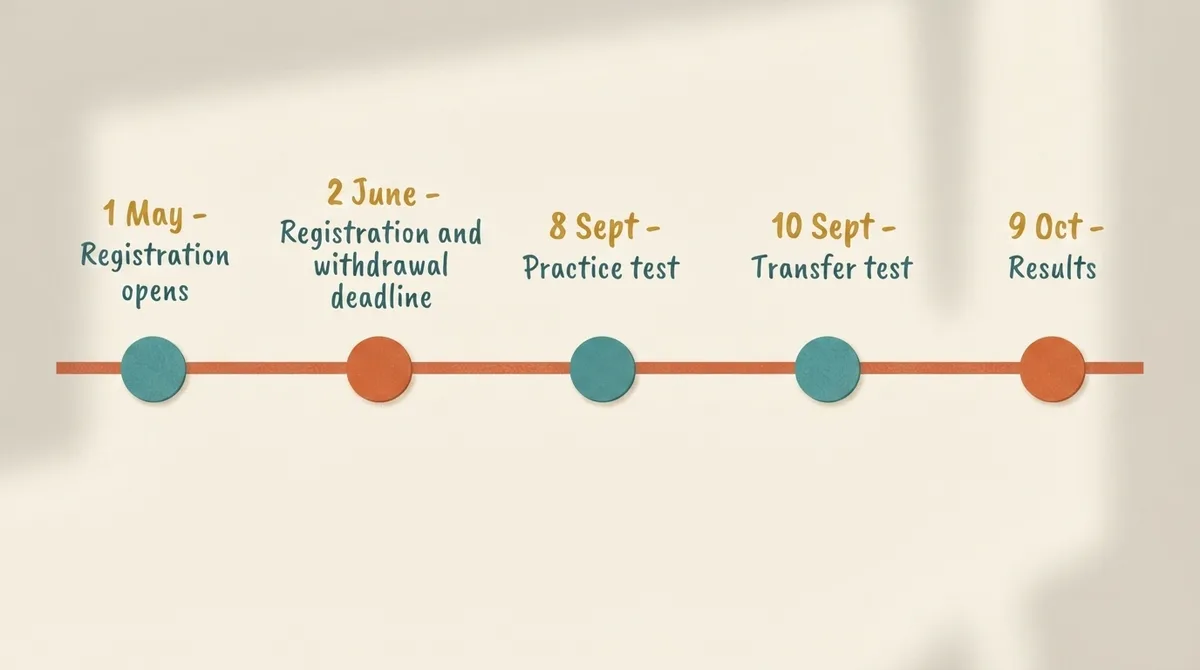
For September 2027 entry, registration opened at 10am on 1 May 2026 and closed at 3pm on Tuesday 2 June 2026. The Council says it will only register a child after the deadline if the family has very recently moved. It will also consider later testing for children who move into the area served by a Buckinghamshire grammar school before 18 June 2027. Contact the admissions team for current requirements if this applies to you.
Familiarisation materials from Buckinghamshire Council
The Council provides a familiarisation booklet with information about the test, advice and sample questions. TBGS says parents of Year 5 children are given a booklet in the summer term. Families at out-of-county schools can download it from the Council’s testing process page. GL Assessment also provides additional familiarisation materials. The booklet explains the format; it does not show whether a child needs tutoring or predict their result.
Early September of Year 6: the practice test, then the real thing
For September 2027 entry, the practice test was on 8 September 2026 and the Secondary Transfer Test was on 10 September 2026. They were two days apart, in school time, at the start of Year 6.
The practice test consists of two shorter multiple-choice papers, each about 40 minutes, taken under test conditions. They are not marked or sent home. The Council says the purpose is to familiarise pupils with the question types, format and separate answer sheet, rather than assess how well they have done.
The real test is two papers, all questions multiple-choice. One paper covers verbal skills including comprehension, technical English and verbal reasoning. The other covers mathematics and non-verbal skills including spatial reasoning. Each paper is about 45 minutes of working time, or roughly 60 minutes including the introduction and worked examples.
If your child is preparing, the most useful thing you can replicate at home is not another topic worksheet but the conditions: a full paper, timed, in one sitting, marked afterwards with the mistakes talked through. Our guide to 11 plus mock exams covers how to run those sensibly without turning every Saturday into an exam hall, and if you want the timing pressure built in, mock tests do the same job with automatic marking.
Worth saying plainly: formats differ by area. If you have read a guide written for Kent, Essex or a London consortium, do not assume the paper structure, timings or question mix carry over. Buckinghamshire is its own thing, and if you are still working out which board applies to you, our comparison of GL, CEM and ISEB is the place to start.
October: results day and the collision nobody warns you about
Results were released on 9 October 2026 for September 2027 entry.
The results report is more informative than a simple pass or fail. It gives your child's Secondary Transfer Test Score (STTS), individual section scores for verbal, mathematical and non-verbal reasoning, and their qualification status. Scores are age standardised, taking the child's age in months at the time of testing into account. The section scores matter if you are considering a Selection Review, because they show where the score came from.
The results report is worth checking promptly because the review and application deadlines follow soon after. Three dates land within three weeks of each other:
- 9 October: results released.
- 30 October: deadline to request a Selection Review.
- 31 October: national deadline to submit your secondary school application to your home local authority.
Read that order again. The application deadline falls one day after the review deadline, and reviews are not decided by then. So a parent whose child scored just under 121 has to submit their preference list, including any grammar schools, while the review is still undecided. The council sets this out on its results page.
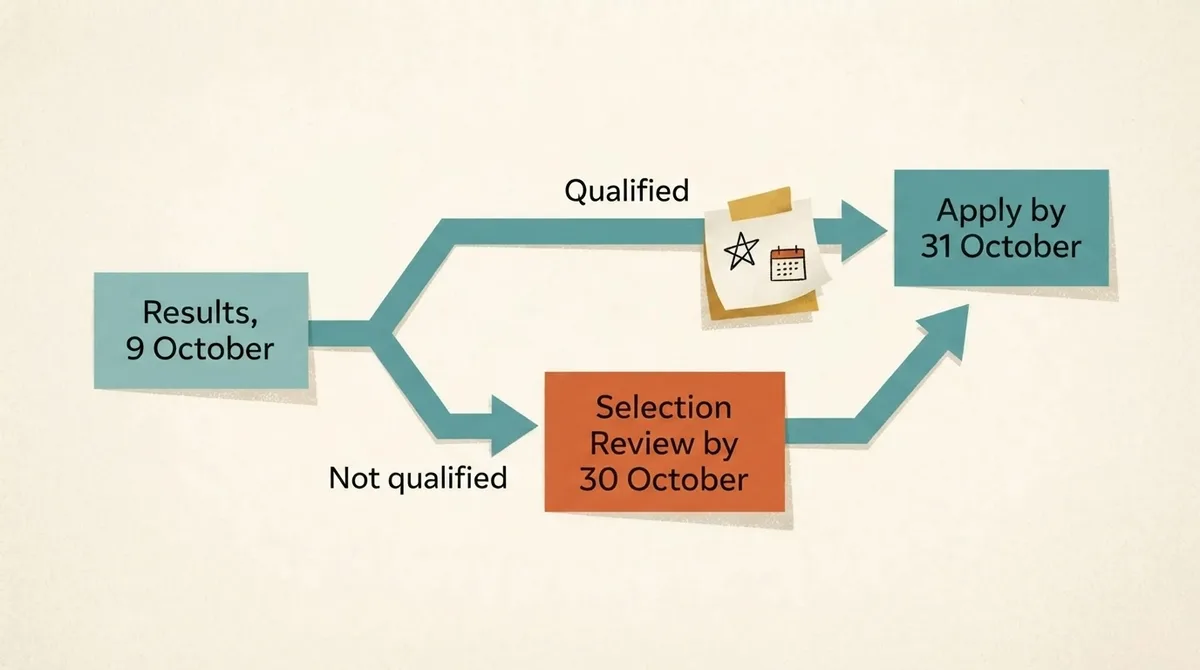
The practical consequence is simple and easy to get wrong. If you are pursuing a Selection Review, list the grammar schools you would want on your application anyway, alongside the non-selective schools you would be happy with. A successful review makes a child qualified; it does not itself add a school to the application. If you need to change preferences after submitting your form, ask your home local authority how it handles amendments and deadlines.
The Selection Review: who it is for and what actually counts
A Selection Review is a written case arguing that your child would be best suited to a grammar school despite not reaching 121. If the panel agrees, the child is treated as qualified for admissions purposes.
The panel is three headteachers: two from grammar schools and one from a primary school. The evidence that counts is set out on the council's Selection Review page and includes a Headteacher's Summary Sheet, school reports, letters from teachers, and evidence of exceptional circumstances such as illness or bereavement close to the test date.
Just as important is what does not count. Samples of your child's school work are not considered. Neither is participation in extracurricular activities. The Council says the panel cannot consider schoolwork or extra-curricular participation. The review is intended to weigh academic evidence alongside exceptional circumstances that may explain the test result.
On odds, the council's own guidance is that most successful reviews historically involved scores between 110 and 120. That is a useful calibration. If your child scored in that band and their school data genuinely points higher, a review is a reasonable thing to pursue. If the score sits well below that range, the honest reading is that a review is unlikely to change the outcome, and your energy is better spent on the rest of your preference list.
If the review does not succeed: appeals, and the real numbers
There are two appeal routes, and they behave very differently.
An unqualified appeal is for a child who did not qualify for grammar school. If a Selection Review was held, the appeal panel first considers whether it was conducted in a fair, consistent and objective way. Only if it finds that it was not can it consider the rest of that appeal. Without a prior review, the panel considers academic evidence of grammar-school suitability and reasons for wanting the school. In 2025, appeal panels found 81% of reviewed Selection Reviews fair, consistent and objective.
The published outcome for 2025: 2% of unqualified grammar school appeals succeeded, compared with 7% of qualified appeals. Both figures are on the council's grammar school appeals page.
A qualified appeal is different. It is for a child who qualified but was not offered a place at the school you wanted, usually because it was oversubscribed. Academic evidence is not required for this appeal, but you should give exceptional medical, social or educational reasons for wanting that particular school. Check the Council’s current guidance for the evidence needed in your case.
We publish these numbers because they should inform planning, not because they are encouraging. Appeal if you have a genuine case. Do not build your family's plan on a 2% route.
The thirteen Buckinghamshire grammar schools
All thirteen use the same Secondary Transfer Test and the same 121 threshold, but they differ in admission arrangements beyond qualification, so check each school's own criteria before ranking them.
- Aylesbury Grammar School (boys)
- Aylesbury High School (girls)
- Beaconsfield High School (girls)
- Burnham Grammar School (co-educational)
- Chesham Grammar School (co-educational)
- Dr Challoner's Grammar School (boys)
- Dr Challoner's High School (girls)
- John Hampden Grammar School (boys)
- The Royal Grammar School, High Wycombe (boys)
- The Royal Latin School (co-educational)
- Sir Henry Floyd Grammar School (co-educational)
- Sir William Borlase's Grammar School (co-educational)
- Wycombe High School (girls)
See the Buckinghamshire area directory and the shared Secondary Transfer Test page for the schools’ admissions routes and test evidence.
Key dates for September 2027 entry
These dates are for the current entry cycle. The practice test and Secondary Transfer Test have passed, and results were released on 9 October. The remaining national application deadline is 31 October 2026. Use the official Council timetable if you need to confirm a date.
- 1 May 2026, 10am: registration opened for children not automatically entered.
- 2 June 2026, 3pm: registration closed. Same date for the online withdrawal form.
- Summer term, Year 5: familiarisation booklet distributed.
- 8 September 2026: practice test, unmarked, not sent home.
- 10 September 2026: Secondary Transfer Test.
- 9 October 2026: results released.
- 30 October 2026: Selection Review deadline.
- 31 October 2026: national secondary application deadline.
- 18 June 2027: latest move-in date for late testing on relocation grounds.
Always confirm current-year dates on the council's grammar schools and transfer testing hub before acting on them.
Planning for September 2028 entry
The Council’s 2028 entry timeline says registration will run in May to June 2027. Children at Buckinghamshire state-funded primary schools are entered automatically; families outside that group need to register. Most schools use 1 September 2027 as the address cut-off, although some have an earlier date. The practice test and transfer test are planned for early September, results for mid-October, and the local-authority application deadline is 31 October 2027. The Council has not yet posted exact registration or test dates.
The lookup below keeps the main dates in one place, with the council's registration link. It also shows any other area if you are looking across a county border.
This part of the guide looks up which 11+ test your area uses. It works in your browser.
What to do with all this
Buckinghamshire’s process has several separate steps. If your child attends a Buckinghamshire state-funded primary school and you do not want them to sit the test, check the withdrawal process and deadline. The familiarisation booklet is available to help families understand the test format. Our year by year preparation plan offers one way to organise practice around the relevant entry cycle.
Then, in October, plan for the collision. Assume the review outcome will not arrive before the application deadline, and build a preference list that works whichever way it lands. That single piece of foresight is worth more than any extra month of practice papers.
If you want to see where your child's accuracy and pace actually sit before making decisions about tutoring, you can start with a free account and work through a couple of timed papers.
Topics
- buckinghamshire
- 11 plus
- grammar schools
- admissions
- transfer test