


Practice Papers and Mock Tests
11 Plus Mock Exams: Online, In Centre and at Home
Compare online, in-centre and at-home 11+ mock exams, with provider-specific 2026 price examples, official format guidance and advice on reading a mock score.
 Elspeth Marlow
- 11 min read
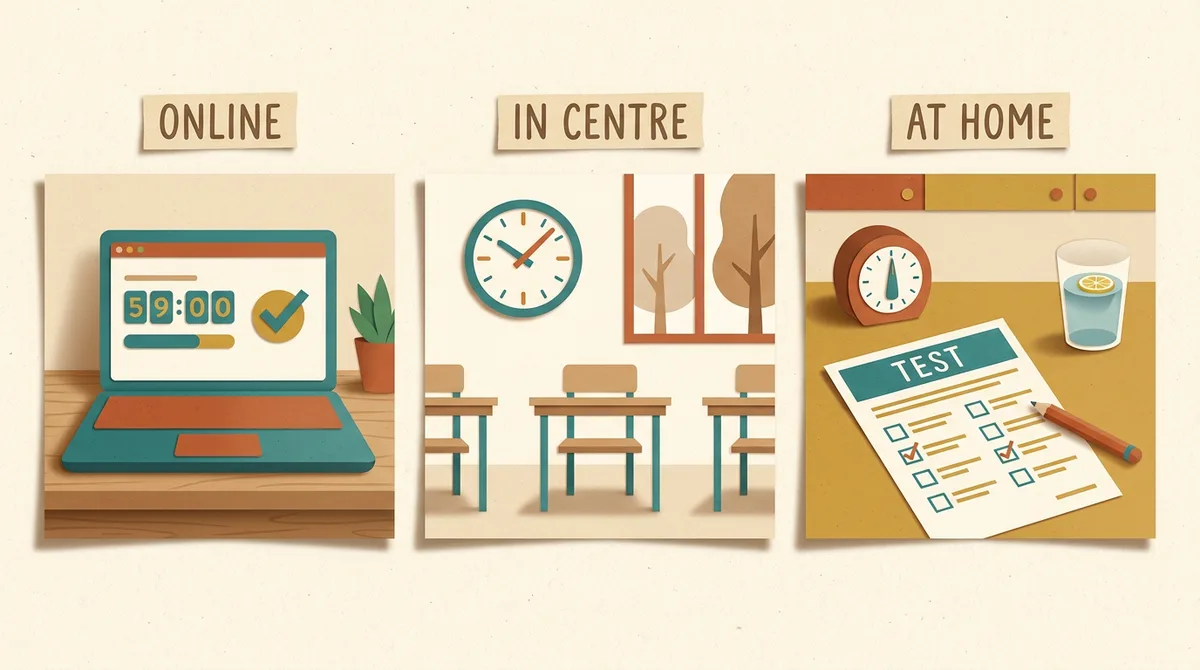
Mock exams are sold in several formats: online, in a centre and at home. A mock can help a child practise timing and show which question types need review, but it cannot reproduce every local test or predict an admissions result. Compare the format, feedback and current price before booking. The examples below are provider listings checked for the 2026 season; some listed test dates have now passed, so confirm availability directly.
One important caution: a mock score is easy to misread if you treat it like an official result. Buckinghamshire does not report percentages at all. It reports a standardised score between 60 and 170, adjusted for your child's age in years and months, with 121 as the qualifying mark (Buckinghamshire Council). No raw mark out of 50 from any provider's paper converts to that. Hold onto that while you read the rest.
A mock is a practice snapshot, not an admissions result
A mock can show which question types need practice and how a child manages the conditions of that paper. It may help you track practice over time, but it cannot reproduce official standardisation or predict whether a child will qualify.
In Buckinghamshire, each paper is standardised with an adjustment for the child’s age. The authority then calculates the Secondary Transfer Test Score by weighting the standardised component scores: 50% verbal skills, 25% mathematical skills and 25% non-verbal skills. A practice-provider mark cannot be converted into this result with a percentage calculation. GL Assessment describes its Standard Age Score as a comparison with a national sample of pupils of the same age, with an average of 100 (Buckinghamshire Council, GL Assessment).
A provider ranking is based on the children in that provider’s comparison group. It is not the national standardisation sample used by an authority or test publisher. Treat a provider percentile as a description of that group, not as an admissions forecast.
Use a mock to choose what to review. Look at question types, timing and answer-sheet transfer alongside the overall mark. Ask your child how they worked before deciding what needs practice.
What each mock format can offer
A centre can let a child practise entering an unfamiliar room and following an invigilator’s instructions. A home paper can practise timing and answer-sheet use if you set it up to match the local test. An online test can mark answers quickly, depending on the product. None reproduces every feature of the real test.
In centre. A child can practise working in an unfamiliar room and following an invigilator’s instructions. Some providers include a ranking or written report, while others charge separately for feedback. Check whether the test matches your area.
Online. Depending on the product, a child may get immediate marking and a timed interface. An online mock cannot reproduce an in-person room or a paper answer sheet. Check whether the online test uses the question format and answer method your local test requires.
At home. A printed paper can provide a low-cost way to practise if you have permission to use it and set the timing and answer method to match the local test. Keep the room quiet, follow the paper’s instructions and avoid giving help during the timed section.
You can choose one format or combine them. Base the choice on what your child needs to practise: unfamiliar rooms, paper answer sheets, timing or question review.
Comparing published mock prices
Prices and schedules change, and many 2026 sittings have already taken place. For example, KSOL listed some GL mock sittings at £70, with a £25 optional detailed feedback package; its 2026 listing described two 45 to 50 minute papers. The 11+ Institute listed a £75 Buckinghamshire-format mock for 2026, including a post-exam session and written feedback. These are provider-specific offers, not a national price range. Check the current booking page for the format, date, what feedback is included and cancellation terms before paying (KSOL, The 11+ Institute).
Compare what the fee buys. A sitting, a written report, question-level feedback and a review session may be priced separately. Ask whether the mock follows your area’s test and whether you receive enough detail to review mistakes afterwards.
The format your mock has to match
This is where a nationally marketed mock can quietly waste your money, because 11+ formats differ by area and GL Assessment itself says so: timings, topic combinations and question counts "may differ" in your local test (GL Assessment).
Buckinghamshire publishes its format in unusual detail. The Secondary Transfer Test is two papers, all multiple choice. One tests verbal skills including comprehension, technical English and verbal reasoning; the other tests mathematics and non-verbal skills including spatial reasoning. Each paper is about 45 minutes of questions inside a 60-minute slot once introductions and examples are counted, an audio soundtrack delivers the instructions, and children get a break between papers (Buckinghamshire Council).
Buckinghamshire provides a separate familiarisation stage. Before the real test, Bucks children sit two Practice Test papers under test conditions, about 40 minutes each, and those papers are not marked and not sent home. Their entire purpose is familiarity with question styles and answer sheet procedure. That is the council telling you, in its own materials, that a substantial part of mock value has nothing to do with the score.
Essex is a different exam altogether. For September 2027 entry, the CSSE test had two papers, English and Maths. English is sixty minutes plus ten minutes of additional reading time; Maths is sixty minutes. From September 2024 the English paper no longer contains Applied Reasoning questions (CSSE), which means older mock papers built around that section now actively mislead. If you are in Essex, read our breakdown of what makes the CSSE exam different before you book anything.
So the first question to ask any provider is not "is it realistic?" It is "which board and which region is this modelled on?" If the answer is a generic "GL style", you are buying a reasonable practice paper, not a mock of your child's exam. Our comparison of GL, CEM and ISEB covers how much the formats actually diverge.
Booking an in-centre mock: what to check before you pay
Searches for mocks are heavily local, and a national page cannot tell you which Birmingham or Wolverhampton hall is good. Use the questions below to compare the format, venue and feedback offered by each provider.
- Format match. Does it follow your board and region, with the right paper count and timings? Ask directly.
- The venue. Ask where the test is held, how many children attend and whether a trained invigilator supervises it.
- Feedback: included or extra? Compare the sitting fee with the cost of any optional report or review session. Decide what feedback you need before booking.
- What the report contains. Ask whether it gives only a total or also shows performance by section, topic or question type.
- Peer ranking, and against whom. Ask how many children sat that paper and whether the cohort is tutored.
- Turnaround. Ask when results and feedback will arrive, and whether the child can still remember their approach to the questions at that point.
- Is the review session useful? Ask what it covers and whether it discusses the questions your child found difficult.
Online mocks: what they practise
Some online products provide immediate marking and let a child repeat practice without booking another in-person sitting. Features, retake rules and the information saved between attempts depend on the provider.
The limits are real and worth stating. There is no hall. If your local test uses a separate paper answer sheet, an online test will not practise transferring answers to it. A printed practice paper can help rehearse that method. Reading on screen differs from reading a printed comprehension passage, so check the local test format and practise with the same medium where possible.
If the local test uses a separate answer sheet, include some paper practice so the transfer method is familiar. Smart Cub Learning's free short GL-style mock offers 24 original questions across four subjects, a 30-minute timer and a results preview without a booking fee. It is a short practice sample; local entrance-test timings and question counts can differ.
How to run a proper mock at home
A timed paper at home only rehearses test conditions if you set aside uninterrupted time and follow the instructions. The example below uses Buckinghamshire’s two-paper structure. For another area, use that authority’s published timings, breaks and answer method.
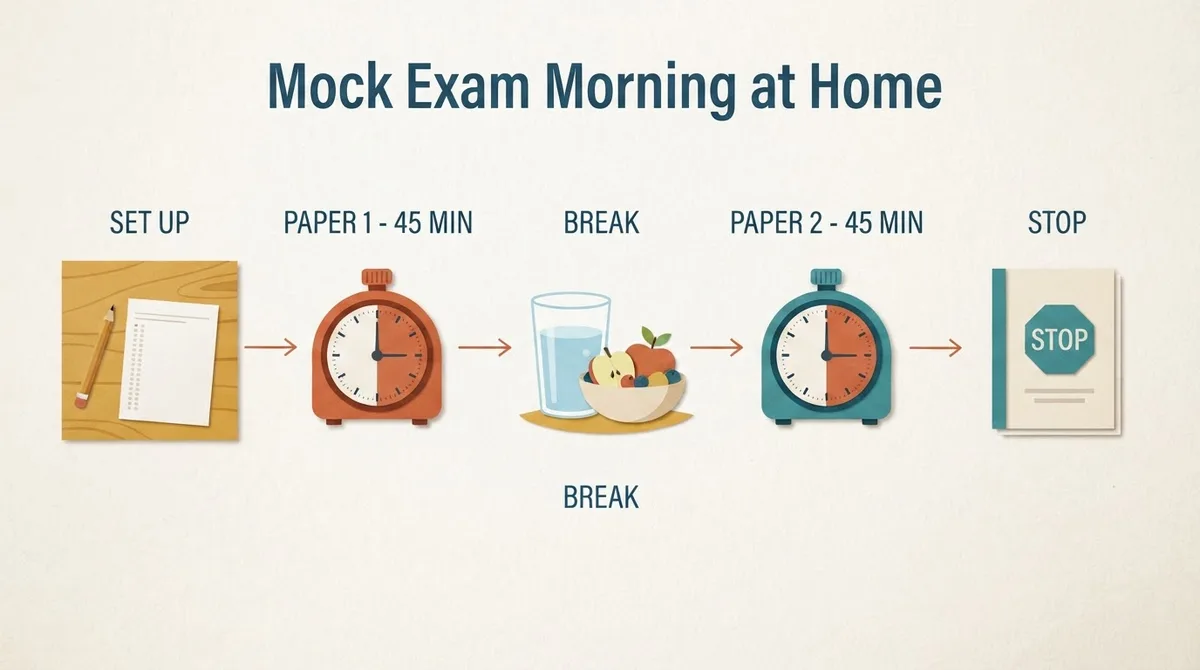
- Schedule it. Choose a quiet time when your child can complete the full practice without interruptions.
- Clear the table. Nothing on it but the paper, a separate answer sheet, two sharpened pencils, an eraser and a glass of water. No phone, no dictionary, no scrap notes from last week.
- Read the instructions aloud once, then stop talking. Bucks uses an audio soundtrack precisely so every child hears the same words. Your job after that is silence.
- Use the published working time for paper one. For Bucks, allow about 45 minutes for questions within the 60-minute slot, including instructions and examples. Follow the practice paper’s instructions and avoid helping during the timed part.
- Take the break. Bucks provides a short break between papers. Follow the authority’s published instructions where available.
- Run paper two using its published working time, then stop when time is up. Note unfinished questions separately from incorrect answers.
- Review the paper calmly. Mark it and discuss the questions after the child has had a chance to rest.
If you need papers to run this with, our guide to free 11 plus practice papers with answers lists what is genuinely free. GL Assessment also publishes around 10 hours of free familiarisation materials in printable PDF form covering verbal reasoning, non-verbal reasoning, English, maths and verbal skills (GL Assessment free materials), and CSSE publishes free downloadable familiarisation papers. These official resources provide a useful starting point; families may still choose paid practice if it fills a specific gap.
For a mock at home, enter the paper's length and number of questions below. The practice clock times the paper and shows the next checkpoint, so you can note where your child was when each one passed.
This part of the guide works out seconds per question and checkpoints for a timed paper. It works in your browser.
Marking the paper, and reading the score honestly
Mark it yourself, question by question, and record three things per question: right, wrong, or not attempted. Unattempted questions can reflect time pressure, unfamiliar methods or difficulty reading the question. Ask your child what happened before choosing the next practice.
Then resist the conversion. "Is 70% enough to pass?" has no answer, because the real test does not work in percentages. In Buckinghamshire a child qualifies at a standardised score of 121 or above, around 37% of children are expected to reach it, and scoring well above 121 confers no extra admissions priority. That score is built from age-adjusted standardisation against the cohort, which your kitchen table cannot reproduce.
What to investigate after a mock:
- Question types with clustered errors. Four wrong out of five on codes is a reason to inspect those questions and the child’s working.
- The drop-off point. If accuracy drops after question 30, check whether the later questions were harder, the child was tired or time was running short. The pattern alone does not establish the cause.
- Careless versus unknown. Ask your child to re-attempt each wrong question untimed. A correct retry may point to time pressure or a missed detail. Ask about the original method before drawing a conclusion. Our exam technique and timing guide covers how to fix each type.
- Answer sheet mechanics. If answers have slipped onto the wrong rows, practise matching question numbers to the answer sheet before trying another timed paper.
The debrief and spacing practice
Review the paper once your child has had a chance to rest, while they can still recall how they approached it. Start with one specific thing that went well, then choose one or two fixable points to practise before the next mock.
There is no evidence-based number of mocks that suits every child. Space practice so there is time to review mistakes and work on them before another full paper. If repeated mocks are not producing useful information, return to targeted practice.
Work backwards from the test date published by your admissions authority. For children moving up in September 2027, Buckinghamshire’s test dates were 8 and 10 September 2026; Kent’s were 10 September for Kent primary pupils and 12 or 13 September for children at other schools. These dates have passed. Check the authority’s next test calendar rather than assuming that dates or preparation schedules are the same everywhere (Buckinghamshire Council, Kent County Council).
If the budget is tight, start with free official familiarisation material. Consider paid practice when it meets a specific need the free material does not cover, such as practising in an unfamiliar room.
Topics
- mock exams
- practice papers
- gl assessment
- csse
- exam technique