
The CSSE Exam in Essex: What Makes It Different
Most guides describe the CSSE 11+ from the outside: two papers, sixty minutes, not multiple choice. We opened the actual papers, mark schemes and standardisation report to show what really decides an Essex grammar school place.
 Elspeth Marlow
- 14 min read

Search for the CSSE exam and you will find a dozen pages telling you the same four things: two papers, sixty minutes each, not multiple choice, and no offer below a total standardised score of 303. All of that is true. None of it tells you what your child will actually be asked to do on a Saturday morning in September.
The reason is straightforward. The Consortium of Selective Schools in Essex publishes almost nothing as readable web pages. Its past papers, mark schemes, annual Standardisation Report and cut-off guidance sheets are all PDFs. They are free, they are public, and as far as we can tell nobody writing about the CSSE exam has opened them. So we did.
This guide covers what the papers physically look like, how the marking actually works, what the standardisation formula does to a raw mark (there is a genuinely surprising finding buried in it), the real score at which the last place went at each school, and two administrative traps that cost Essex families places every year.
The myth: any decent 11+ practice pack will prepare a child for CSSE
This is not our claim to make. The exam board makes it. CSSE's own Information Guide warns parents that commercially available material consists of "tests based at a similar level but are not of the same format as the 11+ papers", and adds that "children only need a limited amount of practice to familiarise themselves with the types of questions and timing".
Read that twice. The organisation that sets the test is telling you that the practice industry built around it is selling something with the wrong shape, and that the correct dose of format practice is small.
CSSE was formed in 1993 so that a child interested in more than one selective school in Essex would not have to sit several tests. Ten schools use it, including Colchester Royal Grammar School, King Edward VI Grammar School, both Westcliff High Schools, both Southend High Schools, Colchester County High School for Girls, Shoeburyness High School, St Bernard's High School and St Thomas More High School for Boys. One test, one score, up to ten possible destinations.
One correction, because pages still get this wrong: the English paper's short Applied Reasoning section was removed from the 2025 test onwards. If a site tells you CSSE includes verbal reasoning, it has not been updated in over a year. For the wider context on how boards differ, our comparison of GL Assessment, CEM and ISEB explains why format, not difficulty, usually catches families out.
The reality: a child writes their answers, and nobody offers them options
The official FAQ sets the frame: "Candidates will sit two tests. One in English and one in Mathematics. The English paper will last sixty minutes with ten minutes additional reading time. The Mathematics paper will last sixty minutes. The final scores for the individual papers are mathematically standardised and weighted, each being worth 50% of the marks." (CSSE Information Guide, 2027 entry)
What that hides is how much of the paper is composed rather than selected. A child sitting a GL-style multiple choice paper is doing recognition under time pressure. A child sitting CSSE is doing production: quoting accurately, explaining in sentences, justifying a yes or no answer, showing a method. Those are different cognitive tasks, and drilling one does very little for the other.
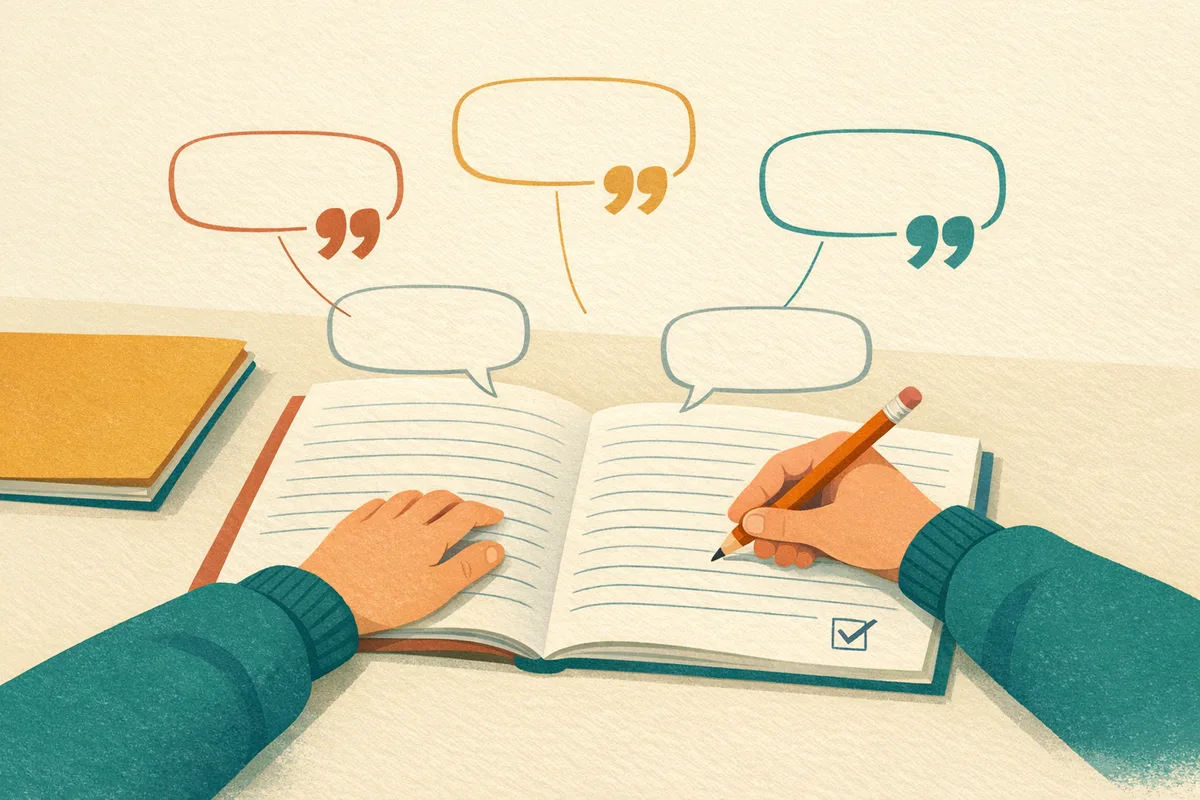
Inside the English paper: self-managed timing and quotation grids
The front page of a published CSSE English paper does something no commercial pack imitates. It lists the sections with suggested timings, then tells the candidate: "AFTER THE FIRST 10 MINUTES YOU DO NOT NEED TO WAIT TO BE TOLD TO CARRY ON TO THE NEXT SECTION."
That is a ten-year-old being handed responsibility for their own clock. There is no invigilator calling section changes. A child who over-invests in the comprehension will arrive at the writing task with too little time and no warning. This is a trainable skill, and it is absent from any paper where a bell manages the timing for them.
The reading passage sits in a separate booklet, and the paper reassures candidates: "REMEMBER: this is not a test of memory. You can look back at the passage to check your answers as many times as you want." The published 2023-entry comprehension booklet carried 40 marks spread page by page as 8, 11, 7, 5, 4 and 5. The passage was an extract from Dodie Smith's I Capture the Castle, a real literary novel rather than a purpose-written test passage (2023-entry English paper).
Two question shapes dominate, and neither exists in multiple choice form.
- The quotation-and-explanation grid. One 6-mark item asked candidates to write down three quotations and then explain how each showed what a character thought about something she had done. The marks are split evenly between finding evidence and interpreting it, so a child who writes three perfect quotations with no explanation caps at half.
- Tick box plus justify. A question offers a Yes or No box, worth almost nothing on its own, followed by a part (b) asking for three reasons, worth 3 marks. The tick is the cheap half. The prose is the paper.
A useful home exercise: take any chapter your child is reading, ask "how do we know this character is nervous?", and require three short direct quotations plus one sentence each explaining what the words reveal. That single drill rehearses the highest-tariff item type in the paper. Our guide to what 11+ English papers test goes further into inference and evidence work.
Continuous writing: 20 marks that drilling never touches
Section Three is a separate booklet worth 20 marks: "This Section may be completed at any time during the total 60 minutes. It is suggested that Candidates allow 20 minutes for this section. Correct spelling, punctuation and grammar will be awarded marks." Candidates must answer both questions, in their own words (2023-entry Continuous Writing paper).
The prompts are deliberately ordinary: one asked candidates to write about their favourite place to relax, real or imaginary, in at least six sentences. There is nothing to revise here. No topic list or vocabulary bank substitutes for a child who can produce controlled, correctly punctuated sentences on demand about anything at all.
Twenty marks is a large share to leave to chance, and it is the section most consistently neglected because it cannot be marked by a machine or a parent with an answer key. If you do one thing differently this year, make it short weekly timed writing with the punctuation actually corrected.
Inside the maths paper: 60 free-response marks and no calculator
The published maths paper runs to 12 questions totalling 60 marks in 60 minutes. Candidates are told "You may work the questions out in your head, or by writing on the white area around the question", that "You will not lose marks for crossing out", and that "The use of electronic calculators of any description (including calculator watches) is NOT permitted". Answers go in a dedicated answer column. There are no options to choose from (2023-entry maths paper).
The questions travel well beyond routine Key Stage 2 procedure: reverse percentages, imperial conversion using inches, feet and yards, function machines run backwards from a fractional value, simultaneous equations disguised as symbol puzzles, three-dimensional reasoning about shapes made from four glued cubes, and a proof-style prompt asking whether a claim about prime numbers is true or false.
The common thread is backwards reasoning. Most primary maths runs forwards: here is an operation, apply it. CSSE repeatedly gives the output and asks for the input, or gives a claim and asks the child to test it. Try this at home: "A price falls by 25% and the sale price is £42. What was the original price?" then "I think every number ending in 5 is divisible by 15. True or false, and how do you know?" If your child can do the first but freezes on the second, you have found the gap.
Marking is examiner judgement, not an answer key
Here is the rule that costs careless candidates entire questions, printed at the top of the official mark scheme: "Candidates must NOT tick more boxes than they are instructed to. Any who do will lose all the marks for that question."
Not one mark. All of them. Hedging by ticking two boxes when one was requested is a total loss on that item, and it is exactly the habit multiple choice practice encourages when a child is unsure.
The rest of the scheme reads like guidance to a human reader: "Accept any logical reason", explicit refusals of particular wordings, and the tolerance "Quotations must be accurate word for word, but spelling and punctuation mistakes are allowed". Partial credit runs throughout (2023-entry English marking scheme).
So you cannot reliably self-mark CSSE English at home the way you can tick a GL answer sheet. What you can check is whether the quotation is exact, whether the number of reasons matches the number requested, and whether the child answered the question asked. Our guide to finding genuine past papers explains how to tell official material from lookalikes.
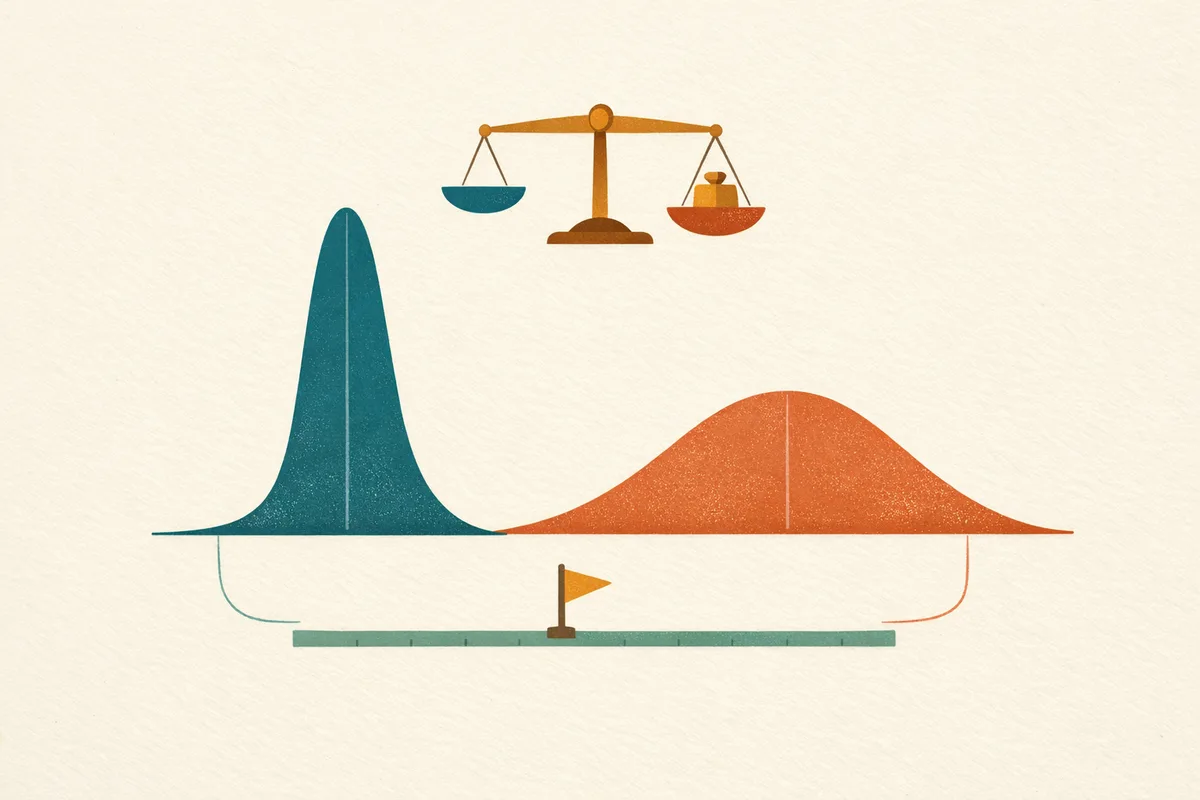
Standardisation decoded: why one English mark was worth more
The method is stated exactly: standardised score = (((raw score - mean) / standard deviation) x 15) + 100, then total score = 1.5 x [(standardised Mathematics + days younger x maths age adjustment) + (standardised English + days younger x English age adjustment)]. A candidate of the reference age with average marks on both papers lands on 300. The papers are weighted 1:1 (2026-entry Standardisation Report).
Now the numbers. For the test sat in 2025 (2026 entry), with 5,113 candidates, English had a mean of 34.99 and a standard deviation of 7.61, while maths had a mean of 27.30 and a standard deviation of 13.08, both papers out of 60. Maths was harder on average and far more widely spread.
Because the formula divides by each paper's standard deviation, that spread changes what a mark is worth. One raw English mark moved the standardised score by 15 / 7.61, roughly 1.97 points; one raw maths mark by 15 / 13.08, roughly 1.15 points. After the 1.5 multiplier, that is about 2.96 total points per English mark against 1.72 per maths mark, making one English mark worth roughly 1.7 times one maths mark.
The papers are weighted equally. The marks are not equally valuable. For a family choosing where to spend the last hour of the week, that is decision-changing, and it points at exactly the section most people ignore: continuous writing.
One firm caveat. These ratios are recomputed every year from that year's distributions, and a year in which maths is tightly bunched would flip the relationship. Treat this as a reason to stop neglecting English, not as a permanent law.
Age adjustment is not automatic either. The report states that "a statistical test was used to assess whether age adjustment was necessary", and for that round it was applied to both papers, at 0.016617024 points per day younger in English and 0.00894304 in maths. For the most summer-born eligible child, 364 days younger, that is about 14 points on the total. Meaningful against a 303 floor, but not a strategy.
The 303 floor is a floor, not a pass mark
CSSE is unambiguous: "CSSE secondary school offers are not made to any child who has scored under a total standardised score of 303." Scoring 303 means you are eligible to be considered. It does not mean you have a place.
What decides the outcome is the score of the last place offered at each school, which depends heavily on whether you live inside that school's priority area. On National Offer Day, 1 March 2025, the last selective place went at these totals, given as inside priority area then outside where both exist (CSSE historical guidance sheet for 2026 entry):
- Colchester County High School for Girls: 322 inside, 333 outside
- Colchester Royal Grammar School: 343, no priority area
- King Edward VI Grammar School: 355 inside, 372 outside
- Southend High School for Boys: 305 inside, 342 outside
- Southend High School for Girls: 303 inside, 321 outside
- Westcliff High School for Boys: 309 inside, 351 outside
- Westcliff High School for Girls: 306 inside, 345 outside
- Shoeburyness High School: 304 inside priority area
- St Thomas More High School for Boys: 303, catchment residents only
Look at the gaps rather than the absolute numbers. Westcliff High School for Boys required 42 more points from outside its priority area than inside; Southend High School for Boys, 37. The maximum age adjustment is worth 14. Where you live can straightforwardly outweigh a substantial gain in preparation, which is why an honest school list is built around geography first. CSSE also cautions that these figures "fluctuate from year to year", so do not treat last year's number as a hard threshold in either direction.
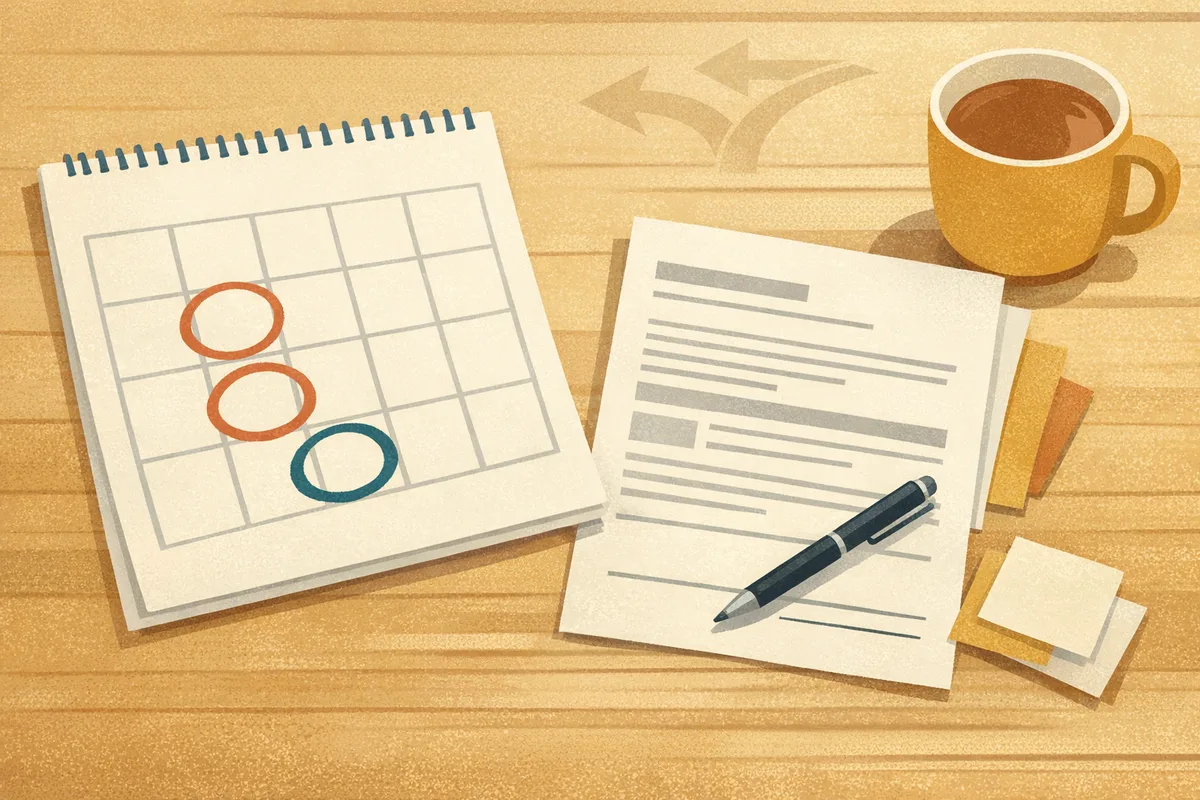
Two traps the rest of the internet ignores
Trap one: Chelmsford County High School for Girls is not a CSSE school. Parents confuse it with Colchester County High School for Girls constantly, and the consequence is severe. Colchester CHS is a CSSE member. Chelmsford CHS is not, and for 2027 entry it uses the separate FSCE test, sat on 3 September 2026, sixteen days before the CSSE test, with its own registration deadline. Registering for one does not register you for the other. Confirm current arrangements on the Chelmsford County High School admissions page.
Trap two: registering for the test is not applying for a place. CSSE puts this in capitals: "Stating a Preference on the Local Authority Common Application Form is the only way of Applying for a Place at a CSSE School... Completing only the test registration form does not constitute a valid application." A child can sit the exam, score above every cut-off, and receive nothing, because the school was never named on the Common Application Form.
The 2027-entry calendar makes the shape clear: registration closed 19 June 2026, the test is Saturday 19 September 2026, results are emailed after close of business on 12 October 2026, and the Local Authority Common Application Form deadline is 31 October 2026, with National Offer Day on 1 March 2027. That leaves roughly nineteen days between results and the application deadline, which is why the school list should be drafted long before the score arrives.
What this actually means for preparation
- Stop treating multiple choice practice as CSSE practice. The board says so itself. Recognition and production are different skills.
- Weight English higher than instinct suggests. In the most recently published round, one English mark was worth around 1.7 times one maths mark, and continuous writing alone carries 20 of them.
- Rehearse self-managed timing. Give your child the whole paper and let them run their own clock, because on the day nobody will move them on.
- Train backwards reasoning in maths, and get comfortable with justify-your-answer prompts rather than sums with tidy answers.
- Handle the admin as a separate project with its own calendar: the test registration and the Common Application Form are two different things, and Chelmsford CHS is a third.
For familiarisation, use the free official material on the CSSE practice material page rather than commercial lookalikes, and keep the dose modest, as CSSE advises. Where a platform earns its place is in the underlying skills and in honest timed practice: our full paper-style tests run to real conditions and track where marks are actually being lost.
Everything above applies to CSSE in Essex and nowhere else. Kent, Buckinghamshire, Birmingham and the London independents run different formats with different marking and deadlines, so if your search extends beyond Essex, start with our guide to grammar schools across the UK and the entrance test each area uses. Read the specification for the area you are actually applying to, and where the official body publishes PDFs rather than web pages, open the PDFs. That is where the useful information has been sitting all along.
Dates, factors and cut-off scores in this article are taken from CSSE publications for the 2026 and 2027 entry rounds and are correct at the time of writing. Standard deviations, age adjustment factors and last-place-offered scores are recalculated every year, so always confirm current figures on csse.org.uk before making decisions.
Topics
- csse
- essex
- 11 plus
- grammar schools
- exam formats