
11 Plus English: What the Papers Test and How to Improve
Most guides list the four 11 plus English topics and stop. We use published papers and mark schemes to show what each section is actually worth, and how that should change your revision.
 Elspeth Marlow
- 13 min read

Ask the internet what is in 11 plus English and you get the same answer everywhere: comprehension, spelling, punctuation and grammar, vocabulary, and creative writing. That list is not wrong. It is just not useful. It tells you the ingredients without telling you the quantities, and quantities are the only thing that should determine how a family spends its limited weekday evenings between now and the exam.
The question a parent actually needs answered is narrower and much more awkward: how many marks is each of those worth? Because if comprehension carries more than half the marks and word-level reasoning carries under a tenth, then splitting revision evenly across four "topics" is not balance. It is a slow, invisible mistake that costs marks in the section that decides the outcome.
The good news is that some admissions authorities publish their papers and their mark schemes, so this is answerable from primary sources rather than from tutor folklore. Below we work through the numbers on a real, named paper, then set them against two areas that do 11 plus English completely differently. One caveat before we start, and it matters more here than in any other subject: 11 plus formats vary substantially by area and by school, so the first job is establishing which paper your child is sitting, not buying a workbook.
The short answer for busy parents
If you read nothing else, read this. On the published Consortium of Selective Schools in Essex (CSSE) English assessment for 2023 entry, the marks split roughly as follows:
- Comprehension: 35 marks, around 58 per cent of the English total
- Continuous writing: 20 marks, around 33 per cent
- Applied reasoning (word-level questions): 5 marks, around 8 per cent
That is 60 marks in total, and it upends the standard four-topic framing immediately. Reading and writing about a text are effectively the entire assessment. The vocabulary-and-wordplay drilling that fills so many workbooks is worth one mark in twelve.
Elsewhere the shape changes again. In Medway, English is a 30-minute paper covering comprehension, punctuation and grammar, and the council's published formula doubles the English score so that it accounts for 40 per cent of the weighted total. In Buckinghamshire there is no separate English paper at all. So "how much English revision should we do?" has no national answer, only a local one.
Myth one: 11 plus English is a single, standard exam
This is the assumption underneath almost every generic guide, and it is the reason so many families buy the wrong material. Three published examples show how far apart the formats are.
Essex (CSSE). The front cover of the 2023-entry English paper states that the test has three parts: a comprehension (30 minutes plus 10 minutes reading time), applied reasoning questions (10 minutes) and continuous writing (20 minutes), for a total of 1 hour 10 minutes. Writing is a marked, substantial component.
Medway. The Medway Test is three papers, English, Mathematics and Reasoning, written by GL Assessment. English is 30 minutes covering comprehension, punctuation and grammar, preceded by three practice questions taking five minutes. Maths is 50 minutes and Reasoning is 45 minutes in total, split between spatial or non-verbal work and verbal reasoning. The council publishes the weighting in plain words: English standardised score multiplied by two, plus Mathematics multiplied by two, plus Reasoning multiplied by one, gives the total weighted score. Raw scores are standardised to reflect a child's age when they sat the test. You can read the Medway weighting and standardisation explanation directly.
Buckinghamshire. The Secondary Transfer Test is produced by GL Assessment and commissioned by The Buckinghamshire Grammar Schools. It is two papers of roughly 60 minutes each, one assessing verbal skills and one covering mathematical and non-verbal skills, with a standardised score of 121 or above needed to qualify automatically for consideration. There is no discrete English paper, no comprehension booklet and no writing task. English ability still matters enormously, because it drives the verbal paper, but it is never assessed as "English".
The practical consequence is uncomfortable but freeing. A family in Buckinghamshire spending an hour a week on creative writing practice for the test is spending an hour on something the test never sees. A family in Essex treating writing as optional is ignoring a third of the marks. Before any purchase, confirm the format with your admissions authority or the school's own admissions page. Our comparison of GL Assessment, CEM and ISEB is a useful next step once you know the name of your test.
Where the marks actually sit
Here is the evidence for the headline numbers, so you can check them yourself. The published CSSE 2023-entry English marking scheme totals the comprehension section at 35 marks and the applied reasoning section at 5 marks, at one mark per question, for a booklet total of 40 marks. The Continuous Writing paper is a separate booklet headed 20 marks. Add them and you get 60.
The ratio is not a one-year fluke. The 2022-entry scheme totals comprehension at 40 marks plus 5 marks of applied reasoning, a booklet total of 45. The absolute numbers moved; the balance between reading and word-level work did not. Applied reasoning has sat at five marks in both published years.
That stability is what makes the planning implication safe to act on. Comprehension is not one topic among four. It is the majority of the paper, and it is also the skill that quietly carries the writing section, because a child who reads closely writes with better structure and sharper vocabulary.
Myth two: comprehension means "find the answer in the text"
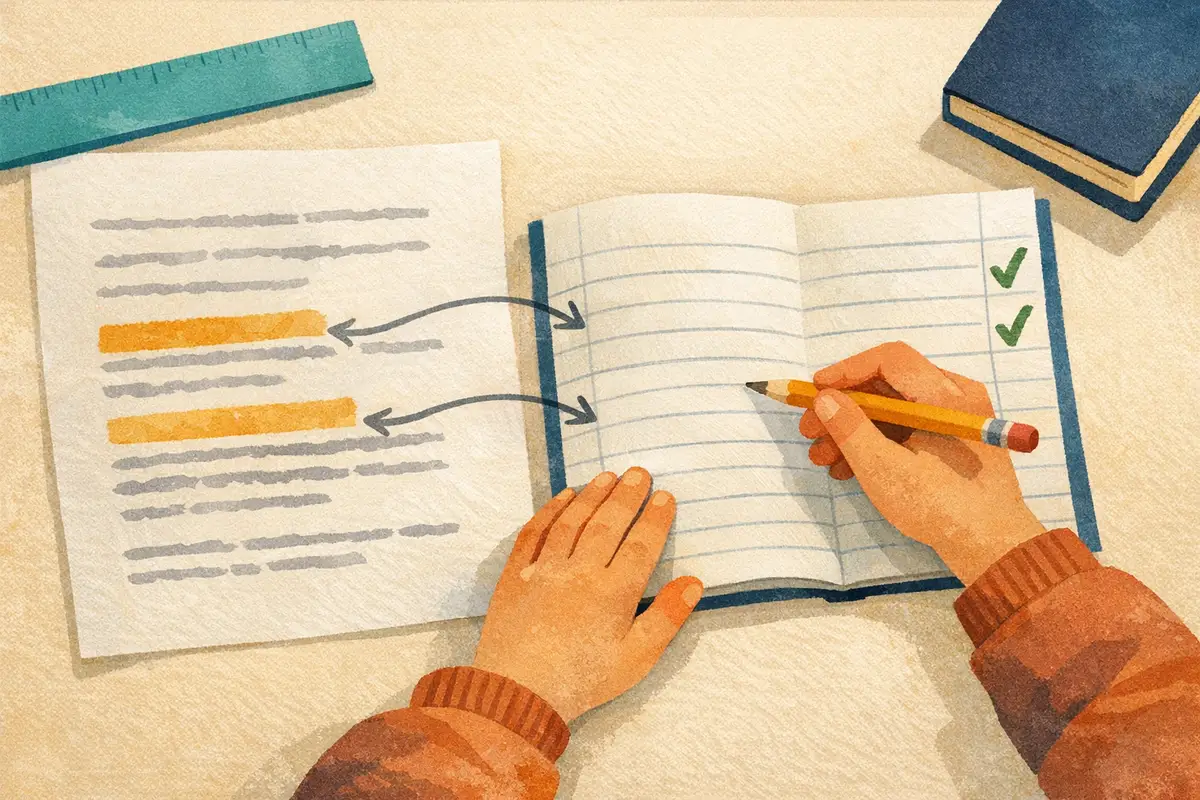
Retrieval questions exist and they are worth having in the bank, but they are not where the marks concentrate. The high-tariff questions are built on a two-part structure that the mark scheme spells out. For a six-mark question, the CSSE scheme awards one mark for each well-selected quotation up to a maximum of three, and one mark for each clear explanation up to a maximum of three.
That single line is the most actionable fact in this article, because it converts a vague instruction ("explain your answer") into a countable technique. A six-mark answer needs three quotations and three explanations. Not one long paragraph. Not three quotations with a shrug after them. Three pairs.
The scheme is also precise about what a quotation is. Quotations must be accurate word for word, but spelling and punctuation mistakes within them are allowed, and paraphrase is not accepted where a quotation is required. So the child who writes "he was scared because it says he was shaking" without lifting the words loses the evidence mark; the child who copies the phrase but misspells one word inside it does not.
A worked example, written for this guide rather than copied from any paper. Suppose a passage reads: Nadia checked the ropes twice, then a third time, before she let go of the rail. A four-mark question asking how the writer shows Nadia's nervousness wants two evidence-and-explanation pairs. Pair one: quote "checked the ropes twice, then a third time", then explain that repeating a check she has already completed suggests she does not trust her own reassurance. Pair two: quote "before she let go of the rail", then explain that holding on until the last possible moment shows she is delaying the thing she fears. Two quotations, two explanations, four marks, no padding.
One more mechanical detail from the 2022-entry scheme that costs children marks every year: candidates must not tick more boxes than they are instructed to, and any who do lose all the marks for that question. Hedging by ticking an extra option is not a safe guess. It is a zero.
The front cover also tells candidates that this is not a test of memory and that they can look back at the passage to check their answers as many times as they want. Children who have only practised under panicky conditions often forget this and answer from recall. Teach re-reading as an explicit habit.
The skills involved are, reassuringly, the ones school already teaches. The national curriculum for years 5 and 6 asks pupils to infer characters' feelings, thoughts and motives from their actions and justify inferences with evidence, to evaluate how authors use language including figurative language, and to summarise main ideas drawn from more than one paragraph. That is a near-exact description of a high-tariff 11 plus comprehension question.
Myth three: SPaG is a separate section you drill separately
This is the most expensive misconception, because it sends families towards the cheapest and least transferable kind of practice. On the CSSE papers, spelling, punctuation and grammar marks are awarded inside comprehension and writing answers, not as a standalone grammar section. The 2022-entry scheme repeatedly specifies one mark per clear answer plus one additional mark for SPaG, and elsewhere simply "one mark for accurate SPaG".
The paper's own instructions reinforce it. Candidates are told that correct spelling and grammar is recommended and that punctuation should be clear and exact. The continuous writing booklet goes further and states outright that correct spelling, punctuation and grammar will be awarded marks.
The implication is direct. Isolated grammar worksheets, where a child underlines the subordinate clause in someone else's sentence, do not convert into marks on this paper. What converts is writing accurate, properly punctuated sentences about a text, under time pressure. The most efficient SPaG practice for an Essex-style paper is a comprehension answer marked twice: once for content, once for accuracy.
Medway is the exception that proves the point, since its English paper explicitly covers punctuation and grammar alongside comprehension, so discrete question practice does have a place there. Again: check your paper first.
Vocabulary: small in marks, large in effect
On the CSSE evidence, applied reasoning is five marks, roughly eight per cent. If you judged vocabulary only by its own section you would nearly ignore it. That would be a mistake, for three reasons.
First, a child who does not know a word in the passage cannot infer from a sentence containing it, so vocabulary gates the 35-mark section. Second, precise word choice earns credit in the 20-mark writing task. Third, in GL-style areas such as Buckinghamshire and in the verbal element of the Medway reasoning paper, vocabulary is the engine of whole question families: synonyms, antonyms, odd-one-out, word completion. Our guide to 11+ verbal reasoning question families covers how that dependency plays out.
So treat vocabulary as a multiplier rather than a topic. Fifteen minutes of reading with a pencil, collecting unfamiliar words in context, beats an hour of list memorisation, because words learned inside sentences come back with their grammar attached.
Writing: marked, tiebreak, or absent
Writing is where area differences bite hardest. CSSE's Continuous Writing paper is worth 20 marks, requires candidates to answer both questions in their own words, and instructs them to aim to write at least six sentences with accurate spelling, punctuation and grammar. It is not separately timed and may be completed at any time during the total 60 minutes, with 20 minutes suggested.
That last detail is a genuine exam-technique point. A child who runs long on comprehension can quietly starve their own writing section, so practise the whole booklet to the total time, not each section in isolation.
Elsewhere writing may not appear in the test at all. ISEB states that its Common Pre-Tests cover mathematics, English (reading comprehension and grammar), verbal reasoning and non-verbal reasoning, so for independent-school pre-tests English means comprehension plus grammar, with no creative writing component in the test itself. Many independent schools then set their own written paper at interview stage, which is a separate assessment with its own criteria. Buckinghamshire's transfer test has no writing element.
Matching revision time to the mark weighting
Here is the allocation the CSSE evidence supports, for a family sitting an Essex-style paper. Adjust the proportions if your area's paper differs, but keep the principle: time should mirror marks.

- Roughly half of English time on comprehension, weighted towards high-tariff quotation-and-explanation questions rather than easy retrieval.
- Roughly a third on continuous writing, always marked for accuracy as well as ideas, since SPaG marks are live in that booklet.
- A small, steady slice on vocabulary, ideally through reading rather than lists, on the understanding that it feeds the other two.
- Almost nothing on isolated grammar worksheets, unless your area sets discrete punctuation and grammar questions, as Medway does.
Across a year, that becomes: build reading stamina and vocabulary in the autumn; shift to timed high-tariff comprehension answers and marked writing in the spring; move to full timed papers in the final term so section pacing becomes automatic. If you want a structure to hang this on, our 11 plus revision timetable guide sets out how to build a schedule a child will genuinely stick to, and Trace Learn's exam plan generates a weekly plan from your test date and your child's current results.
Free official past papers and familiarisation materials
Most of the search traffic around this topic is looking for downloads, so here are the genuinely official sources, which are always preferable to third-party reproductions.
- CSSE publishes past English papers, continuous writing booklets and full marking schemes on its practice material page. These are the documents this article is built on and the single best free resource for an Essex-style paper.
- GL Assessment publishes free familiarisation materials for its test formats. They show question styles rather than full papers, and GL directs parents to their admissions authority for format, timings and question counts.
- Local authorities and grammar school consortia publish familiarisation booklets for their own tests. Start with your council's 11 plus page and the individual school admissions pages.
For a wider curated list, see our roundup of free 11 plus papers with answers. One warning worth repeating: mark schemes are more valuable than papers. A paper tells you what was asked; a mark scheme tells you what earns credit, and that is where the quotation-and-explanation structure and the SPaG rules become visible.
What this means for your family
Three things follow from the published evidence. Comprehension is not one topic among four, it is the majority of the marks, so even revision splits systematically under-invest in it. SPaG is largely earned inside extended answers, so accurate writing about a text beats isolated grammar drilling. And writing's weight swings from a marked 20-mark section in Essex to nothing at all in Buckinghamshire, so confirming your paper is the honest first step before any spending.
Nothing here is a guarantee of a place. Selective admissions depend on cohort performance, standardisation, age adjustment and local oversubscription rules that no revision plan controls. What you can control is whether the hours your child spends are pointed at the sections that carry the marks, in English and in the maths paper, which our guide to every 11 plus maths topic and question type maps in the same source-led way. If you would like that mapped out automatically, you can create a free account and start with a diagnostic.
Topics
- 11 plus english
- comprehension
- spag
- creative writing
- exam boards