
Practice Papers and Mock Tests
Free 11 Plus Papers with Answers to Download
A curated list of genuinely free 11+ papers you can download as PDFs without an account, plus the part nobody else covers: how to mark the paper and turn a raw score into a rough standardised estimate.
 Elspeth Marlow
- 13 min read
Search for free 11 plus papers with answers in PDF form and you will meet the same three disappointments in rotation. Some publishers hand you the questions and hold back the mark scheme until you create an account. Some sites bury a handful of useful files inside a directory of a hundred and fifty, with no steer on which ones match the test your child will actually sit. And some pages rank near the top of the results for a query with "pdf" in it while offering no downloadable paper at all, just an essay about grammar schools and two buttons that send you somewhere else.
This page is built to end that loop, and it sits alongside our wider guide to free 11 plus practice papers with answers if you want the full picture before you start downloading. Below is a short, honest list of papers that are genuinely free, come straight from exam boards or councils, and download without an email address. Each entry says plainly whether answers or mark schemes are included, and whether the file is a real past paper or a familiarisation sample, because those two things are not remotely equivalent and almost nobody tells you which you are getting.
Then comes the part that no page we checked bothers with. Downloading a paper is the easy half. The hard half is sitting it properly, marking it fairly, and working out whether 34 out of 50 is a good result or a worrying one. That question has a real answer, built on arithmetic the exam boards publish themselves, and the rest of this article walks through it.
Free 11 plus papers with answers: the download list, no sign-up
These are first-party sources: the assessment provider or the admissions authority that runs the test. That matters, because a paper written by the organisation that sets the real thing tells you more about style and pacing than a third-party imitation ever will.
- GL Assessment familiarisation materials. Roughly ten hours of free material across six downloads: verbal reasoning, non-verbal reasoning, English, maths, a combined non-verbal reasoning and maths pack, and verbal skills. Answers: yes, answer sheets are included. Type: familiarisation and practice material, not past papers. No registration, and the files are intended for printing at home. The one catch is that the downloads arrive as ZIP archives rather than single PDFs, so you unzip first and print second. See the GL Assessment free materials page.
- CSSE past papers for Essex. Real, previously sat examination papers for 2021, 2022 and 2023 entry, in English (including the Continuous Writing papers) and Mathematics. Answers: yes, mark schemes are published alongside. Type: genuine past papers. Direct PDFs, no account. These are the single most valuable free files on this list if you are in the Essex consortium area, because they are the actual instrument, not an approximation. See the CSSE practice material page. Note that CSSE states all its examination papers are protected by copyright, so use them at home rather than redistributing them.
- Buckinghamshire familiarisation booklet. A downloadable PDF booklet (about 1.4 MB) aimed at out-of-county children who will not see the in-school practice test. Answers: partial, it is a familiarisation guide to question style and answer sheets rather than a full marked paper. Type: familiarisation. The council also points parents towards GL's free materials for more. See the Buckinghamshire secondary transfer testing process page.
And the labels the other pages leave off. Bond 11+ publishes two free direct downloads, a ten-minute non-verbal reasoning test and a maths practice test, but the answers are explicitly gated: you download them when you sign up to the Bond website. PiAcademy puts its files behind account creation. Sutton Tutorials offers four GL-style papers with answers, but only after you supply your name, email, postcode and your child's school year, at which point you are emailed a link. None of that is dishonest, but it is not what most people mean by a free PDF download, and you deserve to know before you click.
Myth: any free 11 plus paper will do. Reality: the region decides
This is the single biggest waste of effort we see. A parent downloads a well-reviewed non-verbal reasoning pack, works through it for six weeks, and then discovers their child's test contains no non-verbal reasoning at all.

The variation is real and it is documented by the authorities themselves. GL Assessment describes the 11+ as a single test or a series of tests covering one or more of English, maths, verbal reasoning and non-verbal reasoning, and notes that verbal reasoning appears in most papers because it is treated as the best predictor of future academic potential. Which of those four your child faces is a local decision.
Three published examples show the spread:
- Buckinghamshire. The Secondary Transfer Test is produced by GL Assessment and measures verbal, non-verbal and mathematical skills. It runs as two papers of about 60 minutes each with a break between them.
- Essex (CSSE). Two papers only, one English and one Mathematics. No standalone reasoning paper at all. The English paper lasts sixty minutes with ten minutes of additional reading time; the Mathematics paper lasts sixty minutes.
- Lincolnshire. Admission rests on the Lincolnshire Consortium of Grammar Schools' 11 plus examinations, sat in September of Year 6, and practice papers are not published openly at all. The council states that further details regarding test dates and practice papers are sent once a child is registered, per the Lincolnshire admission arrangements.
GL itself flags the limit of its own free files: the exact timings for, and number of questions in, your local 11+ test may differ from those in its familiarisation and practice materials. So treat every free national pack as a source of question types and stamina, and treat your local admissions page as the source of truth for format and timing. If you are still unsure which board sits behind your area's test, our comparison of GL Assessment, CEM and ISEB untangles it, and our guide to finding genuine 11 plus past papers covers school-specific sources beyond the free tier.
Free 11 plus papers by subject
Once you know which subjects apply, the free material sorts itself quickly.
English. The CSSE past papers are the strongest free English material available, because they include full comprehension and Continuous Writing tasks with mark schemes. GL's English download covers comprehension, spelling, punctuation and grammar in the shorter, sharper style used in reasoning-adjacent papers.
Maths. GL's maths pack and the combined non-verbal reasoning and maths pack both come with answer sheets. CSSE's Mathematics papers with mark schemes give you genuine sat-paper difficulty, and they are useful even outside Essex as a stretch exercise, provided you ignore the specifics of timing.
Verbal reasoning. GL publishes both a verbal reasoning download and a separate verbal skills download. If your area uses GL, this is the closest free approximation to the real thing you will find, and it is the subject with the heaviest weighting in some areas: Buckinghamshire's final Secondary Transfer Test Score is composed of 50% of the standardised score for verbal skills, 25% for mathematical skills and 25% for non-verbal skills.
Non-verbal reasoning. GL's non-verbal reasoning download is free with answers. This is the subject where question type recognition matters most, so a small number of papers worked slowly beats a large number rushed.
Myth: the paper is the hard part. Reality: the marking is
Here is what we found genuinely striking when we read through the pages currently ranking for this search. Not one of them tells a parent what to do after their child puts the pencil down. They hand over files and stop.
Start with conditions, because a paper sat badly produces a score you cannot interpret.
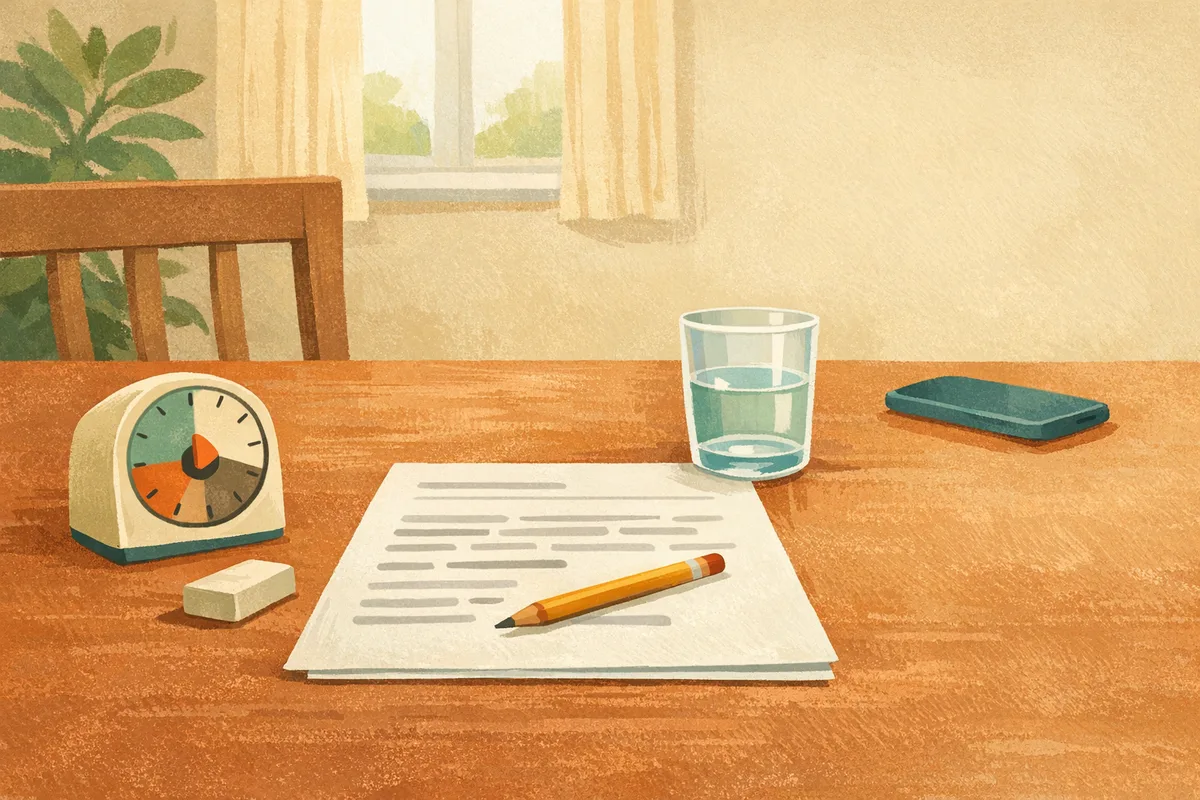
- Use the real timings for your area. In Buckinghamshire that means two papers of about 60 minutes with a break between. For CSSE English, set 60 minutes plus 10 minutes of reading time and enforce the reading time as reading time, with no writing.
- One sitting, one room, no interruptions. Phone away and face down. No dictionary, no calculator unless the local test permits it.
- Print it. Working on paper changes how children annotate, cross out and check. If the real test is on paper, practise on paper.
- Do not help. The instinct to nudge a stuck child is strong and it destroys the diagnostic value of the whole exercise. Note the moment instead and come back to it after marking.
GL's own advice is that tackling a practice paper under timed conditions helps children manage their time and identify strengths and weaknesses. Both halves of that sentence matter, and the second half only works if the first half was honest.
How to mark a paper that has no mark scheme
Multiple choice and short-answer maths mark themselves. The awkward cases are comprehension and writing, where several free packs give you the questions and little else. A workable home approach:
- Comprehension. Award a mark only where the answer is supported by the text. If your child has inferred something reasonable but unevidenced, mark it wrong and explain why. Retrieval questions are right or wrong; inference questions need the evidence stated.
- Writing. Do not attempt a numeric mark. Instead assess four things separately and note each as secure, developing or weak: task response (did they answer the actual prompt), structure (a shaped opening, middle and ending), sentence variety and vocabulary, and technical accuracy (spelling, punctuation, paragraphing). Three of those improve with practice; one improves with reading.
- Record errors by type, not just by count. "Lost 6 marks" tells you nothing. "Lost 6 marks: four on fractions of amounts, two on careless copying" tells you exactly what next week looks like.
- Note anything unfinished separately. Running out of time is a pacing problem, not a knowledge problem, and the fix is different.
That last distinction is why an error log beats a score log. If you would rather not keep it on paper, that is precisely what automatic progress tracking is for: it sorts mistakes by topic so the pattern surfaces without you having to spot it yourself.
Turning a raw score into a rough standardised estimate
Now the question everybody actually arrives with. Your child scored 34 out of 50. Is that good?
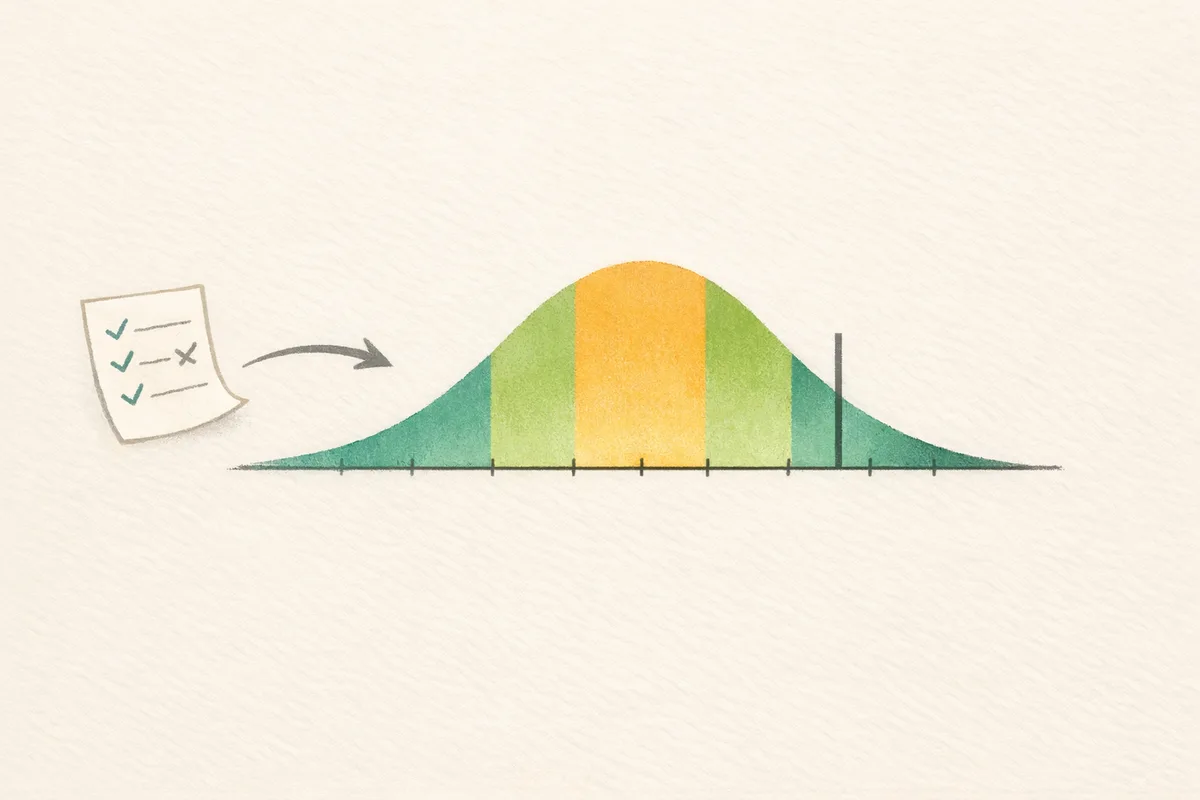
A raw percentage is not a pass mark, and this is where a lot of free-paper sites quietly mislead. Selective tests report standardised scores. In GL Assessment's guide to standardised tests, the average score is 100, and a Standard Age Score converts a raw score into a standardised one that accounts for the pupil's age in years and months, showing how they are performing relative to a national sample of pupils the same age. The National Percentile Rank then shows the percentage of pupils obtaining a given score or below, with 50 being average.
The spread is fixed. GL sets the standard deviation at plus or minus 15 points, which means:
- Roughly two-thirds of pupils in an age group score between 85 and 115.
- Roughly 95 per cent score between 70 and 130.
- Over 99 per cent score between 60 and 140.
So a home estimate works like this. Rank your child's raw score against the paper's difficulty and ask where in the cohort it plausibly sits. A result comfortably above the middle of the class range is probably somewhere in the 110 to 120 band. A result near the top of what the paper allows points higher. This is a sanity check, not a prediction, and the honest caveat is unavoidable: standardisation depends on the performance of the whole national cohort sitting that test, not on one child's paper at your kitchen table. Anyone telling you that 68% equals a standardised 121 is inventing it.
One more feature catches parents out. Because pupils are compared only with others of the same age, an older child with a higher raw score can still receive a lower standardised score than a younger child with fewer marks. Age weighting is not a rounding error; it is the point.
What 100, 111 and 121 mean, and why it varies
Qualifying scores are set locally, so the same number means different things in different counties.
Buckinghamshire is the clearest published example. A child's standardised score for the Secondary Transfer Test will be between 60 and 170, marking takes account of each child's age in years and months on the date of the test, and if the final Secondary Transfer Test Score is 121 or above, the child qualifies for grammar school. The council expects about 37% of children to reach 121 or more. Crucially, a score above 121 confers no extra priority, because Buckinghamshire grammar schools do not use score as an admission rule. All of that is set out on the council's marking the Secondary Transfer Test page.
Elsewhere the arithmetic differs entirely. For Lincolnshire mid-year entry at ages 11.03 to 14, candidates sit age-weighted GL verbal and non-verbal reasoning tests and need an amalgamated score of at least 230 with no individual paper below 110. Same provider, completely different threshold structure.
The practical rule: find the published qualifying arrangement for your own admissions authority, write the number down, and stop comparing your child's marks to numbers quoted by parents in another county.
How many papers are enough, and what to do after each one
More papers is not better. A child who sits twenty papers and reviews none of them has practised being wrong twenty times.
A sustainable rhythm for the year before the test looks like one full paper every two to three weeks, rising to one a week in the final six to eight weeks. Between papers, the work is not more papers; it is the three or four error types the last paper exposed. Our year by year preparation plan sets that cadence out in more detail.
After each paper, run the same short loop:
- Mark it the same day, while the questions are still fresh.
- Sort every error into careless, unknown method, or ran out of time.
- Pick the two biggest clusters and work on those alone until the next paper.
- Re-sit only the question types you got wrong, never the whole paper.
One last thing worth knowing if you are in Buckinghamshire or a similar area: children there also sit a shorter practice test, usually two days before the main test, to help them learn what to expect, and the council's separate school-run practice test uses two papers of about 40 minutes each. It is recommended but not compulsory. If your area offers something equivalent, take it, because the familiarity is free.
When the free files run out, and they will, the next step is repeated full-length papers under real timings with the marking done for you. That is what our mock tests are built for, and you can start with a free account at sign-up.
Topics
- 11 plus
- past papers
- free downloads
- standardised scores
- marking