
How to Pass the 11 Plus: Exam Technique and Timing Strategy
Most 11+ advice tells parents to keep an eye on the time and never says what the time is. This guide turns published test timings into seconds-per-question budgets, checkpoint pacing, answer-sheet discipline and a structured wrong-answer review.
 Elspeth Marlow
- 15 min read

Search for how to pass the 11 plus and almost every page that ranks will tell your child to keep an eye on the time. Not one of them says what the time actually is. The closest anybody gets is a single line of arithmetic, usually some version of fifty questions in fifty minutes so aim for a minute each, applied indiscriminately to every paper in the country.
That is the gap this guide closes. The 11+ is not one exam with one shape, and the correct technique is genuinely different depending on which paper your child sits. Medway Council publishes timings of 30 minutes for English, 50 minutes for Maths and 45 minutes for Reasoning, where the Reasoning slot is split into a 20 minute spatial and non-verbal block and a separate 25 minute verbal block. The Consortium of Selective Schools in Essex publishes an English paper of sixty minutes plus ten minutes of additional reading time, and a Maths paper of sixty minutes. Buckinghamshire publishes two papers of about sixty minutes each. Those are three completely different pacing problems, and one rule cannot solve all three.
This matters more in the final weeks than anything else you could do. Content knowledge plateaus. Marks lost to poor pacing, to a slipped row on an answer sheet, or to the same unexamined mistake repeated across six papers are recoverable this week.
Myth: there is a pass mark you can revise towards. Reality: you are ranked against a cohort
Parents ask what score is needed to pass, and the honest answer is that in most selective areas there is no fixed national pass mark at all. Passing usually means placing high enough in the order of merit for your cohort in your area in that particular year, which means the threshold moves.
Medway is unusually transparent about the arithmetic, so it is worth using as the worked example even if you live elsewhere. Each paper is marked to give a raw score, which is simply the number of questions answered correctly. Raw scores are then standardised to take account of the child's age when they sat the test. The standardised scores are combined into a total weighted score calculated as English multiplied by two, plus Mathematics multiplied by two, plus Reasoning multiplied by one. Children are ordered by that weighted score, and the test is designed so that approximately 26 per cent of Medway maintained school pupils are assessed as suitable for grammar school. Recent minimum weighted scores for children from non-Medway or independent schools were 481 for 2026, 482 for 2025 and 492 for 2024, according to Medway Council's published guidance on results and scoring.
Three things follow from that, and all three change how you prepare.
- The threshold moved by eleven points across three years. Anyone quoting you a fixed percentage is guessing.
- Weighting is not even. In Medway, English and Maths each carry twice the weight of Reasoning, so a mark saved in English is worth two marks saved in Reasoning.
- Because the standard is relative, marks protected through technique are exactly as valuable as marks earned through new knowledge, and they cost far less to obtain.
Reframe the goal. You are not chasing a number on a mark scheme. You are trying to stop your child throwing away marks on questions they already know how to answer.
Step 1: find your child's real paper before you time anything
Every timing rule below is worthless if it is applied to the wrong paper. GL Assessment, which produces the papers used in Buckinghamshire and many other areas, is explicit about this. It warns that the exact timings for, and the number of questions in, your local 11+ test may differ from those in its familiarisation materials, and it directs parents to contact the admissions department of their local grammar school or local authority. It also offers ten hours of free familiarisation materials and recommends that children familiarise themselves with the multiple-choice layout, content and question types before the day.
So before you buy anything, spend twenty minutes collecting four facts from your own authority's or consortium's website: how many papers, how long each one is, whether any paper is split into separately timed sections, and whether answers are recorded on the question booklet or on a separate answer sheet. Write them on a card and stick it above the desk. If you are unsure which board sets your child's paper, our comparison of GL Assessment, CEM and ISEB formats is the fastest way to narrow it down, and the CSSE exam in Essex is different enough to deserve its own read if you are in that catchment.
Your seconds-per-question budget
Once you have the real timings, you can build the budget. The method is deliberately simple, because a ten year old has to be able to run it.
- Convert the published paper length into seconds. A 50 minute paper is 3,000 seconds.
- Subtract a review reserve. Take off ten per cent, so 3,000 becomes 2,700.
- Divide the remainder by the number of questions on the actual paper your child will sit.
- Round down to a number ending in zero or five, because nobody can pace to 43 seconds.
Worked illustrations, using question counts that you should replace with your child's real ones:
- A 50 minute Maths paper with 50 questions gives 2,700 usable seconds and a working budget of 54 seconds per question. Round to 50 seconds and bank the surplus.
- A 30 minute English paper with 25 comprehension questions gives 1,620 usable seconds, or about 65 seconds per question, but that number is misleading until you deduct reading time.
- A 25 minute verbal reasoning block with 40 questions gives 1,350 usable seconds, or about 33 seconds per question. Round to 30 seconds. That is a fundamentally different mental rhythm, and a child drilled only at one minute per question will not finish.
That last comparison is the whole argument. The gap between 30 seconds and 54 seconds is the gap between finishing and leaving a page blank, and the single-rule advice on most sites cannot see it.

The three timing profiles, and the technique each one needs
Profile one: the sprint paper
A sprint paper is a long list of short, self-contained questions with a tight per-question budget. Medway's 50 minute Maths paper and the 20 minute spatial and non-verbal block sit here. The whole skill is rhythm: keep an even pace and never let one question absorb three budgets.
Technique: teach a hard stop. If a question is not resolving by twice the budget, mark it and move. Two extra attempted questions are usually worth more than one hard question solved beautifully.
Profile two: the reading-time paper
CSSE publishes an English paper lasting sixty minutes with ten minutes of additional reading time, and a Maths paper lasting sixty minutes. It also states that with effect from September 2024 (2025 entry) the English paper does not contain Applied Reasoning questions, and it provides free downloadable familiarisation papers on the CSSE website.
Those ten minutes are structurally different from the sixty that follow, and children waste them constantly. Reading time is not warm-up time. It is the only part of the exam where the child can build a mental map of the passage with zero time pressure.
Technique: give reading time a job. First pass, read the whole passage for story and tone without stopping. Second pass, mark where the passage changes: a new speaker, a new place, a shift in mood. Do not attempt to memorise detail, because detail can be found again; structure cannot be rebuilt under pressure.
Profile three: the split-section paper
Medway's Reasoning paper is 45 minutes in total, but it is administered as 20 minutes for spatial and non-verbal reasoning and 25 minutes for verbal reasoning. Time cannot be borrowed between those blocks. Medway also notes a minimum twenty minute break between test papers, and that practice questions precede the papers, on its Medway Test information page.
Buckinghamshire's Secondary Transfer Test takes the opposite approach at the paper level: children sit two test papers, each about sixty minutes long, with a break between, and a shorter practice test is usually taken two days before the main test. Buckinghamshire Council publishes those transfer test arrangements in full.
Technique: run each block as its own exam with its own checkpoints. A child who saves five minutes in the non-verbal block cannot spend them on verbal, so unspent time must be spent inside that block or it evaporates.
Checkpoint pacing: how a ten year old tracks time without panicking
Seconds-per-question is a planning tool for you. It is a terrible tool for a child mid-paper, because checking a clock after every question costs time and raises anxiety. Convert the budget into two or three checkpoints instead.
For a 50 minute, 50 question paper, the checkpoints are: at 25 minutes gone you should be starting question 26; at 40 minutes gone you should be starting question 41. For a 25 minute, 40 question verbal block, one checkpoint is enough: at roughly halfway you should be on question 21.
Teach the response, not just the number, because a checkpoint with no attached action just produces panic.
- Ahead of the checkpoint. Do not speed up further. Slow very slightly and read each question stem twice.
- On the checkpoint. Continue exactly as you are.
- Behind by a few questions. Switch to a triage pass: answer everything that resolves quickly, mark the rest, and return only if there is time in that section.
- Badly behind. Ensure every question has some answer recorded. On multiple choice, a considered guess after eliminating one or two options is strictly better than a blank.
The only way to install this is under a real clock. Sitting a paper untimed teaches accuracy but actively teaches the wrong pace, which is why timed mock tests with per-section clocks are worth more in the last eight weeks than another untimed workbook. Our guide to sourcing genuine 11 plus past papers will keep you supplied with material that matches the real format.
Myth: if you get stuck, come back at the end. Reality: sometimes there is no end to come back to
Skip-and-return is right about half the time. On a single sixty minute paper it works cleanly. On a separately timed twenty minute block it is close to meaningless, because the end of that block arrives while the child is still working. So condition the rule on the paper shape.
- On a single long paper, mark skipped questions with one clear pencil symbol in the margin, finish the paper, then return in the reserved final ten per cent. Return to the cheapest skipped questions first.
- On a separately timed section, treat the section end as absolute. Take one guess before moving on rather than leaving a blank you intend to revisit.
- On any paper, cap skips. Three or four marked questions is triage; twelve is avoidance, and it usually signals a content gap that no pacing work will fix.
Answer-sheet discipline: the marks children lose without getting a question wrong
This is the highest-value, lowest-effort technique on this page. Where answers are recorded by letter on a separate multiple-choice sheet in pencil, a single misaligned row does not cost one mark. It cascades. Every subsequent answer lands one row out, so a child can answer thirty questions correctly and score close to nothing on them.
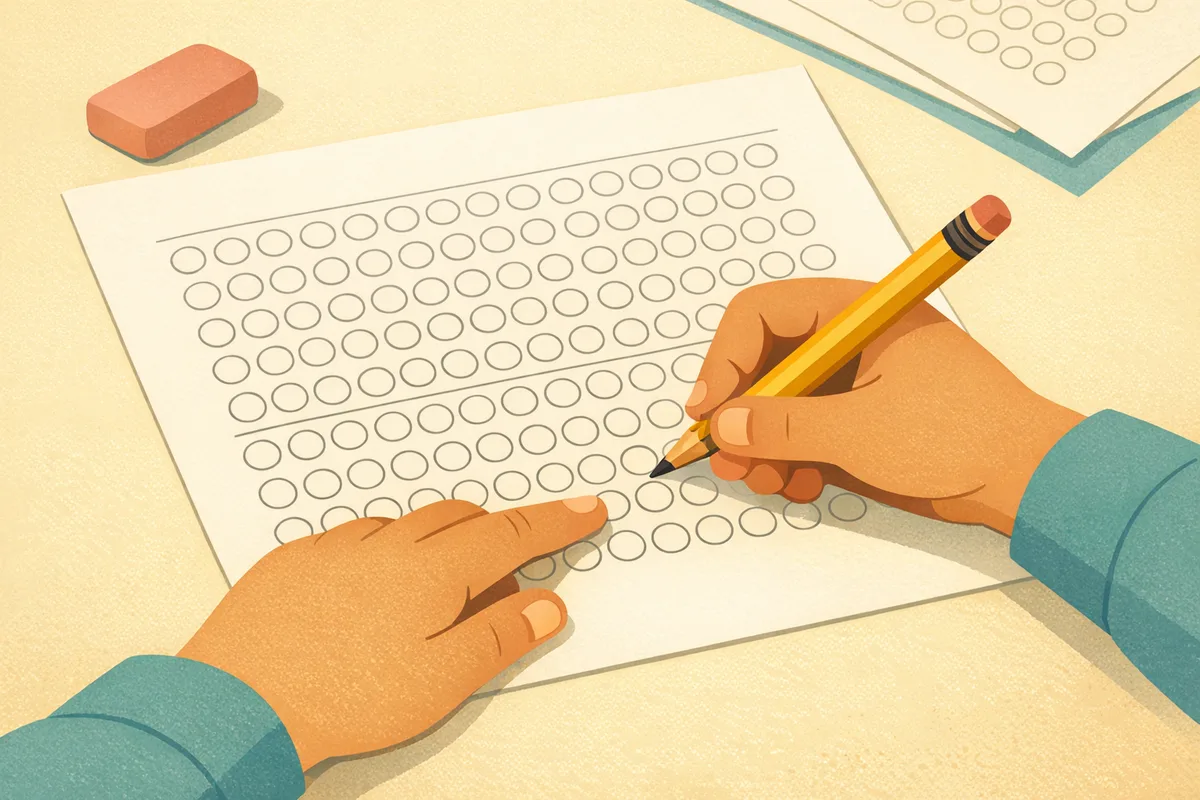
Drill these five habits until they are automatic.
- Keep a finger or ruler on the current row. The non-writing hand has one job: hold the place on the answer sheet.
- Say the question number silently before marking. Number first, then letter. This catches the slip when it happens rather than twenty questions later.
- Check alignment at every checkpoint. Confirm the last mark sits on the row matching the last question answered. Two seconds, twice a paper.
- Transfer as you go, never in a batch at the end. Batch transfer is the most common way children finish the booklet with an empty answer sheet.
- Erase completely, and only once. A half-erased mark can be read as a second response.
GL Assessment specifically recommends that children familiarise themselves with the multiple-choice layout before the day, and this is why. The layout is a skill in itself, entirely separate from knowing the answers.
How to review a wrong answer properly: the four-cause method
Most families mark a paper, note the score, and start another one. That treats every error as the same kind of error, which is why scores stall despite volume. Four different causes need four different fixes.
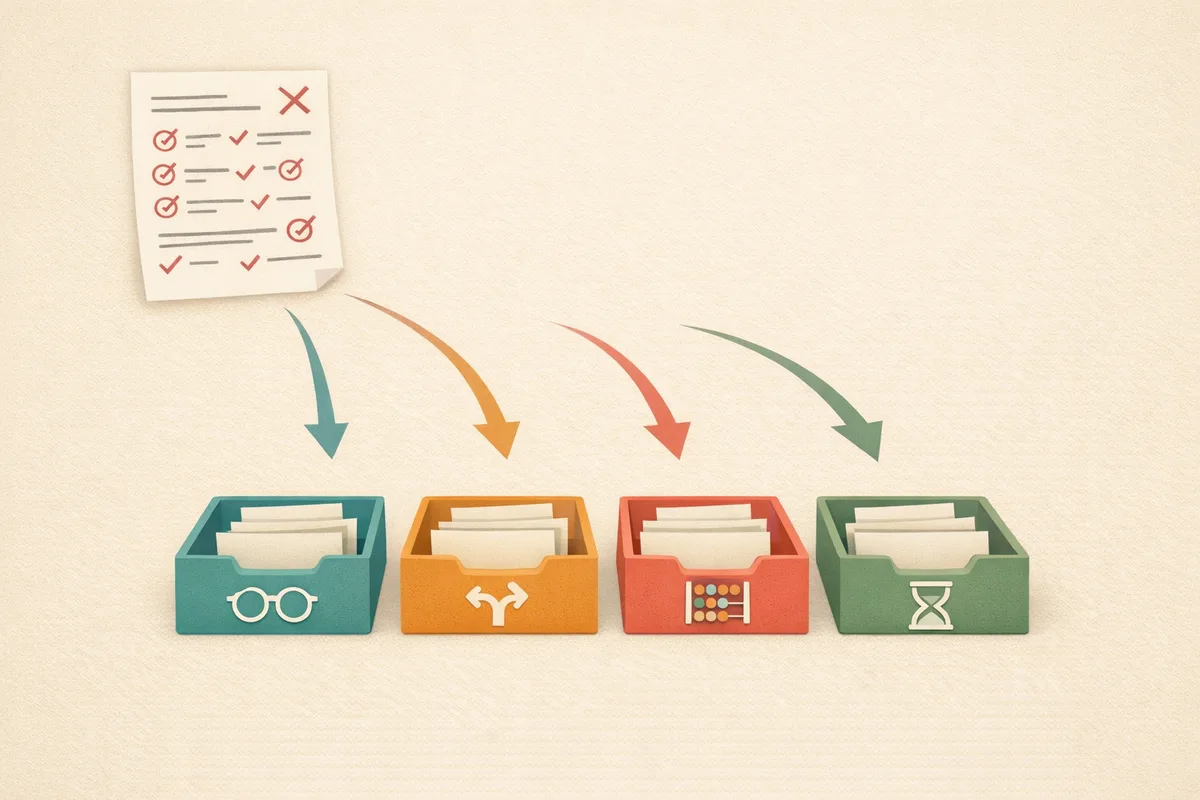
After marking, sort every incorrect answer into exactly one of these buckets. Your child does the sorting, out loud, with you writing it down.
- Misread. They knew the method but answered a different question: missed a not, used the wrong unit, ignored a word like except or least. Fix: underline the command word before starting, and re-read the stem once after solving.
- Method. They did not know how to approach it at all. Fix: this is the only bucket that needs teaching. Work three examples together, then try similar questions untimed before timing them.
- Arithmetic. The approach was right and the numbers went wrong. Fix: five minutes of daily number-fact drills, and a habit of estimating before calculating so absurd results get caught.
- Ran out of time. They never reached it, or rushed it. Fix: this is a pacing problem. Adjust checkpoints and re-run a timed section, not a full paper.
After three or four papers, the pattern is usually obvious. A child whose errors are seventy per cent misread does not need more content; they need thirty seconds of stem discipline. This is also the point at which a structured year by year preparation plan becomes genuinely useful, because you now know which parts of it apply to you.
Your eight-week timing plan
Most families read this in the summer, with the tests in September of Year 6. Lincolnshire's admission arrangements confirm that pattern and add an important warning: taking the 11 plus is not itself an application, and a formal application must still be made to your home local authority. Check those deadlines now rather than in October.
- Weeks 1 to 2, diagnose. Confirm the real format and timings. Sit two full papers under real conditions. Sort every error using the four-cause method. Change nothing yet.
- Weeks 3 to 4, fix method gaps. Teach only the topics in the method bucket. Keep sessions short and untimed. Introduce the seconds-per-question budget on single sections.
- Weeks 5 to 6, install checkpoints. Timed sections rather than full papers. Add answer-sheet transfer to every session.
- Week 7, full rehearsal. Two complete papers at the real time of day, in the real order, with the real breaks. Review, and fix nothing new.
- Week 8, taper. Halve the volume. Short confidence sessions on secure topics only. Sleep and routine matter more than the last twenty questions.
Exam day and frequently asked questions
On the morning itself, the useful preparation is boring: a normal breakfast, arriving early, two sharpened HB pencils and a good eraser, and one rehearsal of the checkpoint numbers in the car. Do not teach anything new. Between papers there is usually a scheduled break, and the right use of it is water, fresh air and no post-mortems.
Is 70 per cent enough to pass the 11 plus? There is no way to answer that from a percentage alone. In areas that rank candidates, the qualifying score is set by where your child falls in the cohort that year. Medway's recent minimum weighted scores of 481, 482 and 492 across three consecutive years show how much movement there can be.
What percentage of pupils pass the 11 plus? It depends entirely on how many grammar places exist locally. Medway designs its test so that approximately 26 per cent of its maintained school pupils are assessed as suitable. A super-selective school may effectively admit a far smaller proportion of those who sit.
How hard is it to pass the 11 plus? Difficulty is relative to the cohort, not the paper. That is reassuring in one specific way: because it is a ranking, marks recovered through pacing, answer-sheet discipline and error review move your child up the order just as effectively as newly learned content, and they can be recovered in weeks rather than months.
How do you pass the 11 plus easily? You do not. What you can do is stop losing marks you have already earned. The recoverable marks cluster in three places: unfinished sections, transcription slips, and the same misread error repeated across every paper because nobody sorted it into a bucket.
One closing caution: formats, timings and thresholds differ by area and change between years, so verify every figure here against your own local authority or consortium before you build a plan around it. The technique transfers everywhere. The numbers do not.
Topics
- 11 plus
- exam technique
- timing
- revision
- mock tests