


Birmingham Grammar Schools: Schools, Tests and Admissions
Compare Birmingham grammar schools, see how the shared West Midlands test works, and follow each school’s admissions and catchment rules.
 Elspeth Marlow
- 13 min read

There are eight state grammar schools in Birmingham and Sutton Coldfield, and they use the shared West Midlands Grammar Schools entrance test. The wider partnership includes nineteen schools across several regions. This guide separates the local schools from the wider group and explains where to find each school's admissions policy and historical offer data. The test score is only one part of the decision. Depending on the school and entry-year policy, catchment, pupil premium eligibility and distance can also affect ranking. Historical offer scores must be read alongside the category they apply to.
For September 2027 entry, the test was held on 12 September and results were issued by 16 October. Families must submit their local-authority preference form by 31 October 2026. Registering for the entrance test is not applying for a school place: they are separate forms for different organisations. The official timetable and entry guidance can change between cycles. Check the West Midlands Grammar Schools test site and your home authority's admissions page for the dates that apply to your child.
How many grammar schools are in Birmingham, and how many use the shared test?
Eight. There are eight selective grammar schools in Birmingham and Sutton Coldfield that share a single entrance test and a single registration process. They are:
- King Edward VI Aston School (boys)
- King Edward VI Camp Hill School for Boys
- King Edward VI Camp Hill School for Girls
- King Edward VI Five Ways School (co-educational)
- King Edward VI Handsworth Grammar School for Boys
- King Edward VI Handsworth School (girls)
- Bishop Vesey's Grammar School, Sutton Coldfield (boys)
- Sutton Coldfield Grammar School for Girls
Browse the Birmingham grammar school area directory or the shared West Midlands Grammar Schools Entrance Test page for the full partnership and current route evidence.
The first six belong to the King Edward VI Academy Trust Birmingham. The last two, Bishop Vesey's and Sutton Coldfield Girls, sit outside the trust but use the same test. As the Foundation's admissions page puts it, "Each school has its own admissions policy". The rules below show why that matters.
The eight Birmingham schools are one of three groupings inside the West Midlands Grammar Schools partnership, which covers nineteen schools in total. The other two groupings are the Shropshire, Wolverhampton and Walsall consortium (Haberdashers' Adams, Newport Girls' High, Queen Mary's Grammar, Queen Mary's High and Wolverhampton Girls' High) and the Warwickshire consortium (Alcester Grammar, Ashlawn, King Edward VI Stratford-upon-Avon, Lawrence Sheriff, Rugby High and Stratford Girls' Grammar). The two figures answer different questions: eight are in Birmingham and Sutton Coldfield; nineteen use the shared test.
King Edward's School and King Edward VI High School for Girls on Edgbaston Park Road are independent schools with separate admissions and their own entrance exams; they are not part of the eight state grammar schools listed above.
One entrance test is used across the partnership. When registering, families applying to schools outside Birmingham must select the relevant schools or areas so their results can be shared with those admission authorities. A separate school-place application still goes to the child's home local authority. Our guide to grammar schools by area and the test each one uses maps the regions and their entrance tests.
What are the two stages parents keep mixing up?
Stage one is registering for the test. You do this directly with the West Midlands Grammar Schools consortium, online, in the summer before your child starts Year 6. It registers your child for an allocated test session in September, and nothing else. It does not express any preference for any school. It does not go to your council.
Stage two is applying for a school place. You do this through your home local authority's coordinated secondary school application, naming the schools you want in preference order. If you live in Birmingham you apply to Birmingham City Council; if you live in Solihull, Sandwell, Walsall or Dudley you apply to your own council, even though the schools are in Birmingham. The deadline is 31 October.
Test registration and the school-place application are separate steps. A test result alone does not apply for a place: you must name the schools you want on your home local authority's application form by its deadline.
For this entry cycle, results were due before the local-authority preference deadline, so families could consider the score when completing their application. If you have not received your child's result, contact the consortium before you finalise your preferences.
What are the key dates for September 2027 entry?
For children born between 1 September 2015 and 31 August 2016:
- Tuesday 5 May 2026: registration for the entrance test opened
- Friday 12 June 2026, 4pm: deadline for reasonable-adjustment requests and supporting evidence
- Friday 26 June 2026, 4pm: test registration closed. The 2027 policies say a later test is possible only in exceptional circumstances, after the main round of allocations
- Saturday 12 September 2026: the entrance test
- Friday 16 October 2026: results issued to parents
- Saturday 31 October 2026: local authority preference form deadline
- Monday 1 March 2027: National Offer Day
Between registering and sitting, the consortium says your allocated test centre will post details of the test and the arrangements for the day to your home address in September. If nothing arrives by early September, chase it rather than assuming.
What is actually in the West Midlands Grammar Schools Entrance Test?
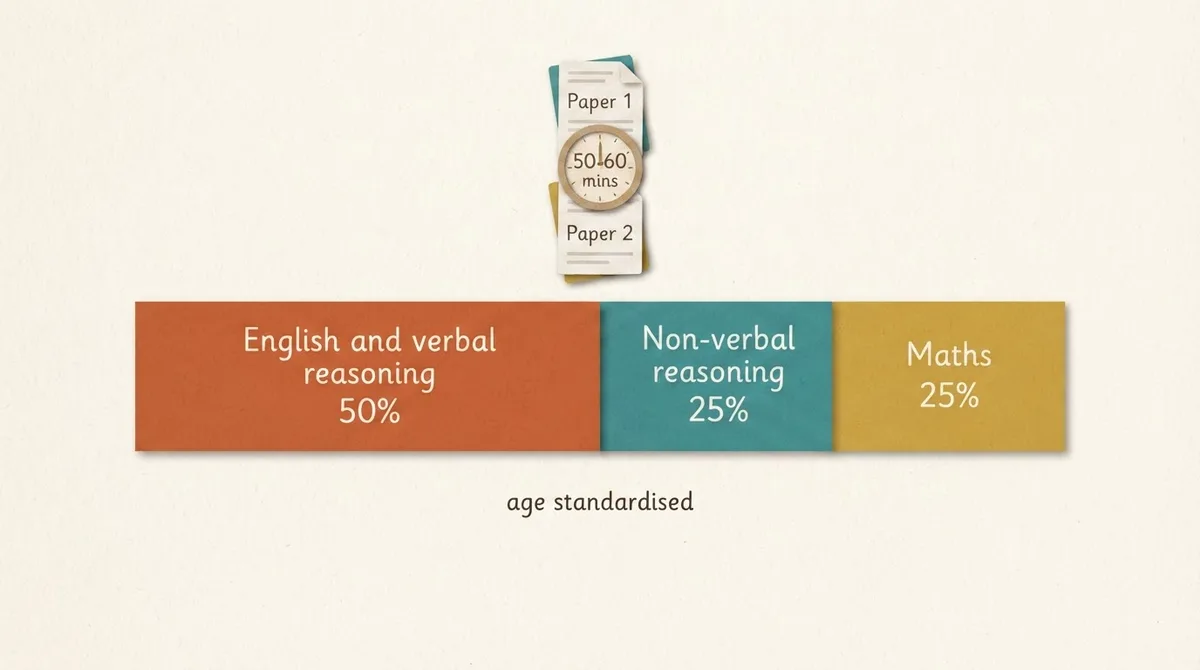
Two papers. Each is approximately 60 minutes long, including the time spent on instructions and example questions, so the actual working time is shorter than the headline number. Between them the papers cover English comprehension, verbal reasoning, mathematics and non-verbal or spatial reasoning. Every question is multiple choice and children record answers on a separate answer sheet.
For Birmingham’s September 2027 entry, the published result weighting is 50% for the combined English and verbal-reasoning score, 25% for non-verbal reasoning and 25% for mathematics. English and verbal reasoning together carry half of the weighting. The published weighting describes how the scores are combined; it does not prescribe how much time an individual child should spend on each subject.
Scores are age standardised. Section scores are adjusted for age so that, in the consortium's words, younger children are not disadvantaged compared with children in the same cohort who could be almost a year older. An August-born child is not competing on raw marks against a September-born child. You cannot convert a raw practice-paper mark into a predicted standardised score at home.
Instructions and timings are delivered by audio. The test instructions, example questions, practice questions and timings are all delivered via audio. Children cannot set their own pace through a section or go back when they feel like it. A child who has only ever practised silently, at their own speed, at the kitchen table, meets an unfamiliar constraint on the day. Practising to an externally imposed clock is a real and specific preparation task, not a detail.
For September 2027 entry, the Foundation identifies GL Assessment as the test provider. If you are unsure what that means for question style, our comparison of GL, CEM and ISEB explains the different providers, and our non-verbal reasoning question type guide describes a section that contributes 25% of the result weighting.
What do the 205 and 224 scores actually mean?
For September 2027 entry, across all eight schools, the qualifying score is 205. The priority score is 224 for the six King Edward VI grammar schools. These are the current published thresholds for this entry cycle, not forecasts for later years.
These are not two versions of a pass mark. They do different jobs.
The qualifying score is the threshold for being considered grammar-school suitable at all. Score below it and you are not in the running, wherever you live. Score at or above it and you are eligible to be ranked.
The priority score is a higher bar used inside the oversubscription rules. At the King Edward VI schools, in-catchment children who are not eligible for pupil premium need the priority score, not just the qualifying score, to sit in the in-catchment priority category.
Neither is a guaranteed pass mark, and this is where the results and offers table becomes essential reading. The last score offered in a category can vary from one entry year to another as applications and places available change. Answer sheets are scanned and marked by computer, and the Foundation says it does not re-mark them. Check the relevant admissions authority for any other review or appeal procedures.
Why can a lower score inside catchment beat a higher score outside it?
Some schools rank applicants in policy categories before using score or distance within a category. The exact rules differ by school and entry year, so use the individual policy rather than assuming one city-wide formula.
The six King Edward VI trust schools use catchment wards in their published policies. The following is the broad category order used by those schools for 2027 entry; details and limits vary by school:
- Looked-after and previously looked-after children achieving the qualifying score
- Pupil premium children living within catchment
- Pupil premium children living outside catchment, subject to that school's policy
- Non-pupil-premium children within catchment achieving the priority score
- All other children achieving the qualifying score
Read category four and category five next to each other. For a King Edward VI school using these criteria, an in-catchment child meeting the priority score may be ranked ahead of a higher-scoring applicant in the final category. The policy ranks categories first, then applies its stated rules within each category.
The Foundation's 2026-entry table illustrates how the categories produced different historical outcomes. For "all other applicants", the last scores offered in March were 255 at Camp Hill Girls, 254 at Camp Hill Boys, 229 at Bishop Vesey's, 227 at Sutton Coldfield Girls, 219 at Handsworth Girls, 217 at Aston and 216 at Handsworth Grammar Boys. At King Edward VI Five Ways, no March offers were made in that category, though offers followed from the waiting list by September. These figures describe one entry year and are not predicted thresholds for future applicants.
Tie-breaks are policy-specific and may include distance. Check the Handsworth Girls admissions policy and the equivalent current policy for each school you are considering. Do not assume a nearby postcode is in catchment.
Do the Sutton Coldfield schools work the same way?
No. Sutton Coldfield Grammar School for Girls sets its own rules. Its admissions page says that when several candidates have the same score and only one place is left, offers go first to looked-after or previously looked-after children, then to pupils eligible for the Pupil Premium, then to those who live closest. Check the school's current policy for the full order. Bishop Vesey's 2027 policy uses distance zones (Zone 1 is within 12 miles) and gives priority to qualifying pupil-premium applicants, up to a maximum of 38 places. Read the current 2027 policy before comparing criteria.
The schools use the same test, but their admissions criteria differ. Compare the distance or catchment rules in each school's policy against your own address; the school names and shared test do not mean the admissions criteria are the same.
What happens after results, and how should you rank preferences?
An equal preference system applies. Each school considers applications against its published criteria. If a child meets the criteria for more than one school, the home local authority offers the highest-ranked school on the preference form for which a place is available.
Two consequences follow. First, there is no tactical advantage in demoting your genuine first choice to look modest. Second, the Foundation says a child who achieves the qualifying score or above is automatically placed on the waiting list for any Foundation grammar school listed higher than the one offered. Check other schools' policies and your home authority's guidance.
The Foundation publishes information about pupil premium eligibility and familiarisation resources on its official admissions pages. Its 2027-entry guidance says the expanded free-school-meal eligibility introduced in September 2026 is not the same as pupil-premium eligibility; only the targeted free-school-meal cohort attracts pupil-premium priority. Check the current entry-year rules and access instructions directly, as they can change. The 2027 policy for Handsworth Grammar School for Boys lists an intended admission number of 150 for Year 7.
How should a Birmingham family actually prepare?
Work backwards from the format rather than from a generic 11+ syllabus.
- Use the published weighting as context. English and verbal reasoning combine for half of the result weighting, while non-verbal reasoning and maths each account for a quarter. This does not prescribe a practice schedule; choose what to review based on your child's needs and the local format.
- Practise multiple choice specifically. Transferring answers to a separate sheet is a skill with its own failure mode, namely the slipped row. A short practice using the same sheet layout may help a child learn to keep their place.
- Know the format. The Foundation describes audio instructions and individually timed sections. Its familiarisation materials show how answers are recorded on the separate answer sheet.
- Use timed practice when it matches your child’s needs and the local format. The official test has two papers, but practice volume and timing are family decisions.
- Do your catchment homework in parallel. Confirm your ward, read each school's policy, and be honest about what the previous year's category cut-offs imply for your position.
Optional practice papers and online exercises can help children become familiar with question formats. Check that a resource matches the subjects and answer style used by the school you are considering. Practice results are not official test scores or predictions of a school offer. See our guide to practice papers for ways to check a resource before using it.
The short version
Eight grammar schools are in Birmingham and Sutton Coldfield; the shared West Midlands test is used by nineteen schools across the partnership. For September 2027 entry, it has two multiple-choice papers. For the Birmingham schools, English and verbal reasoning together account for 50% of the result weighting, with 25% each for non-verbal reasoning and maths. Warwickshire school policies can apply school-selected weights, so check the intended school’s method. The qualifying score is 205 across the eight Birmingham schools; 224 is the priority score for the six King Edward VI grammar schools. Admissions categories vary: Bishop Vesey's 2027 policy has three distance zones and a capped pupil-premium category, while Sutton Coldfield Girls sets its own tie-break rules for applicants with equal scores.
Admissions arrangements can change between entry years. Confirm each school's current policy and the local-authority application deadline before applying.
Topics
- birmingham
- 11 plus
- grammar schools
- west midlands
- admissions
- catchment