


Spatial Reasoning in the 11 Plus
A source-led guide to spatial reasoning for 11+ families: six worked question types, what the official Buckinghamshire familiarisation booklet says about exam conditions, and a decision guide on whether your child needs to revise it separately.
 Elspeth Marlow
- 11 min read
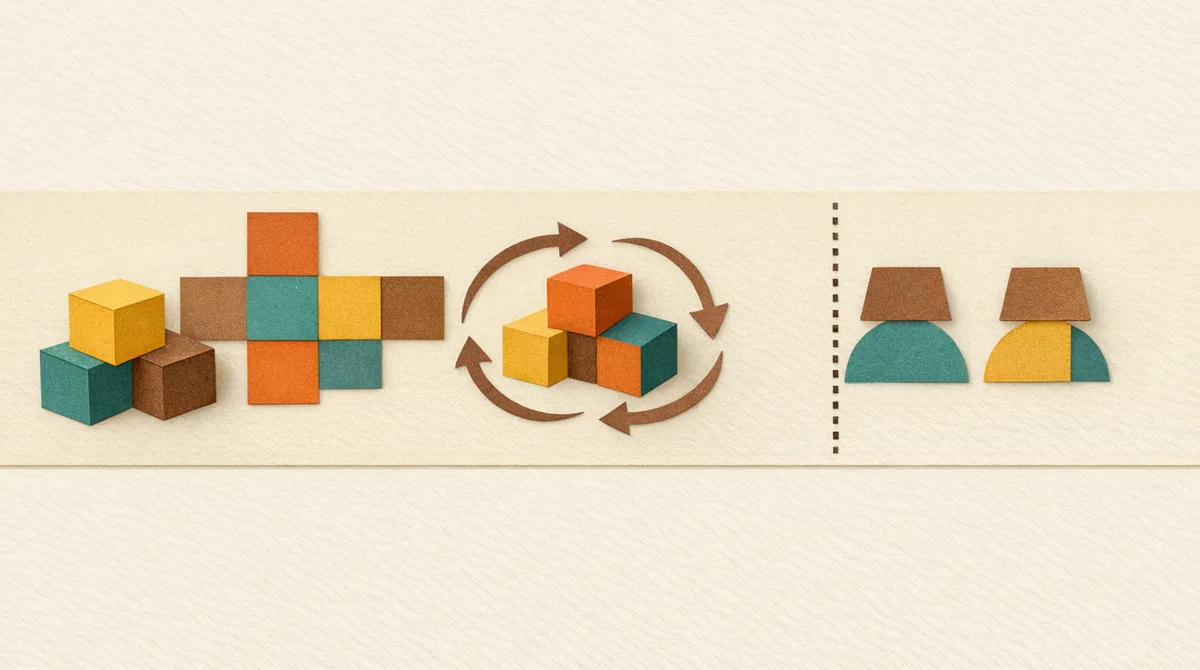
Spatial reasoning questions ask a child to picture shapes and how they might move, turn or fit together. The exact question types and exam rules depend on the school or local authority. This guide covers six question types with examples and methods, then compares current guidance from Buckinghamshire, GL Assessment, ISEB and Bexley.
For Buckinghamshire's 2027 entry test, the current familiarisation booklet says candidates may use rough working in the question booklet, but not on the answer sheet. It lists two HB pencils and an eraser as permitted equipment, and says scrap paper, rulers, calculators and protractors are not allowed. Check the current instructions for your own test before practising with equipment.
What a spatial reasoning test actually measures
Spatial reasoning is the ability to picture a shape and move it around in your head. Rotate it, flip it, fold it, look at it from a different side, or imagine what it would look like assembled from flat parts. A question may ask for mental movement or comparison of shapes; the exact task depends on the assessment.
Buckinghamshire's current familiarisation booklet describes non-verbal reasoning as finding rules and relationships between shapes and patterns, and spatial reasoning as manipulating shapes and space mentally. These skills overlap, but the examples on a particular test depend on its published format.
Six question types, with examples and methods
The examples and methods below illustrate different ways a question can use shapes. They are not a prediction of which types will appear on a particular test. Where a worked question is given, try it before reading the answer.
1. Cube nets
A flat net is made of four squares in a horizontal row, labelled A, B, C and D from left to right. A fifth square, E, sits directly above B. A sixth square, F, sits directly below B. When the net is folded into a cube, which face is opposite A?
Answer: C. For this net, folding the strip around the cube places A opposite C and B opposite D. So A pairs with C, and B pairs with D. That leaves E and F, the two squares hanging off the strip, as the remaining opposite pair. For this net, you can track how the four-square strip wraps around the cube.
To test the strip rule on a net of your own, switch on six squares below and check whether it folds into a cube. Once it does, tap any square to see which square ends up opposite it.
This part of the guide lets you build a net from six squares and check whether it folds into a cube. It works in your browser.
2. Hidden shapes
In a hidden-shape question, a target such as a right-angled triangle is shown beside busy line drawings. The task is to find an exact match within a drawing.
Method: Buckinghamshire’s booklet says the hidden shape must be the same size as the target, may be rotated, and must have all its sides visible. Both conditions matter: a scaled-up copy is wrong, as is a triangle whose third side is only implied. This helps distinguish a complete match from a shape with a missing side.
3. Figure analysis (fold and punch)
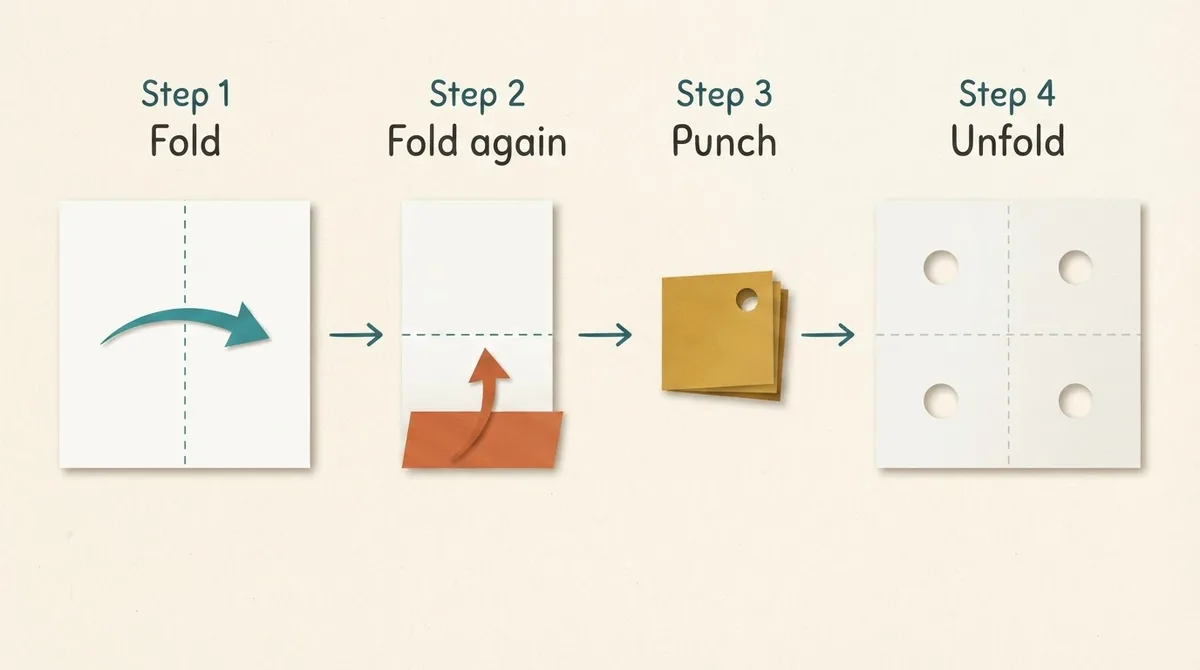
A square sheet is folded in half from left to right, then folded in half again from bottom to top. One small hole is punched through all four layers, away from every fold and edge. How many holes are in the paper when it is opened out?
Answer: four. With the punch away from the folds and edges, unfolding each fold doubles the separate holes: one, then two, then four. The positions mirror across each fold line in turn, which is why the four holes sit symmetrically, one per quarter. Check the folding direction and punch position as well as the number of layers. A punch on a fold or edge can give a different result.
Try a fold and punch now: predict the holes, then open it out to check.
This part of the guide is a short interactive exercise. It works in your browser.
4. Rotation and reflection
An L-shape stands upright with a small dot in the corner of its foot, at the bottom right. It is rotated 90 degrees clockwise. Where is the dot?
Answer: bottom left. The reliable trick is to track a single feature rather than the whole shape. Under a clockwise quarter turn, bottom right travels to bottom left, bottom left goes to top left, and so on. Rotation preserves handedness; reflection reverses it. If an answer option looks right but the shape reads back to front, it is a reflection posing as a rotation.
5. Block counting
A solid stack is built on a three by three base. The bottom layer is complete. The middle layer has cubes on one full row of three. The top layer has one cube sitting on the middle of that row. How many cubes in total?
Answer: thirteen. Nine plus three plus one. Count by layer, including cubes that support those above them but are hidden from this view.
Try a block count now, including the cubes you cannot see.
This part of the guide is a short interactive exercise. It works in your browser.
6. Shape combination
Imagine two flat pieces: a square with a semicircular bite taken out of its right edge, and a semicircular tab of the same size. If the tab fills the bite, the outside outline returns to a square. In a multiple-choice question, compare the outlines and check whether joining the pieces leaves a gap or overlap.
If those felt unfamiliar, the wider pattern-and-rule side of the paper is worth working through as well. Our pillar guide to non-verbal reasoning question types walks through several non-verbal question types with worked examples.
Spatial reasoning and non-verbal reasoning: labels vary
The label varies across assessment materials. Buckinghamshire includes spatial reasoning within non-verbal skills; GL Assessment uses the term in its non-verbal practice-pack description; ISEB names Spatial Reasoning within its current non-verbal framework; Bexley's current guide describes its non-verbal assessment without naming a separate spatial section. These examples do not establish what every test contains. Check the target school's or authority's current materials.
A decision guide: does your child need to revise it separately?
Work out which of these four situations you are in, then act accordingly. Formats differ by region and change from year to year, so always check your own area's current arrangements.
If your child is sitting the Buckinghamshire Secondary Transfer Test. The Council's current process page says there are two papers: verbal skills, and mathematics and non-verbal skills, which include spatial reasoning. The familiarisation booklet gives examples of hidden shapes and figure analysis among its non-verbal sections. Practise from that current material rather than assuming every provider uses the same format.
If your child is using GL Assessment practice materials. GL's non-verbal reasoning practice-pack page includes spatial awareness, rotation, reflection and symmetry in its description of practice content. This describes GL's practice packs. The format of a local test using GL materials can vary, so check its own instructions.
If your child is sitting the ISEB Common Pre-Tests. ISEB's current test framework names Spatial Reasoning within Non-Verbal Reasoning and describes manipulating 3D figures and diagrams. It also describes English, mathematics and verbal reasoning assessments. Check the current framework and the school's own admissions information; our ISEB Common Pre-Test guide gives a broader overview.
If your child is sitting a local test from a different provider. Check the wording. The Bexley Selection Test, for example, is provided by Quest Assessments rather than GL Assessment. It runs as two booklets of timed multiple-choice questions, each around 50 minutes plus instructions, with the whole session lasting roughly two and a half to three hours, and its non-verbal element is described as assessing the ability to recognise patterns, understand relationships between objects and make logical deductions. This guide describes the non-verbal element through patterns, relationships and logical deductions; it does not label a separate spatial section.
What the official booklet reveals about exam day
For Buckinghamshire's 2027 entry test, the current booklet gives these specific instructions. The Council's process page describes each paper as about 45 minutes of test time, with up to 60 minutes including introduction and examples. Within the mathematics and non-verbal paper, the booklet describes four non-verbal sections with five minutes for each section after practice questions. These timings are specific to this test cycle, not a general 11+ rule.
An audio soundtrack sets the pace. Instructions are delivered by recording, and the child cannot slow it down or rewind it. Some sections require two answers to be marked rather than one, which is why the booklet warns pupils to read the instructions carefully in each section.
The answer sheet is machine marked. Answers must not be crossed out, and no working may be written on the answer sheet at all.
Getting stuck has an official answer. The booklet advises pupils to leave a difficult question, continue through the section and return to it if time remains. A child can practise following that instruction during familiarisation, while checking the timings and rules for their own test.
Using sketches and rough working in test practice
Test conditions differ. In Buckinghamshire's current booklet, candidates may use the question booklet for rough working but may not write on the answer sheet; separate scrap paper is not allowed. Other tests may set different rules. Practise the reasoning method that suits each example, and follow the target test's equipment and answer-sheet instructions.
How to practise with physical nets at home
Paper nets and small blocks can make shape relationships easier to handle while learning. They are optional ways to explore the ideas, not a guarantee of transfer to a test.
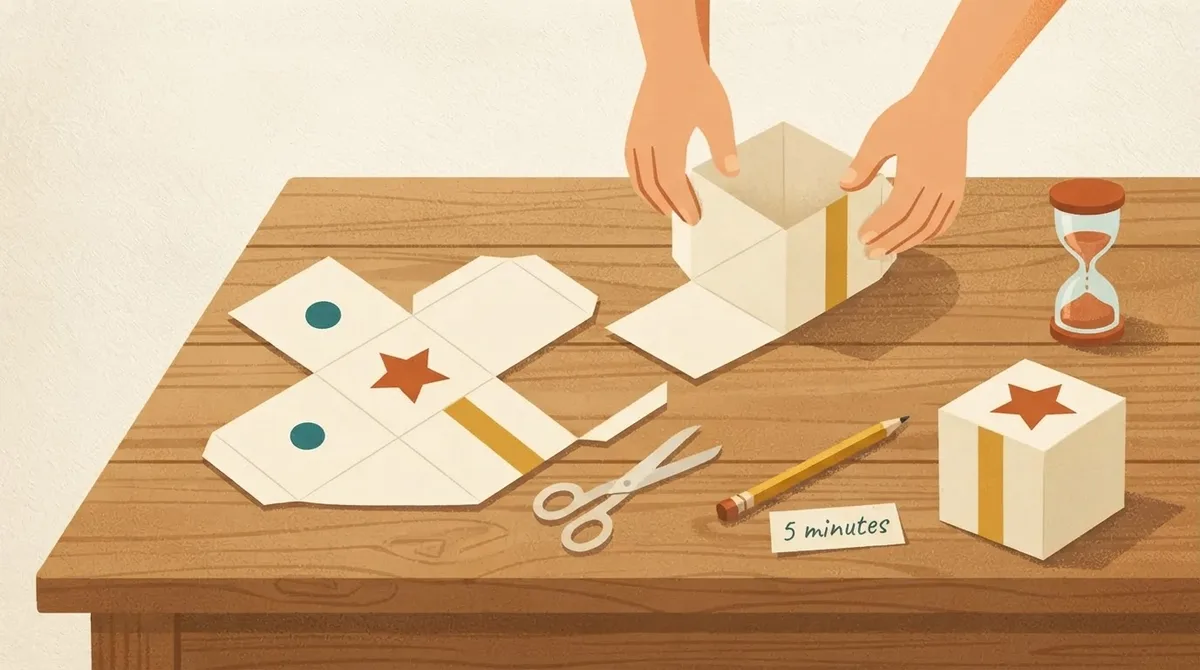
- Cut out a cube net from card. Mark three faces with a dot, a star and a stripe. Before folding, ask your child which face will end up opposite the star. Then fold and check.
- Try another net, asking for a prediction before folding and then checking it.
- Fold a square of paper twice, punch a single small hole through all four layers away from folds and edges, and ask your child to draw the unfolded result before opening it. This is one way to explore the fold-and-punch idea.
- Build small stacks from wooden blocks or sugar cubes, photograph them from one angle, then ask for the total count from the photo. This gives practice in counting cubes that are hidden from that viewpoint.
- For timed practice, use the instructions and timing of the target assessment. Do not assume every test uses five-minute sections or the same paper rules.
When your child is ready for a practice paper, follow its own timing and equipment rules. Our guide to 11+ mock exams explains ways to use a mock without treating it as a prediction of a future result.
Checks to make in these examples
- Choosing a hidden shape that is the right shape but the wrong size. In Buckinghamshire's familiarisation example, the shape must be the same size, though it may be rotated.
- Accepting a hidden shape with a missing side. Buckinghamshire's booklet says all sides of the target must be visible in the diagram.
- Confusing rotation with reflection. If the answer looks correct but reads back to front, it is a mirror image and it is wrong.
- Counting only the visible blocks. Any cube supporting another cube must exist, even if the picture never shows it.
- Spending too long on one question. Buckinghamshire's booklet advises moving on when stuck and returning if time remains in the section.
These checks apply to the examples above. For a particular test, use the question types and instructions in its current familiarisation material.
Frequently asked questions
Is spatial reasoning the same as non-verbal reasoning? Not quite. Non-verbal reasoning is about spotting and applying rules between shapes and patterns. Spatial reasoning adds the requirement to picture a shape and move it in your head. The terminology and coverage vary by assessment. Our 11+ non-verbal reasoning overview explains how the two sit together on a real paper.
Can my child practise spatial reasoning? Yes. The examples here let a child practise component skills such as tracking a rotation or folding a net. They do not predict an individual result or how practice transfers to an assessment.
Are cube nets the most important question type? The Buckinghamshire booklet includes examples such as hidden shapes and figure analysis. Use the examples in your target test's familiarisation materials to guide practice; this article's six examples are illustrative.
How long should we spend on it each week? There is no single weekly practice schedule that suits every child. Keep practice manageable and use breaks when attention drops.
Where do I check what my child's actual exam contains? Your local authority or school admissions page, and the test provider's own material. Anything else, including this article, is secondary. If you are planning the year, our 11+ preparation plan offers general planning guidance.
Topics
- spatial reasoning
- non-verbal reasoning
- 11 plus
- cube nets
- exam technique