


Non-Verbal Reasoning in the 11 Plus: Format, Timing and Marks
Non-verbal reasoning is not one test, and in some areas it is not tested at all. Here is where NVR appears region by region, how long each section runs and what share of the score it carries.
 Elspeth Marlow
- 13 min read
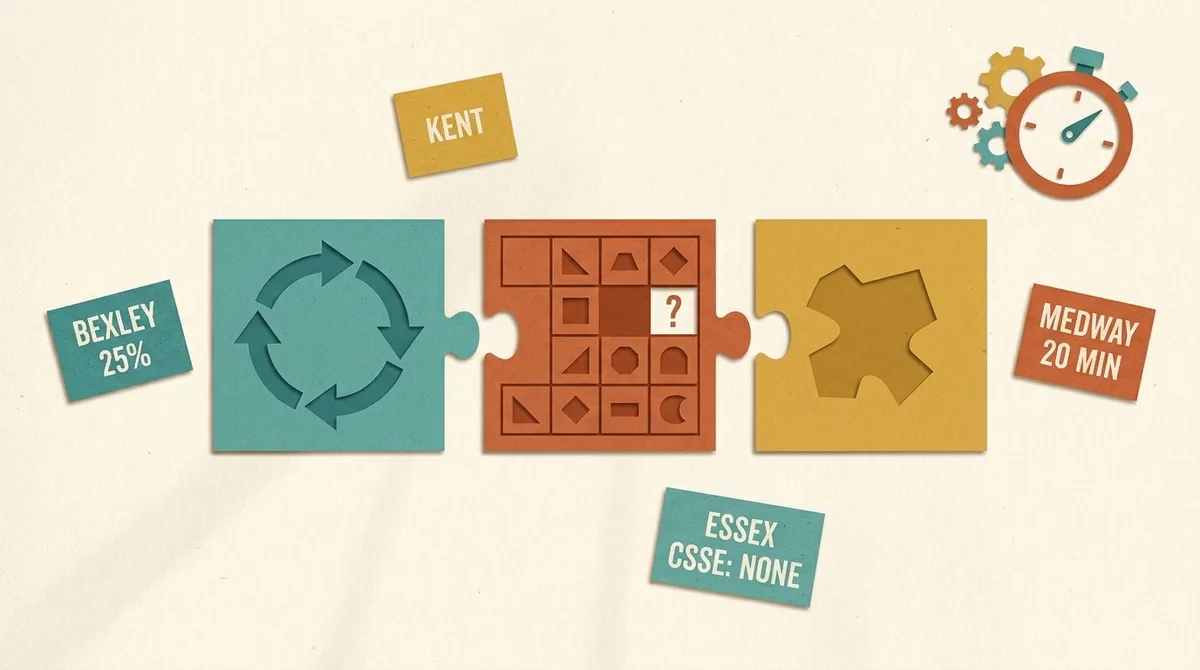
Non-verbal reasoning is not one national test with a fixed format. Before choosing practice, check three things: Is non-verbal reasoning even in my child's test? Where does it sit in the paper? And how much of the final score does it carry?
The honest answer is that NVR is not one test. For September 2027 entry, Essex's CSSE test has English and Maths papers and no non-verbal reasoning. In Bexley, NVR is a quarter of the weighted score. In Buckinghamshire it is not a paper of its own: it appears in the Mathematical and Non-Verbal Skills paper in four five-minute sections paced by audio. Kent's 2026 sitting for September 2027 entry has individually timed NVR sections. Kent County Council has announced that Quest Assessments will deliver its test for September 2028 entry, with the council saying the structure, timing and purpose will stay the same; it also notes question design may differ. GL Assessment's free-materials page cautions that local test timings and question counts may differ from its practice papers.
This guide is a playbook rather than an explainer. It works in seven steps: confirm whether your region tests NVR, find where it sits on the paper, train the section clock instead of the paper clock, learn the question families, rehearse the answer sheet, convert the weighting into practice hours, and read the standardised score properly. If you want the underlying skill work, our 11+ non-verbal reasoning guide covers the solving method itself.
Step 1: Confirm whether your region tests NVR at all
Start here, because a surprising number of families prepare for a section their child will never see. Check the admissions authority or consortium page for the specific schools you are applying to, not a national summary. What the official sources currently say:
- Essex (CSSE): no non-verbal reasoning. "The candidates sit two tests. One in English and one in Mathematics." The English paper is sixty minutes with ten minutes of additional reading time, and Maths is sixty minutes. From September 2024 (the 2025 entry) onwards, the English paper no longer contains Applied Reasoning questions. Source: csse.org.uk.
- Bexley: yes, and heavily weighted. The selection test assesses verbal ability and English comprehension, numerical reasoning, and non-verbal reasoning, sat as two booklets of roughly fifty minutes each. Source: bexley.gov.uk.
- Kent: yes, inside a reasoning paper. For September 2027 entry, the Kent Test uses an English and maths paper of about an hour and a reasoning paper of about an hour, the latter containing verbal reasoning and individually timed non-verbal reasoning sections. Kent says its new provider, Quest Assessments, will deliver the test for September 2028 entry; the council says the structure and timing are staying the same. Sources: Kent County Council, Kent's provider announcement.
- Medway: yes, sharing a paper with verbal reasoning. The Medway Test is three papers: English (30 minutes), Mathematics (50 minutes) and Reasoning (45 minutes). The reasoning paper covers spatial, non-verbal and verbal reasoning. Source: medway.gov.uk.
- Buckinghamshire: yes, bundled with maths. The Secondary Transfer Test uses two booklets. One tests verbal skills; the other contains questions testing non-verbal and mathematical skills.
- Other areas: formats differ. Check the current admissions guide for each school; do not infer a subject or weighting from another consortium.
Regional variation is the rule, not the exception, and areas review their arrangements. Treat the list above as a prompt to check your own authority's current page rather than as a substitute for it. Our parent guide to the 11+ explains how admissions authorities, consortia and individual schools differ.
Step 2: Find where NVR sits on the paper
Once you know NVR is in, find its container. There are three shapes, and they demand different preparation.
- Standalone NVR paper. Some independent-school entrance tests use a separate NVR paper. Check the school's own guide for its paper structure and timing.
- A section inside a reasoning paper. Kent and Medway both work this way. In Medway, the 45-minute reasoning paper splits into 20 minutes for spatial and non-verbal reasoning and 25 minutes for verbal. In Kent, the non-verbal reasoning portion is roughly the same length as the verbal portion.
- A section inside a mixed subject booklet. Buckinghamshire puts non-verbal and spatial reasoning in the same booklet as maths. The whole booklet takes around an hour, with the maths section taking 25 minutes plus five minutes of practice.
This matters because it determines what a useful practice set might look like. A child in Medway who only practises NVR questions has not rehearsed the switch between the spatial/non-verbal and verbal sections in the reasoning paper.
Step 3: Check whether your test uses section timing
Where a test uses short individually timed sections, a single long timer does not reproduce that section timing. Check the local instructions before choosing a practice format.
In Buckinghamshire, the non-verbal and spatial reasoning portion is divided into smaller sections. Each starts with a chance to practise a few questions guided by audio instructions, and after that the child has five minutes to complete each section. Kent states that its non-verbal reasoning will be split into short sections, administered and timed individually.
In a section with its own timer, time remaining in another section cannot be transferred. Short sections also leave less time to recover within that section. Follow the exact instructions for the local test.
How to rehearse it. Set a kitchen timer for five minutes. Give your child a block of ten to fourteen NVR questions of one type. When the timer sounds, pens down, no exceptions, and mark it. Then reset and run a different question type if useful. This exercise is intended to familiarise a child with short timed blocks; it is not evidence that the routine improves a test score. If you want scored versions of this shape, our mock tests run sectioned timing rather than one long clock.
For illustration, a five-minute block with twelve questions allows an average of 25 seconds per question, including reading. Actual sections may differ. If practice is consistently unfinished, first check the local format and ask the teacher or provider what practice material matches it; a slower pace alone does not establish the cause or the right intervention.
To work out the section clock for your child's paper, enter the section's minutes and questions below.
This part of the guide works out seconds per question and checkpoints for a timed paper. It works in your browser.
Step 4: Question families and spatial reasoning
Buckinghamshire's familiarisation booklet groups non-verbal and spatial reasoning within one paper and includes both relationship/pattern questions and tasks involving moving shapes in your head. The distinction can be useful when choosing practice, but labels vary between tests and publishers. Its examples include series, classes, codes and spatial tasks.
Common practice materials may include question families such as:
- Odd one out / classes. Four or five figures share a rule; one breaks it. Original example: four tiles each contain a shaded shape with an even number of sides, and a fifth contains a shaded triangle. Sides, not shading, is the rule.
- Analogies. A is to B as C is to what. Train the habit of naming the transformation in words before looking at the options: "rotated ninety degrees clockwise and the shading swapped".
- Matrices. A grid with one cell missing. Read across the rows first, then down the columns, and check whether the rule is cumulative (elements adding) or transformational (a shape turning).
- Codes. Figures are labelled with two-letter codes; you deduce which feature each letter position encodes. Original example: shapes labelled AX, AY, BX, BY where the first letter tracks outline shape and the second tracks shading.
- Series and sequences. A row of figures progressing by a rule, often rotation combined with a counter that increments.
- Hidden shapes and nets (spatial). Which option contains the target shape embedded in it, or which cube folds from this net.
Question counts vary by test. Use the current guidance from your school or admissions authority rather than assuming a publisher's practice paper matches your test. Our guide to NVR question types with worked examples lists examples, but it cannot establish that every family appears in a particular local test.
The practice test below is a short set of original questions. It includes examples of net folding, shape transformations and analogy grids; it does not cover every family discussed above. It shows a worked answer for each item afterwards.
This part of the guide is a free timed practice test. It works in your browser.
Step 5: Rehearse the answer sheet, because it costs real marks
Some tests use computer-marked answer sheets. Their instructions matter, and a child should practise the answer method for the test they will actually sit.
Buckinghamshire's familiarisation booklet is unusually specific. Follow the matching test's own instructions, since answer-sheet rules are not universal:
- Answers are marked by drawing a thin line with a pencil through the small rectangular box beside the correct answer, on a separate answer sheet, one per booklet.
- The sheets are marked by a computer. The booklet says the answers are read by computer, so pupils should follow its marking instructions.
- Do not cross out answers on the answer sheet, because the computer will not be able to mark them. Changing an answer means erasing it cleanly, which is why an eraser is on the equipment list.
- Check whether a question asks for more than one answer. The booklet's instructions and each question determine how many boxes to mark.
- Equipment allowed is two HB pencils and an eraser, in a transparent bag or pencil case. A ruler, calculator, protractor, scrap paper, watch and phone are not allowed.
- Rough working goes in the question booklet, never on the answer sheet.
Bexley gives a similar direction for its own test: all working out must be done in the test booklet, as rough paper will not be provided. Check each authority's materials for its permitted equipment and answer-sheet rules.
A five-minute drill worth doing twice. Print a blank grid of lettered boxes. Read out fifteen answers at a brisk pace and have your child mark them with a single clean pencil line. Then read out three corrections and make them erase and re-mark. Time the whole thing. This is an optional rehearsal; use the local booklet if its answer method differs.
Step 6: Convert the weighting into practice hours
How much NVR practice is worth doing depends entirely on what share of the score it carries, and this is where regional detail pays off.
- Bexley publishes its weighting. Age-standardised scores are combined as 50 per cent verbal ability, 25 per cent numerical reasoning and 25 per cent non-verbal reasoning. The average total is 200, and roughly two-thirds of candidates score between 170 and 230. The published weighting is one factor to consider when planning practice; it does not prescribe a number of home-study hours.
- Some verbal-plus-non-verbal routes use those reasoning subjects in their selection score. School policies and score calculations differ, so do not assume NVR is exactly half of the result; check the current admissions rules for each school.
- Kent reports three standardised scores, English, maths and reasoning, plus a total aggregate. NVR is a component of one of three reported scores, so it is meaningful but diluted by verbal reasoning within the same paper.
- Medway publishes the paper structure and timings. Its current public test page does not state a weighting between the reasoning paper’s spatial/non-verbal and verbal sections. Check current admissions information rather than assuming that test time equals score weighting.
- Essex CSSE: zero hours. If your only target schools are CSSE consortium schools, NVR practice has no marginal value on the test itself.
A published weighting is one factor in planning practice, alongside your child's needs, the other subjects and the time available. It does not convert directly into a required share of home-study hours. Progress tracking can display results over time; it does not set a practice allocation.
Step 7: Read the standardised score properly
Some admissions authorities report standardised results rather than raw marks. GL Assessment describes the Standard Age Score as an age-normed scale with a mean of 100 and standard deviation of 15; use the guidance for the test your child takes.
That means, per GL's own documentation:
- Approximately two-thirds of pupils score between 85 and 115.
- Approximately 95 per cent score between 70 and 130.
- The age-standard score takes age into account using GL’s stated age norms. A pupil’s age may therefore affect the score derived from a raw mark; do not assume a fixed raw-to-standard conversion.
There is no national "good" NVR score or universal qualifying mark. A selective authority may use a local standard or combine scores, so check the current admissions rules for each school. Treat any claimed universal NVR pass mark with caution.
Official practice material, and why it will not match exactly
GL's free materials page and your own authority's familiarisation booklet can show sample question styles and instructions. The local authority material is the best source for its own test format. If you choose commercial papers, check their instructions against the current local guide.
But read GL's own caveat: the exact timings for, and number of questions in, your local 11 plus test may differ from its practice materials. Familiarisation booklets show layout, instruction wording and answer-sheet mechanics faithfully. Commercial papers give you volume. Neither gives you your local weighting. Use paper tests for additional practice, and compare their format with the current official booklet.
Frequently asked questions
Is non-verbal reasoning part of the 11 plus? Sometimes. It is 25 per cent of the published Bexley weighting and is included in the current Buckinghamshire, Kent and Medway formats described above. Other areas vary. It is absent from the CSSE test for September 2027 entry, which has English and Maths papers only. Check your own admissions authority before spending a single hour on it.
How long is the NVR section? It depends on the container. Medway gives 20 minutes to spatial and non-verbal reasoning inside a 45-minute reasoning paper. Buckinghamshire runs it in five-minute blocks inside an hour-long booklet. Kent times its non-verbal sections individually. There is no single national duration.
What is the difference between non-verbal and spatial reasoning? Non-verbal reasoning asks you to handle unfamiliar visual information without words. Spatial reasoning adds a mental manipulation element: picturing a shape and moving, folding or rotating it in your head. Hidden shapes, nets and 3D rotation questions are spatial; classes, matrices and codes are non-verbal.
Can my child cross out a wrong answer on the answer sheet? No. On computer-marked sheets, crossed-out answers cannot be read by the scanner. The correct procedure is to erase cleanly with the eraser and mark the new answer, which is why an HB pencil and eraser are on the equipment list.
Does doing full-length timed papers help? It depends on the local test. If sections are individually timed or audio-paced, short blocks can reproduce that timing more closely; full papers may be useful for practising a longer sequence. Check the test’s own familiarisation material.
How much should we practise if our area weights NVR at 25 per cent? The weighting tells you how NVR contributes to that school's score, not how much time each child should study. Use the school's current format and familiarisation material, then plan around your child's needs and the time available. Our year-by-year preparation plan sets out options for planning practice.
Topics
- nvr
- 11 plus
- non-verbal reasoning
- gl assessment
- exam format