


11 Plus Verbal Reasoning Questions with Answers
Try 26 original 11+ verbal reasoning questions with worked answers, 10 mixed questions and a free timed test. Learn the method behind each question type.
 Elspeth Marlow
- 14 min read
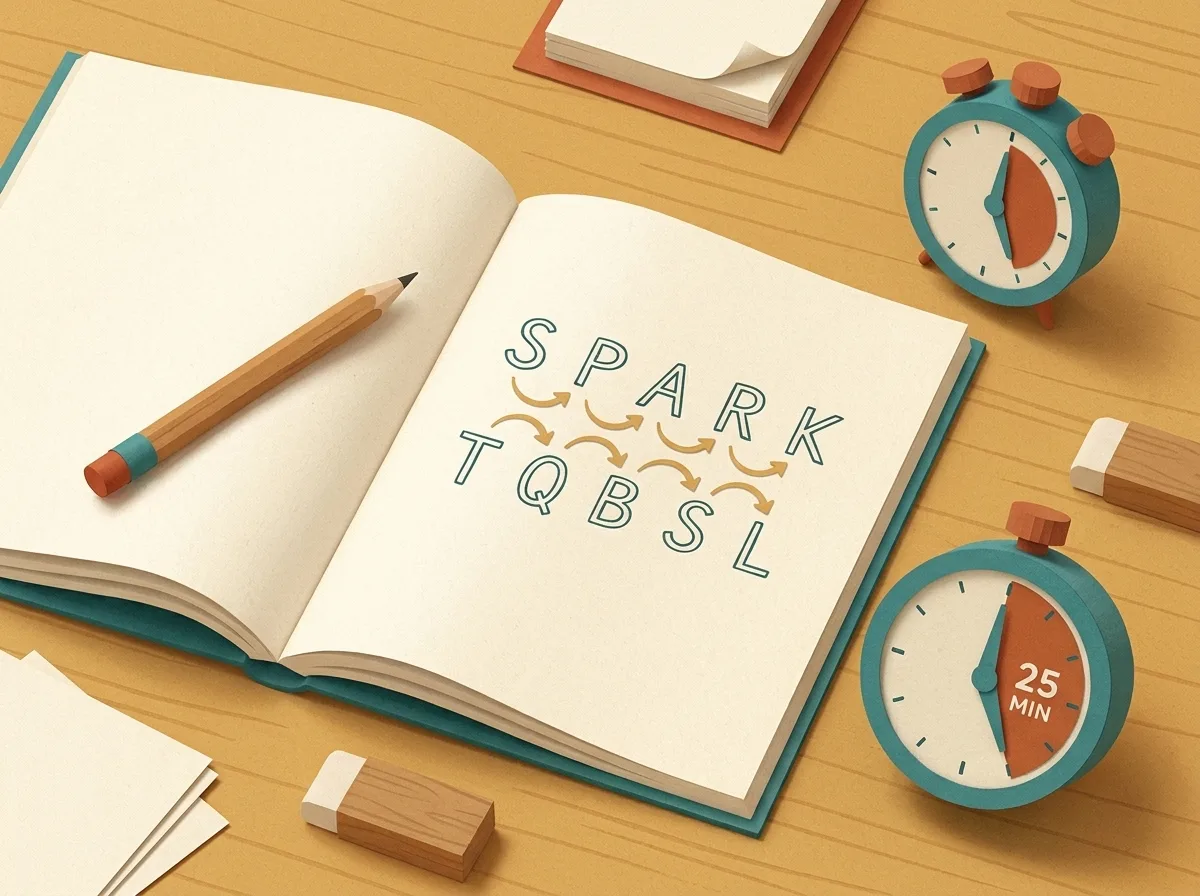
This guide has 26 original 11+ style verbal reasoning questions with worked answers, followed by 10 mixed practice questions and a free 12-question practice test. The examples cover letter codes, sequences, hidden words, word meaning and short logic puzzles.
Try one now: CAT is written as DCW. How is DOG written in the same code? The answer is EQJ. The first letter moves forward one place, the second two places and the third three places: D becomes E, O becomes Q and G becomes J. Question 3 below explains the method.
Check your child's actual test before choosing practice. GL Assessment says schools and local authorities decide which subjects and question types appear, so a question bank cannot stand in for your area's current familiarisation material.
How to use this question bank
Choose a question family or a few examples to begin. Give your child one question on its own, cover the answer, and let them write a response before revealing anything.
When an answer is wrong, compare the method with the worked explanation and ask which step changed the result. When an answer is right, check that the method also fits the example. A correct guess does not show whether the rule was understood.
If you are not yet sure which family is hurting, our verbal reasoning question types explainer defines each format first. This page is what you work through once you know.
What verbal reasoning means in the 11+
GL Assessment describes verbal reasoning as using written information to think logically and solve problems (GL Assessment 11+ FAQs). In 11+ tests, the subjects and question types depend on the area and school. This page uses short practice puzzles with letters, words and simple logic; check the current local test guide for its format and timing.
Some adult aptitude tests use reading passages and true, false or cannot-say questions. The examples here practise a different set of 11+ style puzzles, such as letter codes, sequences, hidden words and odd-one-out questions. Check which formats appear in your child’s own test before choosing practice.
GL also publishes free familiarisation material, including a verbal reasoning familiarisation paper, precisely because children may never have met these question types before (GL free materials). Use those materials alongside your local authority or school guidance. Their examples and timings may differ from this original practice set.
How local 11+ tests use verbal reasoning
Before you drill anything, find out what is on the paper. GL confirms that 11+ tests vary from area to area and that local authorities or individual schools decide which subjects are tested and the balance of question types within them. These examples describe the current 2027-entry arrangements published by the named authorities; check their pages again before relying on a later cycle.
- For 2027 entry, if your child sits the Medway Test, verbal reasoning is a timed block inside a larger paper. The test is three papers (English, Mathematics and Reasoning), and the 45-minute Reasoning paper splits into 20 minutes of spatial and non-verbal reasoning and 25 minutes of verbal reasoning, with GL writing the tests specifically for Medway Council (Medway Council). The council page gives two practice questions but does not list the number of marked verbal reasoning questions, so it cannot support a standard seconds-per-question figure.
- For 2027 entry, if your child sits the Buckinghamshire Secondary Transfer Test, verbal reasoning is folded into a verbal skills paper alongside comprehension and technical English. Every question is multiple-choice, each paper runs about 45 minutes (60 including introduction and examples), and answers go onto a separate answer sheet (Buckinghamshire Council). Practise the transcription, not just the reasoning.
- For 2027 entry, if your child sits the West Midlands Grammar Schools Entrance Tests, verbal reasoning is its own named section, sitting alongside English, Non-Verbal Reasoning and Mathematics, in a multiple-choice format across two tests of around 60 minutes each (Warwickshire County Council). This test names verbal reasoning as one of its four sections.
- For 2027 entry, if your child sits the CSSE Essex 11+, these verbal reasoning puzzles are not part of its English and Mathematics papers. CSSE says Applied Reasoning was removed from the English paper with the September 2024 test for 2025 entry (CSSE). Use its own familiarisation papers rather than treating this bank as CSSE exam practice.
If you are unsure which board your area uses, start with our comparison of GL, CEM and ISEB, then confirm against your own council's admissions page, because arrangements change year to year.
Codes: letter codes and number codes
For a code question, write down what changes in the example before applying the rule to a new word.
1. SPARK is written as TQBSL. Write BLAME in the same code. CMBNF. Every letter moves forward one place. If you get a different answer, check the direction of each shift against the example.
2. MOUSE is written as NNVRF. Write TIGER in the same code. UHHDS. The shifts alternate: forward one, back one, forward one, back one, forward one. A different answer may come from applying the first shift throughout; compare every position with the example.
3. If CAT is written as DCW, write DOG in the same code. EQJ. The shift grows with position: plus one, plus two, plus three. If you get EPH, you may have used the same shift for every letter instead of increasing it by position.
4. BEND is 2537 and DENY is 7534. What is BENDY? 25374. Match letter to digit across both words first: B is 2, E is 5, N is 3, D is 7, Y is 4. Children who answer 25344 mapped D to 4 because D is the fourth letter of the alphabet, importing a rule the question never gave.
5. Using alphabet positions, DOG is 4 15 7. What is CAT? 3 1 20. Count A as 1, as the alphabet positions in the question do.
Letter sequences, letter series and letters for numbers
In many letter sequences, positions follow a pattern. Compare each position across the examples before filling the gap.
6. AZ, BY, CX, D?. W, completing the pair DW. The first letter runs forwards and the second runs backwards. Children who put Y in the gap spotted the plus one in the first half but missed the second letter moving the other way.
7. CE, GI, KM, O?. Q, completing the pair OQ. Inside each pair the gap is two; between pairs the jump is four. Children who put P in the gap applied the between-pairs step to the inside of the pair.
8. AB, DE, GH, JK, ?. MN. Each pair starts three letters after the last. Children who write KL simply continued the alphabet from the final letter shown.
9. ZA, YB, XC, ?. WD. Mirror pairs: one letter reversing, one advancing. Children who write WC moved only the first half of the pair.
10. If A = 2, B = 3, C = 4, D = 12 and E = 6, what is (D divided by B) plus A, given as a letter? E. Twelve divided by three is four, plus two is six, and six is E. Children who write 6 did every step correctly and lost the mark by answering with a number when the question asked for a letter.
11. If P = 5, Q = 2, R = 10 and S = 4, what is R divided by (Q times S), as a number? 1.25. Brackets first. Children who work left to right get 20, so make them circle the brackets before calculating.
Compound words, hidden words and word building
This family is where two options can both be real words. The winning habit is to test every option to the end rather than stopping at the first one that works.
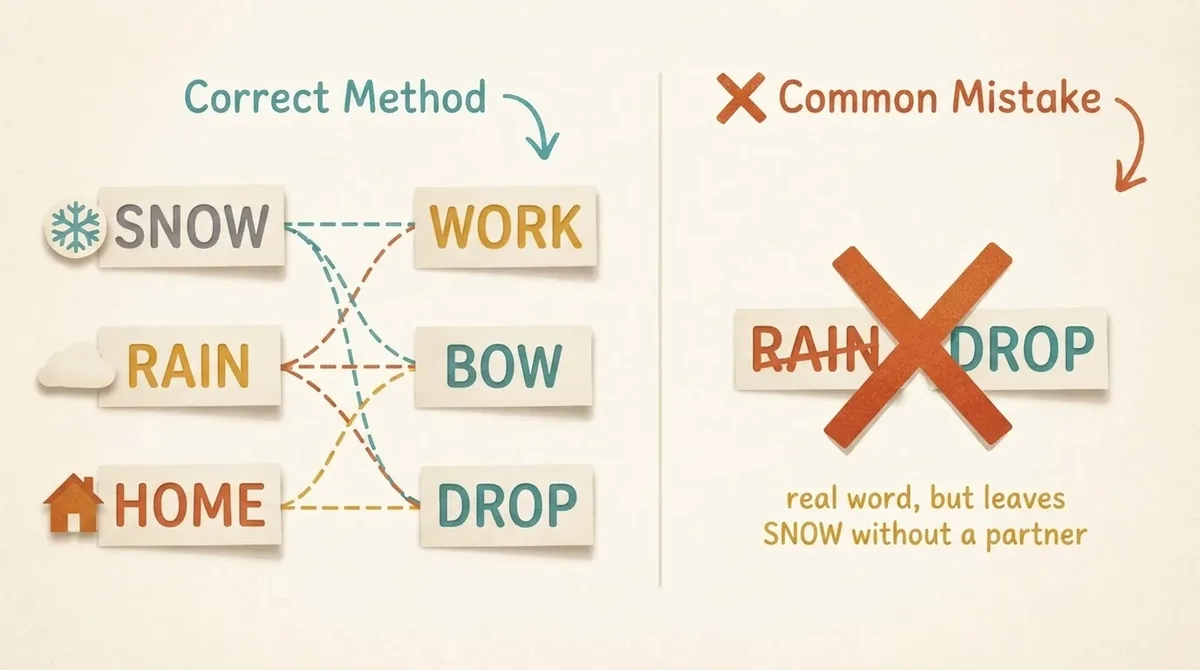
12. Pair each word on the left with one on the right so all three make compound words, using each word once: SNOW, RAIN, HOME with WORK, BOW, DROP. Snowdrop, rainbow, homework. For example, choosing raindrop leaves no word for snow. Check that all three pairings work before settling on a set.
13. Which word goes in front of all three: ___ball, ___print, ___path? Foot. Hand can form handball and handprint, but not handpath. Foot forms all three words.
14. A four-letter word is hidden across the join of two words in this sentence: "We must open the gate." STOP, spanning must and open. Check the adjoining letters in the sentence: this example uses the end of "must" and the start of "open".
15. Move one letter from the first word to the second so both remain real words: CLAMP, HARM. Move the C: LAMP and CHARM. Moving the L makes CAMP but does not make a real word from HARM. Check that both results are words.
16. Add the same letter to the front of each to make three new words: OUR, ATE, EDGE. H, giving hour, hate and hedge. Try the same letter in all three words: a letter that works with OUR may not make a word with ATE or EDGE.
Word meaning: synonyms, antonyms, analogies and odd one out
Vocabulary questions are decided by relationship, not by association. Ask what the link is, in words, before choosing.
17. Choose one word from each group that is closest in meaning: (brief, lengthy, hasty) and (concise, wordy, rude). Brief and concise. Children who pick brief and hasty have chosen two words from the same bracket, which the instruction forbids even when the meaning feels close.
18. Which is most opposite in meaning to scarce: plentiful, cheap or hidden? Plentiful. Cheap can be associated with a price, but it does not mean the opposite of scarce.
19. Book is to library as painting is to what? Gallery. The relationship is the place where the thing is kept. Children answer artist, which is a genuine relationship but not the one in the first pair.
20. Odd one out: sofa, stool, bench, cupboard, chair. Cupboard, the only one not for sitting on. The intended group is items normally used for sitting; a stool and bench may invite other comparisons, but a cupboard is not normally a seat.
21. Find the two odd ones out: violin, cello, trumpet, viola, flute. Trumpet and flute, the only non-strings. The trap is answering with one word when the question asked for two, and it is a mechanical loss, not a knowledge gap.
For more closest-meaning practice, the quiz below asks for synonyms of ten words from our 11+ vocabulary word list, with the meaning shown after each answer.
This part of the guide is a short vocabulary quiz. It works in your browser.
Logic, following instructions and reading information
These questions are short comprehension puzzles. The rule is to use only what is written on the page.
22. Amir is taller than Beth. Beth is taller than Cara. Dev is shorter than Cara. Who is shortest? Dev. Write each comparison in the same direction: Amir is taller than Beth, Beth is taller than Cara, and Dev is shorter than Cara.
23. Sam, Priya and Rani each chose a different fruit from apple, pear and orange. Sam did not choose the apple. Priya chose the pear. Who chose the apple? Rani. Cross off as you go: Priya has the pear and Sam cannot have the apple, so Sam has the orange and the apple is Rani’s.
24. Write the third letter of PLANET followed by the first letter of MOUSE. AM. Count PLANET from the start: P is first, L second and A third. Then take M, the first letter of MOUSE.
25. A club meets every three days, starting on Monday. On which day is the third meeting? Sunday. Monday is the first meeting; the next is Thursday, then Sunday.
26. "All of the pupils in Class 6 walk to school. Jo walks to school." Must Jo be in Class 6? No. The statement does not work backwards. Real-world plausibility is the trap: the answer must follow from the sentence alone.
Checks to use when reviewing answers
As you review answers, check four things: whether the rule was applied in the right direction, whether it changes by position, whether all parts of a word question were checked, and whether the answer uses the form requested (for example, a letter rather than a number). These are checks for this practice set, not a ranking of mistakes across 11+ tests.
For timing, start with the rules for your own test. Medway Council allows 25 minutes for its verbal reasoning section, but does not publish a question count on that page, so it cannot tell you a reliable number of seconds per question. In practice, let your child write out the rule for a code or sequence, and move on if a word meaning question remains unclear. Use official familiarisation material and the published time limit when you practise a full paper.
Then add the mark nobody covers. Where questions are multiple-choice onto a separate answer sheet, as in Buckinghamshire, transcription is its own skill and its own risk. Practise filling the sheet, not just solving the question, and check every ten answers that the number on the sheet still matches the number in the booklet.
Mixed set under exam timing
If you want a short mixed challenge, try these ten questions without the type headings. You can set your own timer, but the duration is not an official test time limit.
- FROG is coded GSPH. Code BIRD. (CJSE)
- BD, FH, JL, ?. (NP)
- Which word goes in front of both ___light and ___flower? (Sun)
- Opposite of ancient: modern, ruined or rare? (Modern)
- Hidden four-letter word: "They rose at dawn." (Seat, hiding across "rose at".)
- Odd one out: oak, pine, tulip, birch, willow. (Tulip)
- Finger is to hand as toe is to what? (Foot)
- If A = 3, B = 6, C = 2, what is B divided by A, as a letter? (C)
- Move one letter: SPACE and TAR to make two real words. (Move the S: PACE and STAR)
- Ravi is older than Mia. Mia is older than Leo. Who is youngest? (Leo)
For question 5, the final two letters of "rose" and the first two of "at" make seat. Point to the exact four letters with your child; spotting the word elsewhere in the sentence does not meet the hidden-word rule.
Try a timed verbal reasoning practice test
The free test below gives your child 12 questions in 10 minutes and shows worked feedback afterwards. It is a short practice set, not a prediction of an official 11+ result. Review the question types they found difficult, then return to the methods above. For a full sitting, use the current familiarisation material and timings from your target school.
This part of the guide is a free timed practice test. It works in your browser.
Sharing practice with a class or tutoring group? Our free exercise embed page lets you choose a verbal reasoning activity and copy the HTML for your own website. Try the activity first and check that its question type matches the test your learners are preparing for. The embedded exercise links back to its original page so families can read the full explanation.
Topics
- verbal reasoning
- 11 plus
- gl assessment
- practice questions
- exam technique