


Non Verbal Reasoning Questions With Answers
Nine original non-verbal reasoning questions with explained answers, plus notes on possible distractors and how selected local tests are timed.
 Elspeth Marlow
- 13 min read
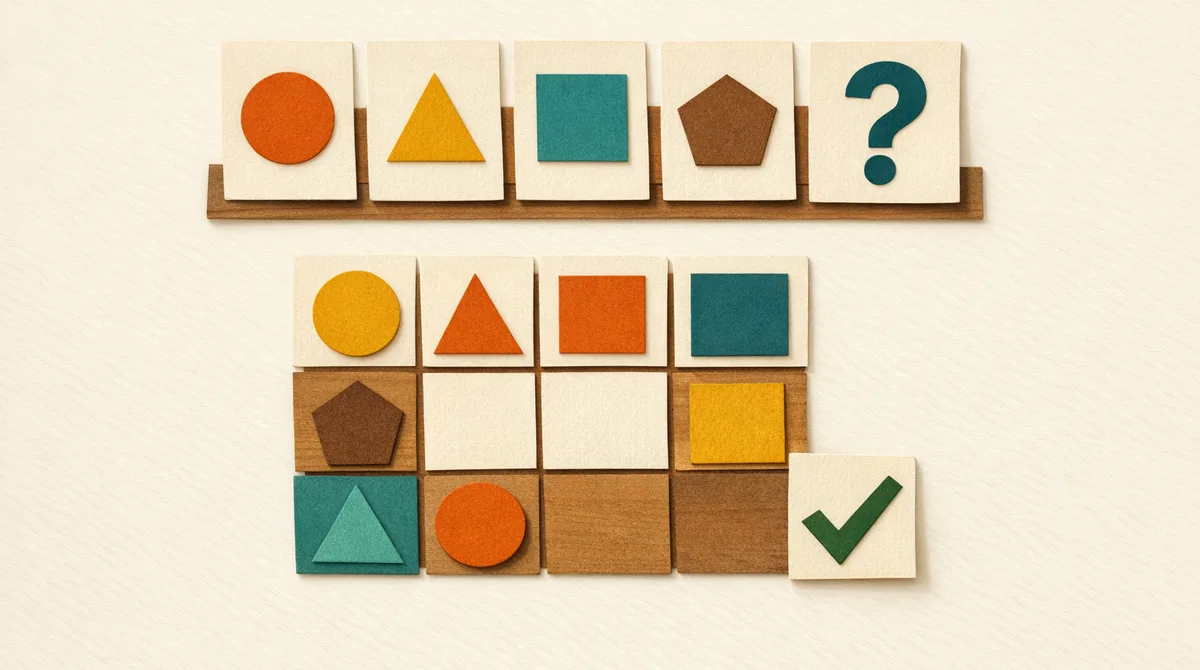
The worked questions below give you a chance to practise describing a rule and checking it against the answer options.
That is what this page is. Below are nine original non-verbal reasoning questions, written out in words so you can work through them together. They use examples from five categories shown in Buckinghamshire’s GL Assessment familiarisation booklet: series, classes like, codes, hidden shapes, and figure analysis (paper folding and hole punching). This is not a complete list of formats used by GL or other providers. Each one gives the rule behind its answer; some also discuss possible wrong turns.
The questions are described rather than drawn. Reading a description and picturing the shape is one way to practise visual reasoning, but these written examples are not a substitute for the format or instructions of a particular test. If useful, sketch the folding examples on scrap paper.
Myth: you need a practice paper before you can see a real question
Reality: A worked example can be a useful place to start. Use official familiarisation materials for the target test’s own format. Here is the shape of the thing.
Worked example. Four boxes in a row. Box 1 has a black dot in the top-left corner of a square. Box 2 has the dot in the top-right corner. Box 3 has it in the bottom-right. Box 4 has it in the bottom-left. Which option comes fifth?
- A: a square with a dot in the top-left corner
- B: a square with a dot in the top-right corner
- C: a square with a dot in the centre
- D: a square with two dots, top-left and bottom-left
- E: a diamond with a dot in the top-left corner
Answer: A. The dot moves one corner clockwise each step, so after bottom-left it returns to top-left. B is what you get if you lose your place and step twice. C invents a position that never appears in the sequence. D changes the number of dots, which no step does. E changes the outer shape, which also never changes.
That last paragraph is the part that matters. Reading "the answer is A" teaches your child one question. Comparing C and E with the sequence shows which feature each changes. You can use that comparison to explain these options.
Myth: non-verbal reasoning is one big blur of shapes
Buckinghamshire’s familiarisation booklet presents five categories for its test. Other tests may group or use question types differently. The Buckinghamshire familiarisation booklet, written by GL Assessment, sets them out with a worked example and two practice questions each: Series (page 16), Classes like (page 17), Codes (page 18), Hidden shapes (pages 19 to 20), and Figure analysis, meaning paper folding and hole punching (pages 21 to 22). You can read the whole thing in the official familiarisation booklet.
That booklet also gives a definition of what is being tested: non-verbal reasoning "tests your ability to apply rules and relationships to shapes and patterns and how well you can manipulate shapes and space in your head" (page 14).
This booklet is one example, not a universal taxonomy. If you want more worked examples, our guide to non-verbal reasoning question types goes deeper than this page does.
Series questions: complete the sequence
Question 1. Box 1: a white triangle. Box 2: a grey square. Box 3: a white pentagon. Box 4: a grey hexagon. What is fifth?
- A: a grey heptagon (seven sides)
- B: a white heptagon
- C: a white hexagon
- D: a white octagon
- E: a grey pentagon
Answer: B. Two rules run at once: the number of sides goes up by one each step, and the shading alternates white, grey, white, grey. Five must be seven-sided and white. A is the classic right-shape-wrong-shading trap: it satisfies one rule and ignores the other. C keeps the shading but freezes the side count. D advances the side count too far. E goes backwards.
Question 2. An arrow points north. In the next box it points east, then south, then west. Each time, the arrowhead alternates between solid black and hollow, starting solid. What is fifth?
- A: a solid arrow pointing north
- B: a hollow arrow pointing north
- C: a solid arrow pointing east
- D: a solid arrow pointing south
- E: a hollow arrow pointing west
Answer: A. The arrow turns ninety degrees clockwise per step, so the fifth points north again. Boxes 1 to 4 are solid, hollow, solid, hollow, so box 5 is solid. B gets the direction right and the shading wrong. C and D are correct shading with a mistimed rotation. E gets both wrong.
Classes like: shapes that belong together
These show a small group of figures that share a hidden property, and ask which option belongs with them. Odd-one-out questions are the same skill run backwards.
Question 3. The group is a symmetric arrowhead with one line of symmetry, a kite with one line of symmetry and a non-equilateral isosceles triangle with one line of symmetry. Which option has the same number of lines of symmetry?
- A: a square
- B: a non-square rectangle
- C: a plain block capital T with its stem centred below the top bar
- D: a non-rectangular parallelogram with unequal adjacent sides
- E: a circle
Answer: C. Each figure in the group has exactly one line of symmetry. The block T described here has one line of symmetry, down the middle. A square has four, the non-square rectangle two, the stated parallelogram none, and a circle has infinitely many. Notice that four of the five options are symmetrical in some way, so "it looks symmetrical" is not a rule. The rule is the number.
Question 4 (odd one out). Four figures, each a shape divided into equal parts with some parts shaded: a square with one of four parts shaded, a circle with two of eight shaded, a triangle with one of four shaded, a rectangle with two of six shaded. Which is the odd one out?
Answer: the rectangle. Three of the four are one quarter shaded. Two sixths is one third. Compare the fractions rather than the number of shaded parts: the first three are one quarter, while the rectangle is two sixths, or one third.
Code questions: matching shapes to letters
Question 5. Four shapes carry codes. A striped triangle is MP. A dotted triangle is MQ. A striped circle is NP. What is the code for a dotted circle?
- A: MP
- B: MQ
- C: NP
- D: NQ
- E: QN
Answer: D. Split the code into positions. The first letter encodes the outline: M for triangle, N for circle. The second encodes the fill: P for striped, Q for dotted. A dotted circle is therefore N then Q. E contains both correct letters in the wrong order.
Question 6. A small square with one line through it is RT. A small square with two lines is RU. A large square with two lines is SU. What is a large square with one line?
- A: RT
- B: ST
- C: SU
- D: TS
- E: RU
Answer: B. First letter is size (R small, S large), second is the number of lines (T one, U two). Large plus one line is ST. A, C and E are codes already given in the question, so they belong to other shapes.
Hidden shapes: finding the figure inside the pattern
Buckinghamshire’s booklet says the hidden target must be the same size and have all sides visible, though it may be rotated. Other test instructions may differ.
Question 7. The target is a small right-angled triangle. Which figure contains it?
- A: a pattern containing a right-angled triangle of the same size, tilted forty-five degrees
- B: a pattern containing a right-angled triangle twice the size
- C: a pattern where two sides of the triangle are drawn but the third is missing
- D: a pattern containing an equilateral triangle of a similar size
- E: a pattern containing an obtuse triangle of the same size
Answer: A. Rotation is allowed, so a tilted copy still counts. B fails the same-size rule, C fails the all-sides-visible rule, D is the wrong triangle altogether, and E is not a right-angled triangle. Check the target instructions: some hidden-shape tasks allow rotation but not reflection.
Figure analysis: paper folding and hole punching
A paper model can help some children picture a fold. The examples below state the fold line and keep each punch away from that line.
Question 8. A square sheet is folded in half, right side over left. One hole is punched inside the folded paper, halfway down and away from the fold line and outer edges. How does it look unfolded?
- A: one hole in the centre
- B: two holes, one either side of the vertical centre line, at the same height
- C: two holes, one above the other
- D: four holes in a square arrangement
- E: two holes at different heights
Answer: B. One fold produces one mirror image, and the mirror line is the fold, which runs vertically. A forgets the paper was folded at all. C mirrors across a horizontal line, which is what happens when a child rotates the fold in their head. Two folds can produce four holes when the punch passes through all layers away from the fold lines. That is not the single fold described here. E breaks the mirror.
Question 9. A square is folded along its diagonal to make a triangle. One hole is punched inside the folded triangle, away from the diagonal fold line and outer edges. Unfolded?
- A: one hole
- B: two holes mirrored across the diagonal
- C: two holes mirrored across the vertical centre line
- D: two holes mirrored across the horizontal centre line
- E: four holes
Answer: B. The mirror line is the fold, and here the fold is a diagonal. C and D are the same trap in two costumes: the right number of holes reflected in the wrong line. These options show why identifying the fold line matters.
Myth: the answer key is the useful part
Wrong options in multiple-choice questions can represent plausible errors. The examples below are possible traps, not a universal list.
- Right shape, wrong shading. The option satisfies the rule you spotted and breaks the one you did not.
- Right rotation, wrong direction. Check which way the figure turns; clockwise and anticlockwise can lead to different answers.
- Mirrored rather than rotated. A reflection can look like a turn until you check a distinguishing corner.
- Right count, wrong arrangement. A folded-paper answer can have the correct number of holes in the wrong positions.
- A feature that never varies suddenly varies. Outer shape, container, dot colour: if the sequence never changes it, the answer does not either.
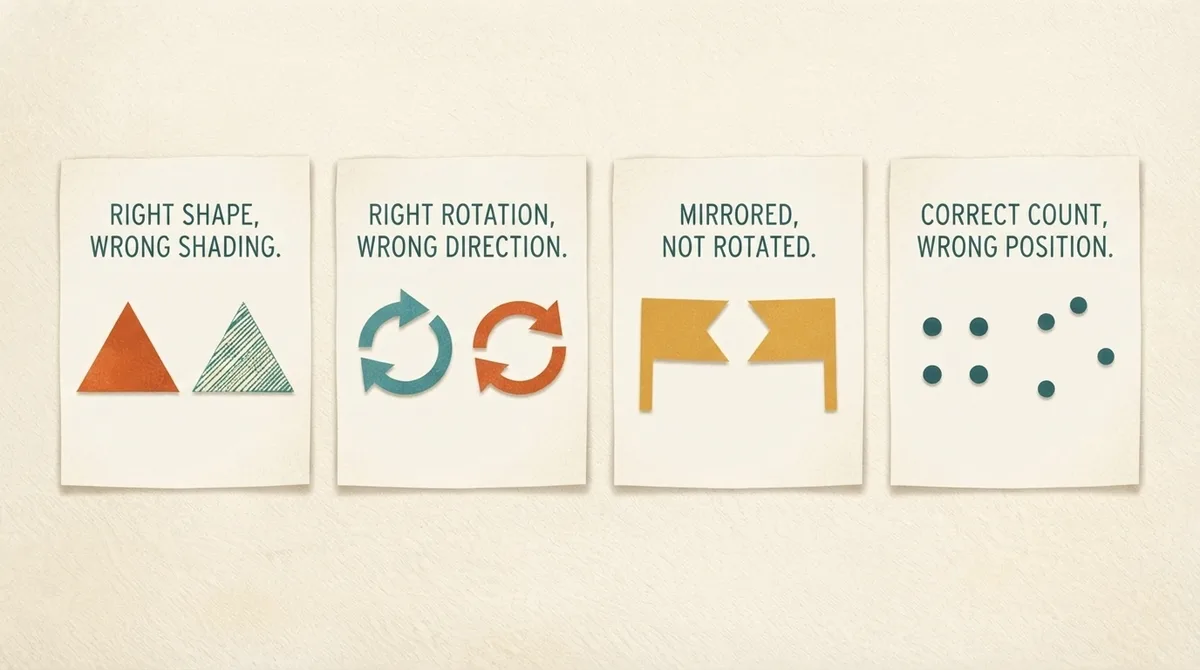
After a difficult question, you could ask which feature led to the answer and compare it with one alternative. This can make the reasoning visible, but it does not guarantee that a method will transfer to every question.
Myth: practise long papers because the exam is a long paper
Test timing and layout vary. Buckinghamshire’s familiarisation booklet, which is written by GL Assessment and linked from the council’s current guide, describes four five-minute NVR sections within a combined mathematics and non-verbal paper. Kent’s published guidance for September 2027 entry (test sitting in September 2026) also describes individually timed NVR sections. These examples do not establish a standard format for other tests or future sittings. Check the current instructions for your child’s test.
Buckinghamshire’s booklet says working should go in the question booklet rather than on the answer sheet, and that answer changes should be rubbed out rather than crossed out because scanning may fail (page 6). For its test, children may bring two HB pencils and an eraser in a transparent case, but not a calculator, ruler, protractor, scrap paper, watch or pen (page 5). Follow the current equipment list for the child’s test.
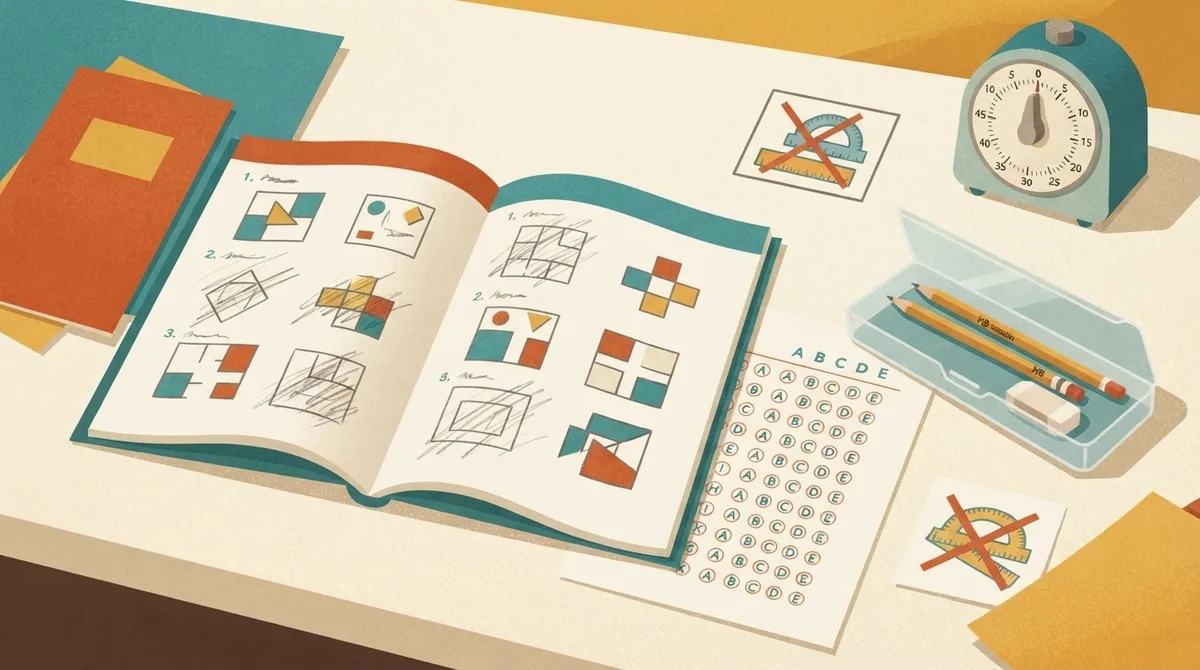
Optional answer-sheet practice
For optional answer-sheet practice, make a small grid with one row per question and one space for A to E. Follow the materials and equipment rules for the target test when rehearsing its format. The nine examples here are not calibrated to a five-minute test block, so use them untimed or choose a smaller group for a short timed exercise.
Some tests use a separate answer sheet and others do not. Check the current guidance for your target test before practising that format. The interactive set below is also available in our non-verbal reasoning guide. It does not reproduce a local paper or answer sheet.
The online practice set below mixes non-verbal question types and gives feedback for its questions. It does not reproduce the timed blocks or answer sheet of a local test.
This part of the guide is a free timed practice test. It works in your browser.
Teaching this in a school or tutoring group? You can embed one of our free non-verbal reasoning exercises on your own website. Choose the activity that fits the skill you are teaching, then preview the copied HTML on a phone before sharing it. The embed links families to the original exercise and does not record their answers.
Free non-verbal reasoning practice papers, and common questions
Where can I find free familiarisation materials? GL Assessment currently lists ten hours of free familiarisation materials across six subject or skills downloads, including non-verbal reasoning. Kent County Council publishes a free familiarisation paper too. Our round-up of free 11+ practice papers with answers covers what else is worth downloading.
How many questions should we do a week? There is no single weekly question target that suits every child. You might try a short session and see whether your child can explain the rule without becoming frustrated.
Is it worth sitting a practice test? In Buckinghamshire there is a formal one: two multiple-choice papers of about forty minutes each, sat under test conditions, not marked and not sent home, recommended but not compulsory, according to Buckinghamshire Council. For another test, follow that school or local authority’s current guidance.
What if my child is strong at maths but weak here? Different strengths across subjects are possible and do not by themselves indicate a problem. You could ask your child to describe what changed between two pictures. For the format and marking detail in one place, read our guide to non-verbal reasoning in the 11+.
Nine questions is a start, not a programme. A useful next step is to describe the rule behind an answer and check it against the options.
Topics
- non-verbal reasoning
- 11 plus
- practice questions
- gl assessment
- exam technique