


11 Plus Maths Questions with Worked Answers
Twenty-two original 11+ maths questions with worked answers and alternative mental methods. Check your local test format before choosing how to practise.
 Elspeth Marlow
- 13 min read
Families searching for 11+ maths questions may want a full paper or a few examples to discuss. This page provides worked examples on screen; use official familiarisation material to check the format used by your child's test.
Below are twenty-two original practice questions with worked answers and alternative mental methods. They are arranged as a teaching sequence, not as a prediction of the order or difficulty of another school's paper. Bancroft's 2017 sample paper, for example, says its Section A questions increase in difficulty and reserves a later section for non-standard problems (Bancroft's sample paper). Test rules vary: CSSE and Buckinghamshire prohibit calculators, while Buckinghamshire also prohibits rulers, protractors and scrap paper. Check the rules for your own test before practising exam conditions.
The question groups form a suggested practice sequence; they do not reproduce the timing or section order of a local test. Work through the examples in order or choose a topic to revisit.
First, check the format of your child's test
Some tests use multiple-choice answers; others ask pupils to write answers and may award marks for working. Check the format before choosing how to practise.
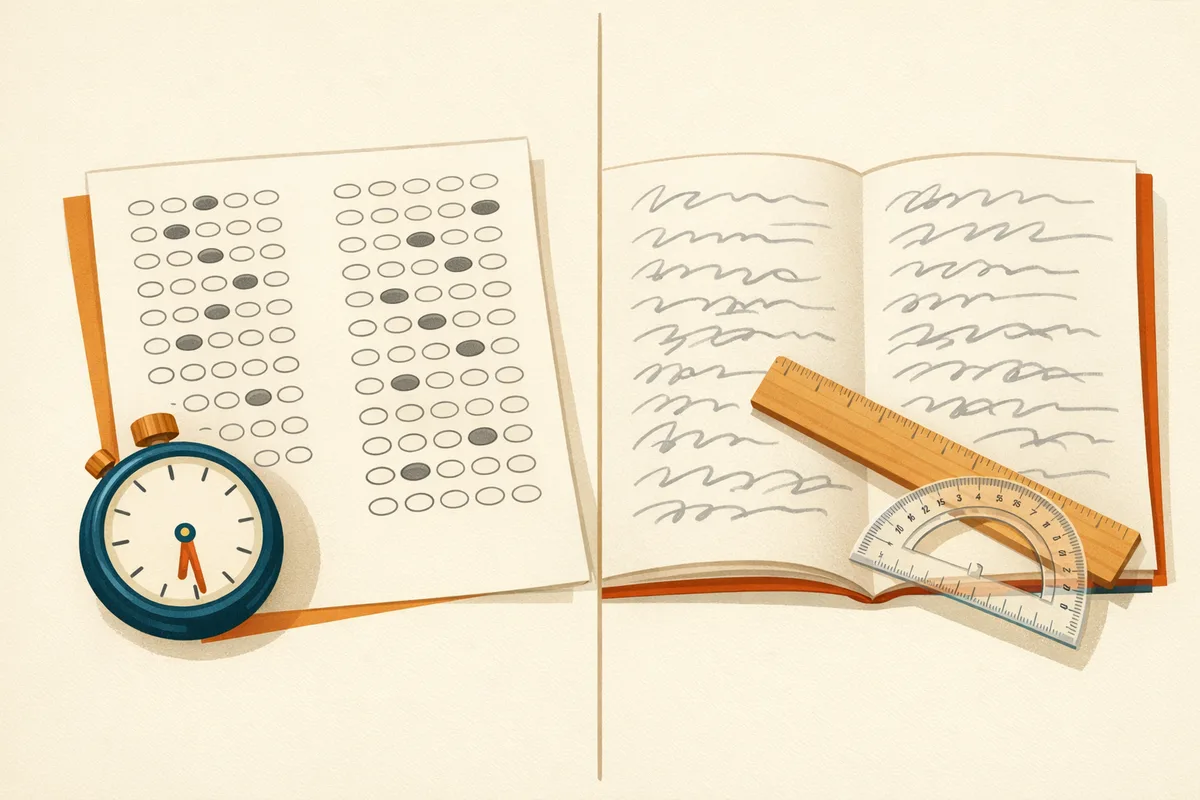
Example: multiple choice. The Buckinghamshire Secondary Transfer Test uses two booklets with multiple-choice questions and computer-marked answer sheets; its maths section takes 25 minutes plus five minutes of practice (Buckinghamshire familiarisation booklet). Kent describes a combined English and maths paper with a five-minute practice exercise and a 25-minute test for each section (Kent County Council). In these formats, the selected answer is marked; working in a booklet does not replace marking the answer sheet.
Example: written answers with method marks. CSSE's 2022-entry paper allowed 60 minutes for 60 marks and instructed candidates to show working; its mark scheme assigns marks to individual steps. Bancroft's 2017 sample paper also says candidates may receive marks for working (Bancroft's sample). These are specific examples; check your target school's current paper instructions.
Many test questions draw on primary mathematics, but the national curriculum is not an 11+ specification and local tests differ. The England curriculum expects pupils to be fluent in written methods for all four operations by the end of Year 6 (Department for Education). For a broad practice checklist, see our guide to 11+ maths topics and question types. To compare common providers, see GL, CEM and ISEB.
The notes below show one method and, where useful, an alternative. A local test may use a different format or mark scheme.
Questions 1 to 4: number, place value and the four operations
This first group practises place value and calculation before moving to less familiar combinations.
Question 1. Write four hundred and six thousand and ninety in figures. Answer: 406090. Build it column by column from the words: 406 thousands, then no hundreds, then 9 tens, then no units. The trap is writing 406,900 by sliding the ninety into the wrong column. Fast route: say the number aloud and count how many digits must follow "thousand", which is always three.
Question 2. What is 7000 minus 2486? Answer: 4514. One way to check is to count up: 2486 to 2500 is 14, 2500 to 7000 is 4500, and 14 plus 4500 is 4514. Alternative method: counting up can be convenient when subtracting from a round number.
Question 3. A crate holds 24 tins. A shop orders 17 crates. How many tins? Answer: 408. Long multiplication gives 24 times 10 equals 240 and 24 times 7 equals 168, totalling 408. Alternative method: 17 times 24 is 17 times 25 minus 17, which is 425 minus 17, or 408. Format note: on a written paper that awards method marks, showing the partition may earn credit even if the arithmetic slips.
Question 4. What is the smallest whole number greater than 20 that leaves a remainder of 3 when divided by both 4 and 5? Answer: 23. Numbers leaving remainder 3 with both divisors are 3 more than a common multiple of 4 and 5, and the lowest common multiple is 20, so the sequence is 3, 23, 43. Format note: on a multiple-choice paper, test each option against both divisions rather than deriving anything.
Questions 5 to 8: fractions, decimals and percentages
This group practises changing between fractions, decimals and percentages.
Question 5. What is three eighths of 240? Answer: 90. Divide by the denominator first, then multiply: 240 divided by 8 is 30, and 30 times 3 is 90. Here the division gives a whole number, so this is a convenient route. For another fraction and amount, choose the order that keeps the arithmetic manageable.
Question 6. Put these in ascending order: 0.7, three fifths, 65 per cent. Answer: three fifths, 65 per cent, 0.7. Convert everything to decimals: three fifths is 0.6, 65 per cent is 0.65, and 0.7 stays put. Alternative method: comparing decimals is one way to order these values.
Question 7. A coat costs 80 pounds and is reduced by 15 per cent. What is the new price? Answer: 68 pounds. Ten per cent of 80 is 8 and 5 per cent is half of that, so the reduction is 12 pounds. Alternative method: split 15 per cent into 10 per cent and 5 per cent for this calculation.
Question 8. Priya spends two fifths of her money, then one third of what is left. She has 24 pounds remaining. How much did she start with? Answer: 60 pounds. After spending two fifths she has three fifths left; spending a third of that leaves two thirds of three fifths, which is two fifths of the original. So two fifths equals 24 pounds, one fifth is 12, and the whole is 60. Format note: on a written paper that awards method marks, writing the fraction remaining at each stage makes the reasoning clear.
Questions 9 to 13: ratio, proportion and early algebra
Buckinghamshire's familiarisation booklet says some questions may feel more difficult because they ask pupils to use existing knowledge on new problems. The ratio examples below practise that kind of transfer.
Question 9. Share 45 pounds in the ratio 4 to 5. Answer: 20 pounds and 25 pounds. Add the parts to get 9, divide 45 by 9 to find one part is 5 pounds, then multiply out. Method: find the value of one part, then work out each share.
Question 10. Five identical pens cost 3 pounds 60. What do eight cost? Answer: 5 pounds 76. Unitary method: 3.60 divided by 5 is 0.72, and 0.72 times 8 is 5.76. Alternative method: 72 times 8 is 576 hundredths, or 5.76.
Question 11. If 3n plus 7 equals 34, what is n? Answer: 9. Subtract 7 from both sides to get 3n equals 27, then divide by 3. Alternative method: if a multiple-choice paper supplies a short list of options, substituting them may be quicker than rearranging.
Question 12. In a class the ratio of boys to girls is 3 to 4, and there are 6 more girls than boys. How many children are there altogether? Answer: 42. The difference between the ratio parts is 1, and that single part is worth 6 children, so the 7 total parts are worth 42. Format note: on a written paper with method marks, stating "1 part equals 6" helps show the reasoning.
Question 13. Two numbers have a sum of 31 and a difference of 7. Find them. Answer: 19 and 12. Add the sum and the difference to get 38, halve it for the larger number, then subtract 7. Fast route: add the sum and the positive difference, then halve the result: (31 + 7) ÷ 2 = 19. This works because adding the difference to the sum gives twice the larger number.
Questions 14 to 16: measurement, money and time
These examples practise unit conversion and elapsed time.
Question 14. A film starts at 18:45 and lasts 1 hour 50 minutes. When does it end? Answer: 20:35. Add the hour first to reach 19:45, then add 15 minutes to reach 20:00, then the remaining 35 minutes. Alternative method: counting up to the next hour can make the remaining minutes easier to track.
Question 15. A jug holds 1.5 litres. How many 125 ml glasses can be filled from it? Answer: 12. Convert first: 1.5 litres is 1500 ml, and 1500 divided by 125 is 12. Fast route: eight 125s make 1000, so 1500 gives another four, totalling 12.
Question 16. A car travels 150 km in 2 hours 30 minutes. What is its average speed? Answer: 60 km per hour. Divide distance by time, writing 2 hours 30 minutes as 2.5 hours. Format note: check that any answer includes a unit of speed, such as kilometres per hour.
Questions 17 to 19: geometry, shape, area and perimeter
Bancroft's expects candidates to bring "A ruler, pencil and protractor", while Buckinghamshire candidates may bring only two HB pencils and an eraser in a transparent case, with no mathematical instruments at all. Check your board before your child practises with a protractor in hand.
Question 17. A rectangle measures 9 cm by 4 cm. Find its perimeter and its area. Answer: perimeter 26 cm, area 36 cm squared. Perimeter is twice the sum of the sides, so 2 times 13; area is 9 times 4. Fast route: add length and width once, then double, rather than adding four numbers.
Question 18. Two angles sit on a straight line. One is 2x degrees and the other is x plus 30 degrees. Find x. Answer: 50. Angles on a straight line total 180, so 3x plus 30 equals 180, giving 3x equals 150. Format note: on a written paper with method marks, explaining that the angles sum to 180 shows the reasoning.
Question 19. A 10 cm by 6 cm rectangle has a 4 cm by 3 cm rectangle cut away from one corner, leaving an L-shape. Find its area and perimeter. Answer: area 48 cm squared, perimeter 32 cm. Area is 60 minus 12. The perimeter is the surprise: cutting a corner notch removes two lengths and adds two identical ones, so the perimeter is unchanged at 32 cm. Fast route: for corner notches, perimeter stays the same as the original rectangle.
Questions 20 to 22: statistics, averages and probability
Question 20. Find the mean of 7, 9, 12 and 4. Answer: 8. Total 32, divided by 4. Fast route: look for pairs that make round numbers, so 7 plus 9 is 16 and 12 plus 4 is 16.
Question 21. The mean of five numbers is 14. Four of them are 10, 12, 15 and 18. Find the fifth. Answer: 15. Work backwards from the total: five numbers with a mean of 14 sum to 70, the four given sum to 55, so the missing value is 15. Alternative method: find the total first by multiplying the mean by the number of values.
Question 22. A bag holds 3 red, 5 blue and 4 green counters. If a counter is drawn at random and each counter is equally likely to be chosen, what is the probability of drawing a green one? Answer: one third. Four green out of twelve counters, simplified. Format note: 4/12 and 1/3 are equivalent. If a question asks for the fraction in simplest form, write 1/3; a single-answer multiple-choice question should not treat both equivalent fractions as competing answers without that instruction.
Alternative mental methods to practise
Several methods above can be useful in other questions. Practise a method when it makes a calculation clearer or easier to check:
- Multiply by 25 by multiplying by 100 and dividing by 4, and by 5 by halving then multiplying by 10.
- Subtract from round numbers by counting up rather than borrowing down.
- Build a percentage from familiar parts, such as 10 per cent, 5 per cent and 1 per cent, when that is convenient.
- With fractions of amounts, divide by the denominator before multiplying by the numerator.
- Multiply by 9 as "times 10, minus one lot", and by 11 as "times 10, plus one lot".
On multiple-choice papers, estimating, checking units and substituting options can help when the question suits those methods. On a written paper that awards method marks, show enough working to make your method clear; check the instructions for the paper you are sitting.
Try the short timed practice test below, then use its result to decide which subject or topic to practise next.
This part of the guide is a free timed practice test. It works in your browser.
What to do with the ones your child got wrong

When an answer is wrong, look at the working before choosing what to practise next. For example, an error on Question 8 could involve tracking the fraction that remains, calculation, or interpreting the wording. A second question on the same skill can help show whether the same step is still difficult.
These can be useful prompts when reviewing an answer: was the method sound but the arithmetic wrong, is the topic new, or did time run out? More than one cause may be involved. Look at the working and the test instructions before deciding what practice would help.
Bancroft's 2017 guidance says candidates likely to cope comfortably may need only timed problem-solving experience and cautions that excessive coaching can be counter-productive. Follow the advice for your own school rather than assuming every child needs the same preparation. Smart Cub Learning's mock practice offers a short timed paper and topic results; combine those with your child's working and the target school's current guidance.
Where to find free official practice material
When your child is ready for a full sitting, use official familiarisation materials or sample papers. CSSE currently lists downloadable maths papers and mark schemes for 2021, 2022 and 2023 entry on its practice material page and notes that its papers are protected by copyright. Buckinghamshire and Kent publish familiarisation material through their council sites, linked earlier in this article. Bancroft's sample paper is also available on its school website. These examples illustrate different formats; confirm current details with your target schools.
For a wider list of what is available by region and school, see our round-ups of free 11+ practice papers with answers and where to find genuine past papers. Formats and timings vary considerably by area and by individual school, so always confirm the details with the admissions page of the schools you are actually applying to before you build a practice routine around them.
Twenty-two questions are a starting point for practice, not a complete preparation plan. Working through them may help you notice a method to revisit; use more than one example and the target test's guidance before deciding what is secure.
Topics
- 11 plus maths
- worked answers
- practice questions
- exam technique
- mental maths