


11 Plus Algebra Questions and Worked Examples
Practise four forms of algebraic reasoning with twelve original worked examples: function machines, sequences, equations and word problems. Check methods for multiple-choice and written-answer tests.
 Elspeth Marlow
- 14 min read
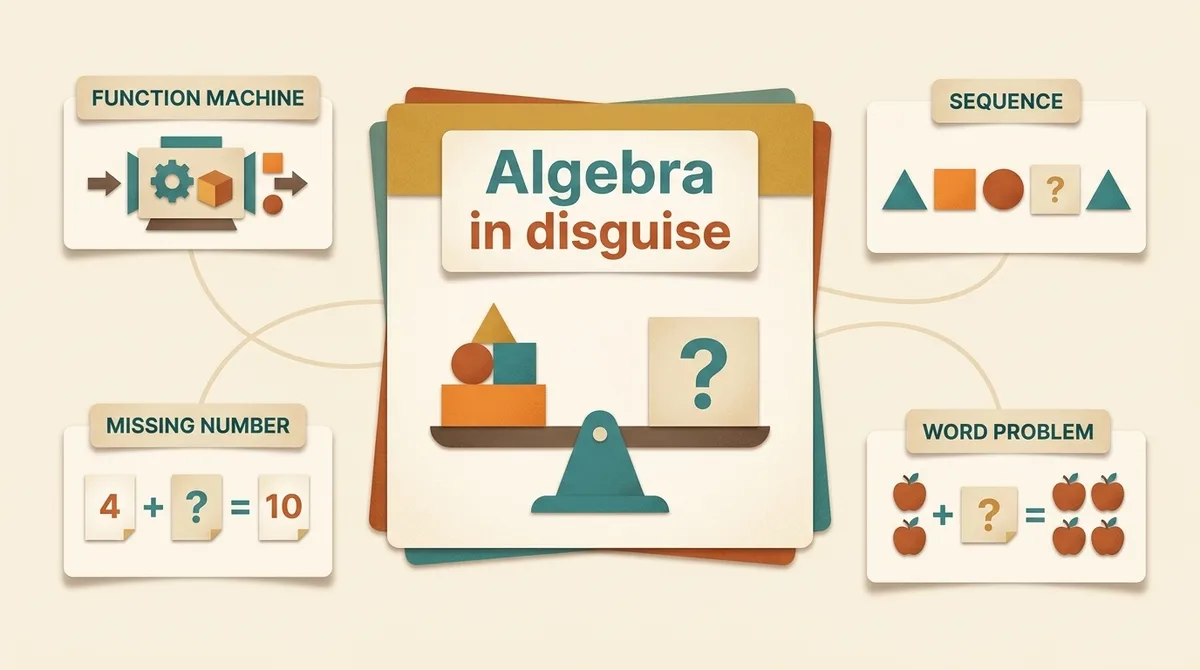
Algebra is not limited to questions that use the letter x. A missing number, a rule in a table or a number sequence can ask a child to reason about an unknown quantity.
This guide covers four useful forms: function machines, sequences, equations and word problems. Each has three original worked examples, from a short calculation to a problem that needs several steps. They are practice examples, not copied questions or a prediction of any particular test.
The primary mathematics curriculum for England includes simple formulae, linear sequences and missing-number problems in Year 6. The 11+ is set locally, so check the official familiarisation material for the test your child will sit.
Is algebra actually on the 11 plus? The short answer
Algebraic reasoning can appear in maths questions, but its form and difficulty vary by test. A formula, sequence, missing number or word problem can involve finding an unknown even when the question does not use the word algebra.
Practise recognising the relationship as well as carrying out the calculation. Some schools may also ask children to simplify expressions or solve equations directly, so use their current sample papers to decide what to cover.
Introduce the idea before adding time pressure
In England's primary mathematics curriculum, algebra is a named Year 6 topic. Earlier missing-number work helps prepare children for it. A child sitting an entrance test near the start of Year 6 may not yet have covered every method below at school.
Ask which ideas are familiar. Start with a small example and explain what the unknown stands for. Let the child try it without a time limit, then check the answer together. Use the target test's official examples to choose what to practise; its subjects, timing and question styles can differ from another test.
How algebra can appear in questions
The CSSE Mathematics familiarisation paper is a useful specimen because it is free, official and long enough to show a pattern. The following questions involve finding an unknown or using a rule:
- Question 14 gives a table of values for the formula 2(n+1). One row supplies n and wants the output. Another supplies the output (80) and wants n. That is a function machine run in both directions.
- Question 16 builds a sequence by starting at 0, then adding 1, subtracting 2, adding 3, subtracting 4, and asks for the 6th, 11th and 100th terms. For a distant term, describing the pattern is more practical than listing every term.
- Question 5 gives incomplete calculations with a question mark for the missing part, including a negative-answer case. That is "express missing number problems algebraically" with no algebraic notation on the page at all.
- Question 15 is a magic square of decimals where every row, column and diagonal totals 1.5, with one shaded cell to find. A linear equation in a grid.
- Questions 10 and 21 give letters number values (A = 1, B = 2, C = 3 and so on) and ask for totals and products of words, ending in a word-sum puzzle. Substitution plus equation-forming, dressed as a word game.
- Question 20(b) gives four boys' scores, then says a fifth boy has batted and the mean for all five is now 16, and asks for his score. A reverse mean, which is a one-step equation.
These examples connect algebra to familiar calculations and patterns. For the wider picture of how these sit alongside fractions, ratio and geometry, see our pillar guide to 11 plus maths topics and question types.
Decision guide: which technique does your child actually need?
Check the test format before choosing a method. The paper format affects which methods are available. Work out which of these three situations you are in before you choose how to practise.
For the Buckinghamshire Secondary Transfer Test familiarisation format: maths questions have five options and a computer marks the answer sheet, with no credit for working. The Buckinghamshire familiarisation booklet confirms that "all the questions are multiple-choice" and that "your completed answer sheets will be marked by a computer", with the maths portion running to "25 minutes for Mathematics (plus 5 minutes practice)" (Buckinghamshire familiarisation booklet). Trying the answer options is one possible method. For 6n - 5 = 37, a child can test a proposed value of n or solve the equation. Compare both methods in practice and choose the one the child can use accurately.
If your child sits a written-answer paper (for example CSSE for the Essex consortium): the paper runs 60 minutes for 60 marks, calculators of any kind are forbidden, and pupils write on the paper itself, working "in your head, or by writing on the white area around the question". There are no answer options to test. Write down the relationship, label the unknown and check the result in the original question. Follow the paper's instructions about working; do not assume every written calculation earns a method mark.
For an independent school: check which assessment it uses. The ISEB Common Pre-Tests are online and adaptive; a school's own written maths paper is a different format. Prepare with its official familiarisation material and practise recording the answer in the required way. Our comparison of GL, CEM and ISEB exam boards explains the main distinctions.
One caution that applies everywhere: 11+ formats differ by area, and areas change their arrangements between admissions cycles. Confirm the current format on your own council or consortium's admissions page before building a plan around it.
Disguise one: function machines
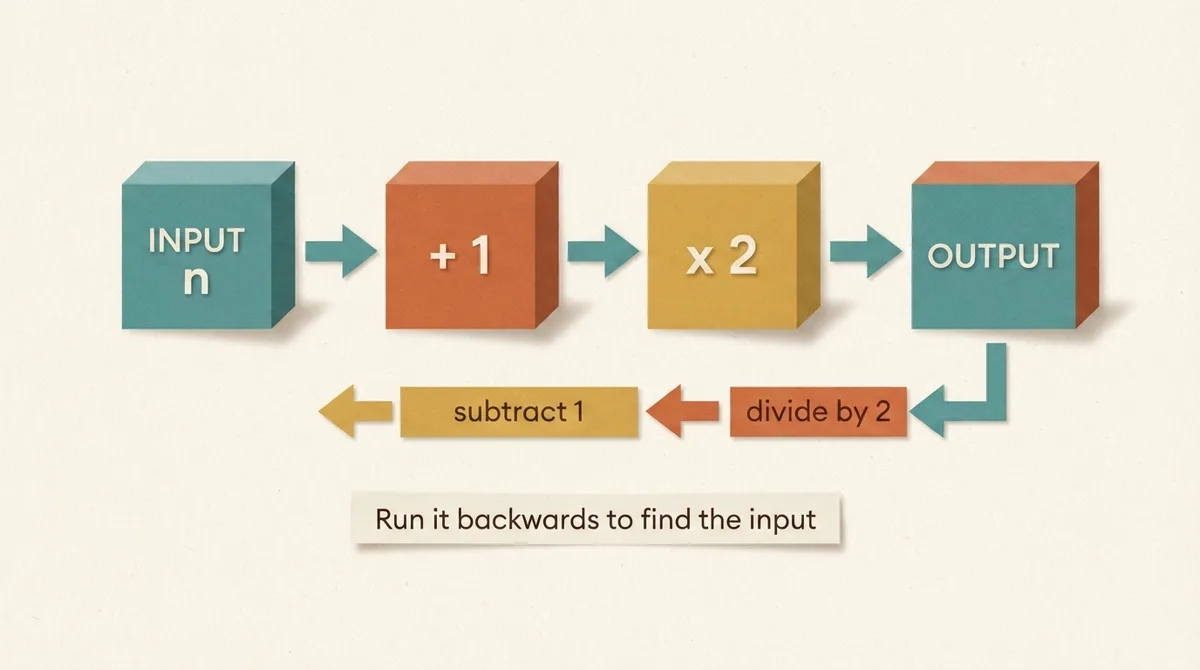
A function machine applies a rule to an input number to give an output. A table may ask for the output or give the output and ask for the input.
Easy. A machine multiplies by 3, then adds 2. What comes out when 5 goes in?
5 times 3 is 15. 15 plus 2 is 17. Answer: 17.
Medium. A rule is given as 3(n + 4). Complete the table for n = 7 and n = 12.
Do the bracket first every time. For n = 7: 7 plus 4 is 11, and 11 times 3 is 33. For n = 12: 12 plus 4 is 16, and 16 times 3 is 48. Answers: 33 and 48.
Hard (modelled on the CSSE table-of-values type). A rule is given as 5(n - 2). One row of the table says the answer is 145. What is n?
List the forward steps: subtract 2, then multiply by 5. Reverse them in the opposite order: divide by 5, then add 2. So 145 divided by 5 is 29, and 29 plus 2 is 31. Answer: n = 31. Check it forwards: 31 minus 2 is 29, times 5 is 145. Checking forwards helps catch an error in the order of the inverse operations.
Try a function machine: work out which two operations turn the inputs into the outputs.
This part of the guide is a short interactive exercise. It works in your browser.
Disguise two: sequences and the nth term
A sequence is an ordered list of numbers. Each number is a term. The nth term means the term in position n, so n = 1 gives the first term. A rule can help you find a distant term without listing all the earlier ones.
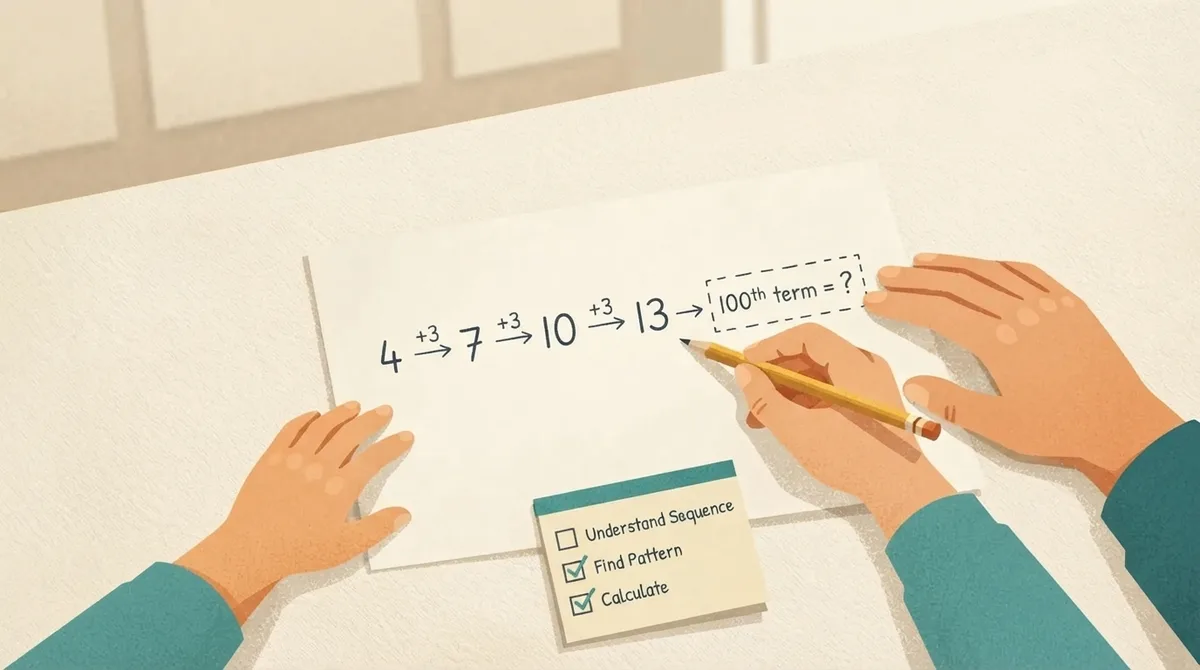
Easy. A sequence starts 4, 7, 10, 13. Write the next two terms.
The step is plus 3 each time. Answer: 16 and 19.
Medium. For the sequence 6, 11, 16, 21, find the 100th term.
The step is 5, so the rule is built on 5n. Test it: 5 times 1 is 5, but the first term is 6, so the rule is 5n + 1. The 100th term is 500 plus 1. Answer: 501. For a sequence with the same difference between consecutive terms, the step size gives the multiplier of n. Compare the rule at n = 1 with the first term to find the adjustment.
Hard (modelled on the CSSE alternating sequence). A sequence starts at 0. Then add 2, subtract 4, add 6, subtract 8, and so on, increasing the amount by 2 each time. Find the 7th, 12th and 101st terms.
Write out enough terms to see the shape: 0, 2, -2, 4, -4, 6, -6. Now stop counting and describe it. Every even-numbered term equals its own position: term 2 is 2, term 4 is 4, term 6 is 6. Every odd-numbered term after the first is negative and equals one less than its position, made negative: term 3 is -2, term 5 is -4, term 7 is -6.
So the 7th term is -6. The 12th term is even-positioned, so it is 12. The 101st term is odd-positioned, so it is -100.
Listing a few terms helps reveal this pattern. Once you have described it, check the rule against those terms before using it for a distant position.
Disguise three: forming and solving simple equations
This is the closest the 11+ comes to conventional algebra, and it usually arrives as a missing number or a grid.
Easy. Find the missing number: ? + 9 = 24.
Subtract to undo the addition: 24 minus 9. Answer: 15.
To step through equations like this one, including two-step ones such as 3n + 4 = 19, use the solver below. At every step it does the same thing to both sides, then checks the answer at the end.
This part of the guide solves missing-number equations one step at a time, doing the same to both sides. It works in your browser.
Medium (the negative-number case). Find the missing number: 8 - ? = -3.
Read the missing-number position carefully: what do I take from 8 to land three below zero? Getting to 0 uses 8, and getting three further down uses 3 more. Answer: 11. Check: 8 minus 11 is -3. A number line can help show why the answer is 11.
Hard (modelled on the CSSE magic square). In a three by three grid, every row, column and diagonal adds to 2.1. The top row reads 1.0, 0.3, 0.8. The bottom row reads 0.6, 1.1, 0.4. The middle row starts 0.5, 0.7 and then a shaded cell. What is in the shaded cell?
The middle row must total 2.1. So far it holds 0.5 plus 0.7, which is 1.2. The shaded cell is 2.1 minus 1.2. Answer: 0.9. Confirm down the third column: 0.8 plus 0.9 plus 0.4 is 2.1. Correct.
The skill being tested is choosing which row or column to use: the one with exactly one unknown. Choose a row or column with just one unknown to avoid unnecessary working.
Try solving an equation on a balance: keep it level and get one bag on its own.
This part of the guide is a short interactive exercise. It works in your browser.
Disguise four: word problems that hide algebra
Easy (modelled on the Buckinghamshire first practice question type). A school has 184 pupils in Junior and Infant classes altogether. There are 96 pupils in the Junior classes. How many are in the Infant classes?
This is 96 + x = 184 written in English. Subtract: 184 minus 96. Answer: 88.
Medium (modelled on the CSSE letter-value type). Each letter has the value of its position in the alphabet, so A = 1, B = 2, C = 3 and so on. The word BAT has a value of 23. Which single letter must be added to BAT to make a total of 30?
Check the given value first: 2 plus 1 plus 20 is 23. The equation is 23 + x = 30, so x = 7, and the 7th letter is G. Answer: G. Notice the two-stage structure: substitute to get a number, then form an equation with what is left over. Other letter-value questions may use a different rule, so read it before calculating.
Hard (modelled on the CSSE reverse-mean type). Four girls scored 21, 8, 15 and 12 in a quiz. A fifth girl, Nadia, then took the quiz, and the mean score for all five girls is now 15. What did Nadia score?
One method is to turn the mean into a total. If five scores have a mean of 15, the five scores add to 5 times 15, which is 75. The four known scores add to 21 plus 8 plus 15 plus 12, which is 56. Nadia's score is 75 minus 56. Answer: 19.
The algebra underneath is (56 + n) divided by 5 = 15. Children who see it that way and multiply both sides by 5 arrive at the same place. Both methods use the same relationship between the mean, total and number of scores.
Eight algebra mistakes to check
Use these descriptions to discuss an error and choose what to practise next.
- The counting-on trap. Listing terms one by one when the question asks for the 100th. Fix: list a few terms, describe the pattern and check the rule before finding a distant term.
- The off-by-one nth term. Getting the step right (5n) but forgetting the adjustment (+1). Fix: always test the rule on term 1 before using it on term 100.
- Forwards when it should be backwards. Given the output of a formula and multiplying anyway. Fix: check whether the missing value is the input or the output.
- Inverting in the wrong order. For a machine that subtracts 2 and then multiplies by 5, undoing the steps by adding 2 first is wrong. Divide by 5 first, then add 2. Fix: write the forward steps in a row, then read them right to left.
- The negative-number flip. Answering 5 to "8 - ? = -3". Fix: draw a number line and count the whole journey, past zero.
- Averaging the average. Adding the new score to the old mean and halving. Fix: use total = mean × number of values, then subtract the known scores.
- The unlabelled unknown. Writing a page of numbers with nothing showing what the letter or box stands for, then handing in an intermediate value. Fix: one short sentence at the top, such as "let n be the number of pens".
- Answering the wrong question. Solving correctly for the unknown when the question asked for twice the unknown, or for the difference rather than the total. Fix: reread the final sentence of the question before writing the answer down.
Review which errors your child actually makes. Misreading a relationship needs a different explanation from an arithmetic slip.
Practising at home: a five-minute check
Use these three questions as a short starting check. Work on paper without a calculator, and watch the method as well as marking the answer.
- A rule is 4(n - 1). One answer is 100. What is n? (Answer: 26. You are watching for whether they reverse the steps in the right order.)
- A sequence starts 9, 14, 19, 24. What is the 50th term? (Answer: 254, from 5n + 4. You are watching for whether they start listing terms.)
- Three friends scored 14, 19 and 9. A fourth friend joins and the mean for all four is 14. What did the fourth friend score? (Answer: 14, since the four scores must total 56 and the first three total 42. You are watching for whether they convert the mean to a total.)
Three correct answers are a useful starting check, but they do not establish that the whole topic is secure. Revisit the ideas later with different numbers and unfamiliar contexts. If a question is difficult, ask the child to explain the known numbers and the unknown. Return to one small worked example of that relationship before trying a similar question independently.
Begin without a time limit so the child can explain the method. Add short timed practice when the method is familiar and the target test uses timed sections. Smart Cub Learning's topic and paper tests provide further practice, and you can see how these questions behave in a full paper in our set of 11 plus maths questions with worked answers or in the free 11 plus practice papers round-up. If you want to go straight to the official material, CSSE publishes familiarisation papers free, and GL Assessment provides ten hours of free familiarisation downloads alongside its paid practice papers.
Keep asking what is unknown and how it relates to the known numbers. Then check the answer in the original question.
Topics
- 11 plus
- maths
- algebra
- worked examples
- exam technique