


Medway Test Guide: Papers, Scores and Grammar School Entry
Understand the Medway Test papers, age-standardised scores and separate school application. Includes the 2026 sitting for September 2027 entry.
 Elspeth Marlow
- 13 min read
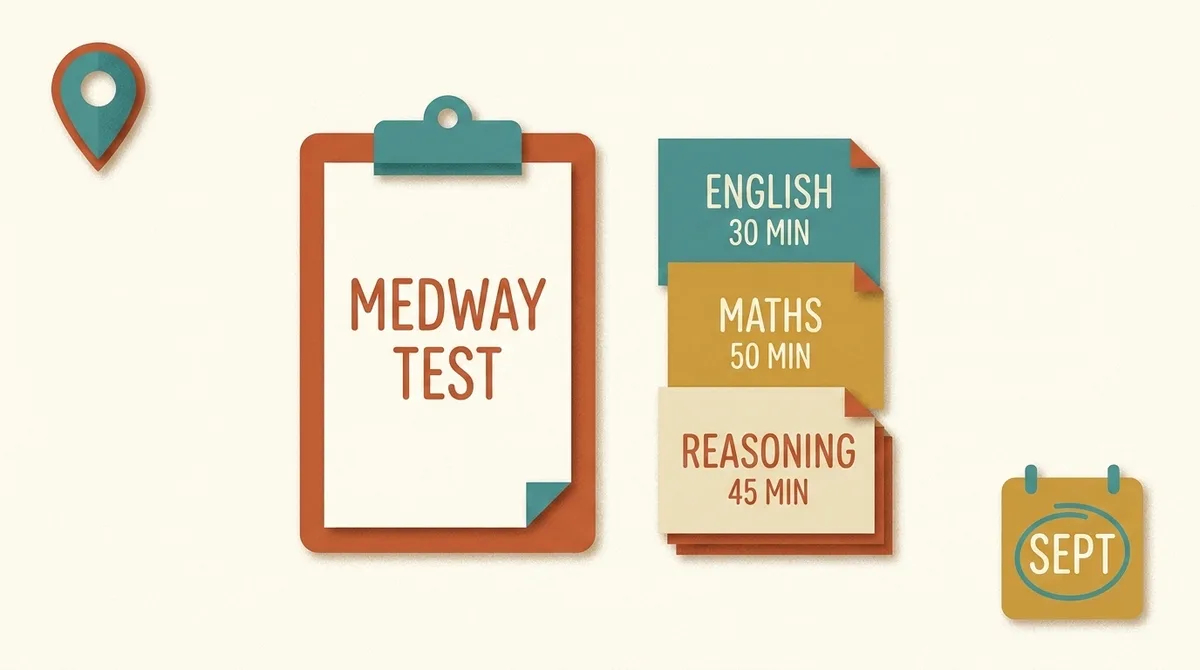
The 2026 Medway Test minimum score was 478. Results were sent on Wednesday 14 October, and Medway residents’ secondary school applications close on 31 October 2026. Families outside Medway apply through their home council and should check its deadline. This guide explains what the result means and distinguishes the current test format from older descriptions of a writing paper or academic review.
The format, qualifying score and admissions rules are separate pieces of information, and older descriptions can mix the Medway and Kent processes. The details below distinguish the 2026 test sitting for September 2027 entry from historic arrangements and proposed future changes. For help comparing selective schools near your address, see our guide to finding grammar schools near you.
What is the Medway Test, and who runs it?
The Medway Test is the selective entrance assessment used by the six grammar schools in Medway. It is administered by Medway Council, and the papers are produced by GL Assessment and, in the council's own words, "written specifically for Medway Council". That last phrase matters: Medway papers are not a generic GL pack with a local badge on it, which is why familiarisation material sold as "Medway practice" from third parties can drift from the real format. The council and GL both warn that "any test materials found online or in retailers, other than on the GL website are not official" (Medway Council, About the Medway Test).
The test is sat in September of Year 6, and the result feeds into the separate secondary school application your family submits through its home council. Medway residents’ on-time deadline is 31 October 2026. It is a suitability assessment, not an offer. As the council puts it plainly, "if your child has been assessed as suitable for grammar school, it does not guarantee them a grammar school place."
The Medway Test is used for the six Medway grammar schools, and cannot be used for grammar schools in other areas. A child must sit the papers at a Medway Council venue in Medway; there is no remote or out-of-area test venue.
What changed in 2024, and why so many guides are wrong?
The 2025-entry cycle, tested in autumn 2024, introduced a different format and no academic review. These details help explain why older descriptions may be out of date.
- The extended writing task was removed. In its place there is now a 30 minute English paper testing comprehension, punctuation and grammar. There is no creative writing element, no "fringe case" writing task and no writing score contributing to the total.
- The reasoning paper was broadened. What used to be described as a verbal reasoning paper is now a single 45 minute reasoning paper covering spatial reasoning, non-verbal reasoning and verbal reasoning.
- A test-result review and an admission appeal are different processes. The council's current results guidance directs families assessed as non-grammar to name a mixture of schools and, after a refused place, use the admission appeal route. Do not rely on older guides describing an academic Review.
In the autumn 2024 test for September 2025 entry, Medway Council reported 3,844 test takers, including 2,103 Medway pupils; 936 Medway pupils were assessed as grammar, compared with 847 the previous year. The published minimum moved from 492 to 482 as the council changed the cohort share assessed as grammar from 23% to 25%. These figures describe those cohorts, not a fixed future threshold. Medway’s current arrangement for the 2026 test is 26% for its maintained-school cohort.
Which schools use the Medway Test, and what changes in September 2026?
Six grammar schools use it: Chatham Grammar, Fort Pitt Grammar, Holcombe Grammar, Rainham Mark Grammar, Sir Joseph Williamson's Mathematical School (the Math) and Rochester Grammar. The Howard School is not one of those six selective grammar schools.
Chatham Grammar, Fort Pitt Grammar and Holcombe Grammar are admitting boys and girls to Year 7 from September 2026, following Department for Education approval. Fort Pitt's own 2027-entry prospectus is headed "Year 7 (co-ed)". Check the current entry-year arrangements when building a shortlist, because each school sets its own admissions and oversubscription rules (Chatham Grammar, September 2026 admissions).
Check which qualifying tests each school accepts: Chatham Grammar's arrangements offer places "to 150 students who are deemed to be selective based on the LA Testing Arrangements (Medway Test and/or Kent Test)". A Kent Test pass can therefore open a Medway door at that school. Do not assume it generalises to all six; check each school's published arrangements for the year of entry.
What does each paper actually look like?
The Medway Test is three papers with a minimum 20 minute break between them (Medway Council, About the Medway Test).
- English. Three practice questions in five minutes, then a continuous 30 minute marked test on comprehension, punctuation and grammar.
- Mathematics. Two practice questions in two minutes, then a continuous 50 minute test.
- Reasoning. 45 minutes in total. Spatial and non-verbal reasoning take 20 minutes across four individually timed sections, and verbal reasoning takes 25 minutes in a single section.
Note the structural difference between the papers. English and Maths run continuously, so a child can budget their own time across the whole paper. The spatial and non-verbal portion is divided into four separately timed sections. A child cannot move extra time from one section to another, so use the official familiarisation booklet to learn the instructions and timing. Our overview of non-verbal reasoning question types and timing covers the sub-skills that appear in this section.
As a hypothetical pacing example, in a five-minute section spending 90 seconds on one question leaves three minutes and 30 seconds for the rest. The council does not publish the question count or exact time limit for each individual spatial or non-verbal section in its overview, so do not treat this example as the real paper’s item count or section timing.
GL Assessment provides the test, but Medway Council says the papers are written specifically for Medway. Generic GL materials are not official Medway test papers. Our comparison of GL, CEM and ISEB formats explains the providers, but official Medway familiarisation material should guide expectations for this test.
How is the Medway Test marked?
Each paper produces a raw score. Each raw score is then standardised against the child's age at the time of testing, so that summer-born children are not disadvantaged relative to autumn-born children in the same year group.
Medway then combines the standardised scores using this weighting:
Total weighted score = (standardised English x 2) + (standardised Maths x 2) + (standardised Reasoning x 1)
English and mathematics each have a weighting of two, while reasoning has a weighting of one. This describes how the council combines standardised scores; it does not predict a child’s result or prescribe how much practice to do in each subject. Use the official familiarisation material to understand each paper.
The council describes the test as "designed to assess the equivalent of 26% of children attending Medway maintained schools as grammar". Medway maintained pupils are ranked by weighted score, and non-Medway children who meet the same published minimum also qualify (Medway Council, how the test is marked).
What score does a child need?
Medway publishes the minimum weighted score for each recent entry cohort:
- 2027 entry (2026 test): 478, representing 26 per cent of the Medway cohort.
- 2026 entry (2025 test): 481, representing 25 per cent of the cohort.
- 2025 entry (2024 test): 482, representing 25 per cent of the cohort.
- 2024 entry (2023 test): 492, representing 23 per cent of the cohort.
Read these as history, not as a target. The threshold is set after the test against the cohort, so the share and resulting score can change each year. Medway Council is consulting on a proposal to increase the share to 27% for the 2028–29 admissions scheme, subject to extra places being available. The consultation closes on Thursday 19 November 2026 (Medway Council notice). That is a proposal, not a change to the 26% rule or 478 threshold for September 2027 entry. In the September 2026 test, 3,962 children took part, including 2,113 Medway pupils; 995 Medway pupils were assessed eligible. The council said the minimum score of 478 represented 26 per cent of the cohort (Medway Council results announcement, October 2026).
Anyone quoting you a precise pass mark for a test that has not been sat yet is guessing. These historical cut-offs do not predict the next threshold. A practice-paper percentage cannot be converted into a Medway weighted score. Mock tests offer practice only; they do not predict a child’s assessed outcome.
How and when do you register?
For the 2026 sitting, registration opened Monday 18 May 2026 and closed Friday 12 June 2026, with the council stating: "Registrations after the closing date cannot be accepted. There are no exceptions to this." Parents, not schools, register each child separately through the Parent Portal, and if no confirmation email arrives, the child is not registered (Medway Council, registering for the Medway Test).
Access arrangements run on a separate track. Schools had to submit special arrangements requests by Monday 22 June 2026; that deadline has passed. Children with an EHCP or Person Centred Annual Review must still have a special-arrangements request submitted by their school. Medway says it grants 25% additional time where the school deems that appropriate; other arrangements need supporting evidence. Speak with the school before its request deadline.
Before registering, the council recommends speaking with the child’s teacher or headteacher about whether the test and grammar school are right for them. It also says it does not recommend the test for a child not working at or above expected levels for their age.
Test dates for 2026 were Tuesday 15 and Wednesday 16 September for children at Medway maintained primary and junior schools; Thursday 17 and Friday 18 September for special arrangements; and Saturday 19 or Sunday 20 September for independent-school and out-of-area children. Invitations went out by email or post by the end of August. Medway maintained pupils sit at their own school; everyone else sits at an allocated Medway Test Centre (Medway Council, test dates).
Children at external centres must bring a completed test day contact form and attend the centre named on their invitation. And withdrawal is one way only: "Once you withdraw your child from the test you cannot change your mind and re-register them."
The lookup below shows the Medway dates we have checked against the council, with the registration link. Pick another area to compare, such as Kent.
This part of the guide looks up which 11+ test your area uses. It works in your browser.
What happens on results day?
Results for the 2026 sitting were emailed after 10am on Wednesday 14 October 2026, with results sent by post where the council holds no email address. If a result has not arrived, contact the council by email after checking junk mail; results are not given over the phone (Medway Council results guidance).
Medway says the result includes a total score, a breakdown by paper and a grammar or non-grammar assessment. The same page also lists paper scores among information it cannot provide, so ask the council if your result letter is unclear. It says raw marks, percentages, individual-paper pass marks, the standardisation calculation and copies of the papers are not supplied.
Crucially, a grammar assessment is a ticket to apply, not a place. For Medway residents, applications close on 31 October 2026. Other families must use their home council’s application and deadline. Offers for September 2027 entry are due on Monday 1 March 2027, according to the Medway Council admissions calendar.
What if the result is not what you hoped?
The council states that there is no resit or remark of a Medway Test paper and no appeal process for a remark. Its current admissions process does not include an academic Review: "There is no resit and there is no remarking of any Medway Test papers. There is no appeal process for a remark of any paper." The current admissions process does not offer an academic Review.
What you can still do:
- Name grammar schools on the application anyway. Children not assessed as suitable are not blocked from listing them.
- Use the statutory admission appeal after a refusal on 1 March 2027. This is a legal right attached to a refused place, heard by an independent panel, and it is separate from anything to do with the test paper.
- Look properly at the non-selective options. Check the published arrangements and available schools when deciding which preferences to name.
A guide that describes an academic Review may refer to an older process. Check its publication date and the current council information.
Should you register from outside Medway?
Medway Council publishes figures about non-Medway applicants; they describe the 2026 admissions data, not an individual child’s chance of an offer.
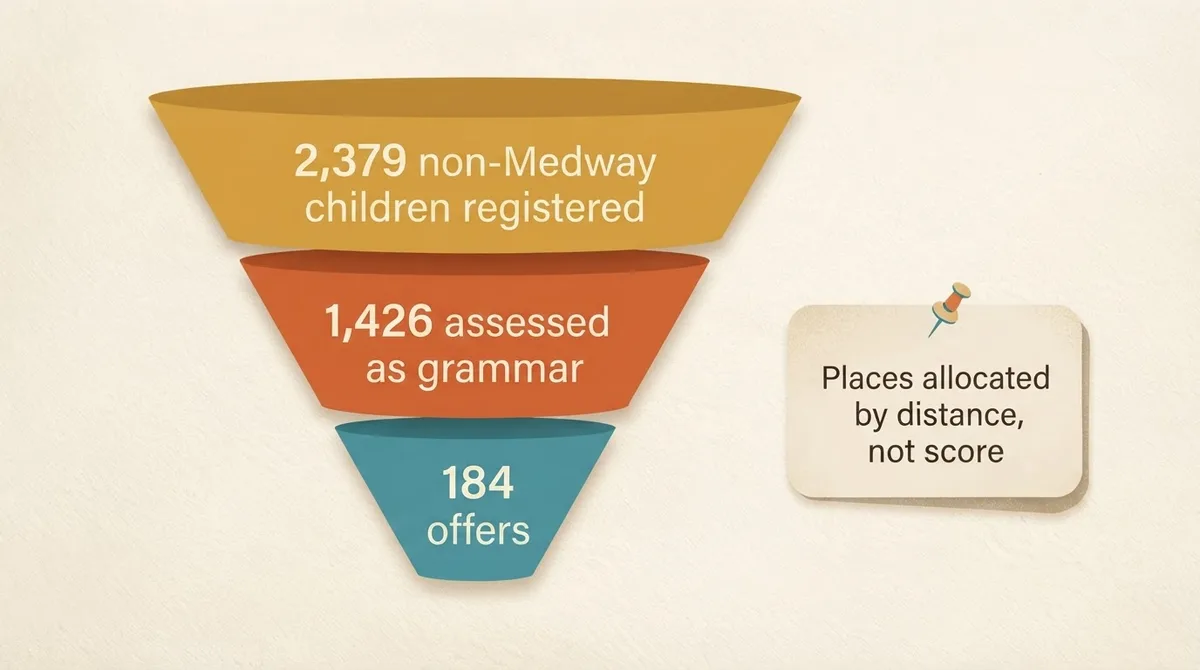
Medway Council’s 2026 admissions data records 2,379 non-Medway children who registered for the test. Of those, 1,426 were assessed as suitable for grammar school. Only 184 received an offer. That is fewer than 8 per cent of non-Medway registrants, and under 13 per cent of those who passed (Medway Council, out of area guidance).
Medway Council says its grammar schools are oversubscribed and places are mainly allocated by distance from home, not test score. Each school applies its own published oversubscription criteria, which may include other priorities before distance. The same council guidance says around 20 per cent of non-Medway registrants do not attend; it does not state why families are absent.
For an out-of-area family, review the oversubscription rules for the schools under consideration and weigh them alongside the journey. Medway Council advises families to consider the likelihood of an offer before registering.
Medway or Kent: how do they actually differ?
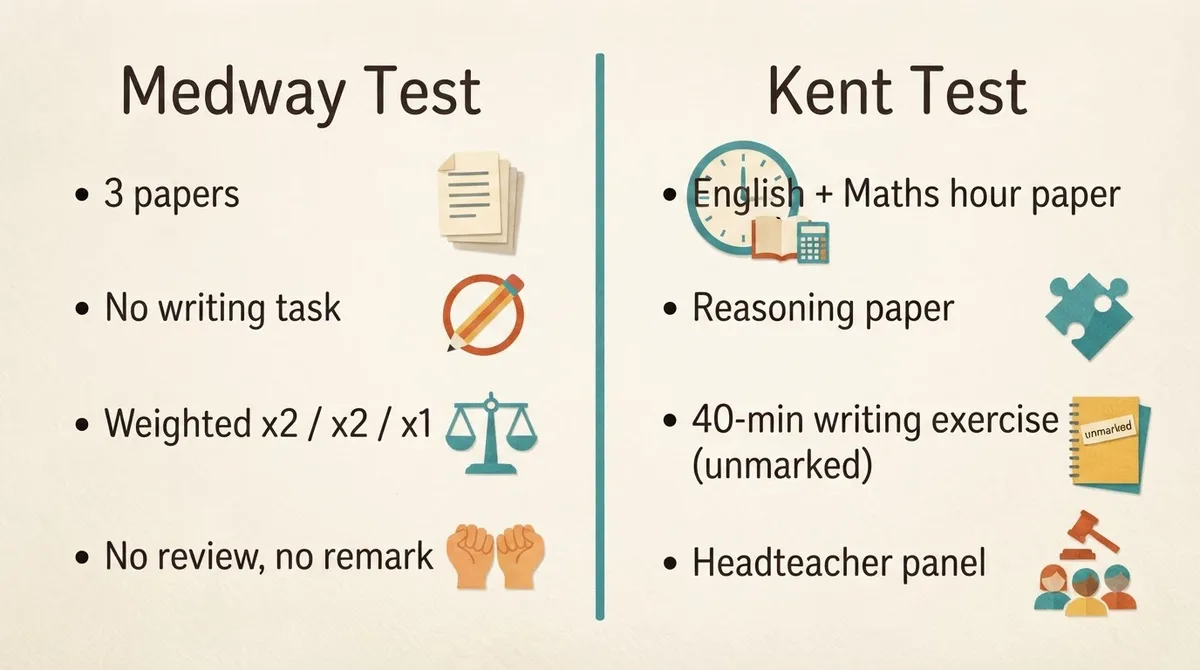
- Medway: three papers (English, Maths, Reasoning), no writing task, weighted x2/x2/x1, published minimum score, no review, no remark, no resit.
- Kent for September 2027 entry: a combined English and Maths paper, a reasoning paper, plus a 40-minute writing exercise that is not marked but may be used by a local headteacher panel (Kent County Council, prepare for the Kent Test). Kent has announced Quest Assessments as its provider from the 2027 test cycle, so check its current information for later entry years.
Families near the boundary may consider both tests, but each test has its own registration and sitting arrangements. Check the dates and admission rules for each school. Our Kent Test guide covers that separate process.
Where to start if you are preparing
The weighting describes how Medway combines the standardised scores, not how a family should divide practice time. Use the official GL familiarisation material to see the current format for English, maths and reasoning, including spatial and non-verbal sections. Other practice materials are not official Medway papers and should not be treated as a preview of them.
Smart Cub Learning has practice and progress-tracking tools. They are not official Medway Test materials and cannot predict an admissions result. Check the council’s familiarisation booklet for the paper format.
Dates, thresholds and school arrangements change each cycle, so verify anything decision-critical against the council pages linked above before you act on it.
Topics
- medway test
- 11 plus
- grammar schools
- kent
- admissions