


Is the 11 Plus Hard? Difficulty, Competition and Managing Pressure
The 11+ can be hard to sit and harder to turn into a school place. See the difference between a qualifying score, a school offer and a Selection Review, with current official examples.
 Elspeth Marlow
- 14 min read
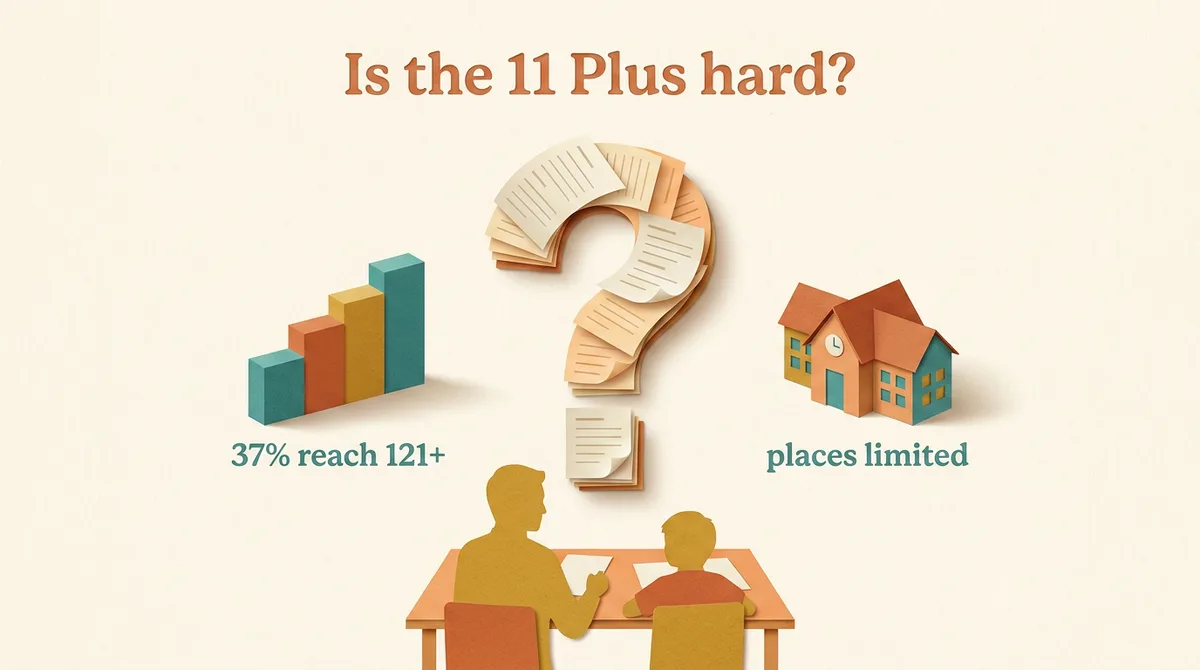
Is the 11+ hard? The papers can be unfamiliar and timed, but passing a test and getting a place are different hurdles. Buckinghamshire Council expects about 37% of its test-takers to score at least 121. That qualifies a child for consideration there; it does not promise a school offer. Other areas use different scores, stages and school priority rules. There is no useful national 11+ pass rate.
Already have an autumn 2026 result for September 2027 entry? Check what that result means for each school, then submit your home council's separate school application on time. A near miss may have a local review route, and some schools have their own lower-score priority or evidence deadline. Start with our results and appeals guide and the relevant area and school guides. Families preparing for a later intake can use the year-by-year preparation guide.
For example, a Buckinghamshire family told its result on 9 October 2026 must submit a complete Selection Review case by 30 October if requesting one. Buckinghamshire residents must also submit their separate school application by 31 October. A later test result has a different review window, and families outside Buckinghamshire use their home council's application deadline.
Is the 11 plus hard? The short answer
The test can feel demanding because it is timed and may use question formats a child has not met before. Content, format and timing vary by area, so check the test provider's specification. Familiarisation can explain the format, but a first practice result cannot establish how a child would perform on the official test.
The likelihood of qualifying or receiving an offer depends on the local system. Buckinghamshire expects roughly three or four children in ten to reach its qualifying standardised score of 121. Tiffin School has a different staged admissions process; check its current policy rather than comparing its applicants directly with Buckinghamshire test-takers.
That gap between the two systems is the whole story. Answering "is the 11 plus hard?" without saying which system you are in produces advice that is either needlessly frightening or dangerously relaxed.
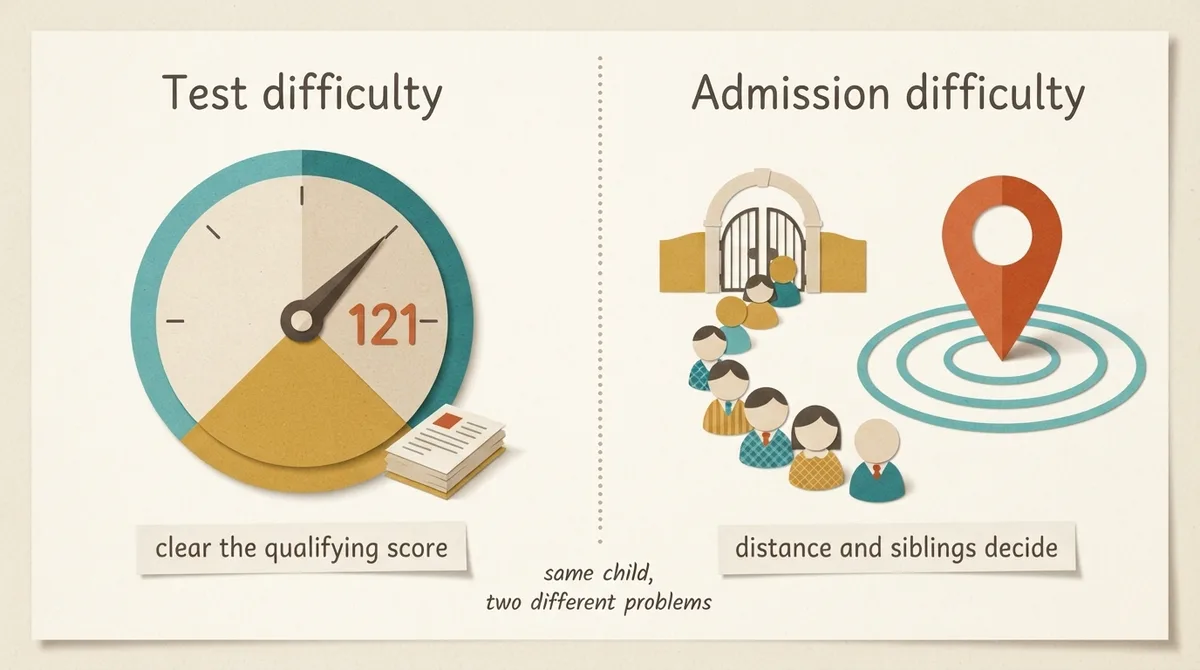
What are the two different difficulties parents keep confusing?
There are two separate problems and they behave in opposite ways.
Test difficulty is answering the papers well enough to meet the published or later-set qualifying standard. Familiarity with a question format can help a child show what they know, but a practice-paper percentage is not an official standardised score.
Admission difficulty is getting a place once the child is eligible. Depending on the school's policy, the order may depend on score rank, care status, pupil premium, siblings, catchment, distance and the other qualified applicants that year.
Buckinghamshire demonstrates the split better than any other system, because the council writes it down. It confirms that "a score above 121 does not mean your child has a higher priority for a grammar school place as Buckinghamshire grammar schools do not use score as an admission rule" (Buckinghamshire Council). The Buckinghamshire grammar schools add that their schools are "usually significantly oversubscribed", with places usually offered to siblings, then to children living in catchment, then to others by distance (The Buckinghamshire Grammar Schools).
For a child who has already received an official Buckinghamshire score of 121 or more, extra marks would not improve their place priority under that system. Before the test, a practice score cannot establish that the child will reach 121 on the day. After the result, check the school's actual catchment and priority rules rather than treating a higher score as an offer forecast.
In a school that ranks applicants by score, a higher score may affect priority under that school's published rules. Check the current admissions policy: eligibility thresholds and ranking rules differ, and neither a practice mark nor a general description predicts an offer.
What are the qualifying scores, according to the people who set them?
Buckinghamshire publishes the clearest set of figures. GL Assessment marks the papers and standardises each child's marks for age in years and months, producing scores between 60 and 170. The Secondary Transfer Test Score is weighted 50% verbal, 25% mathematical and 25% non-verbal, and the qualifying score is 121. The Buckinghamshire Grammar Schools confirm the same threshold.
Kent works differently again. Tunbridge Wells Girls' Grammar School's admissions FAQs state: "We do not have cut off grades. We accept applications from any pupil who is 'grammar-assessed' by KCC, i.e. who has passed the test with the required scores in each paper and met the aggregate score. The score threshold changes each year." The school's Published Admission Number is 174 Year 7 places. A moving threshold means last year's number is a guide, never a target.
Sutton Grammar School's current FAQ says the SET pass mark is decided after marking and participating schools may set their own. For Sutton Grammar, candidates who pass are not given their mark; those who do not pass receive their overall score. Do not assume that disclosure rule applies to every school or every second-stage assessment.
This illustrates why a practice-paper percentage is not an official target. If the pass mark is decided after marking, no tutor, app or practice paper can tell you in advance what score you needed. You can only aim to perform as well as the child reasonably can, then stop. Our guide to 11 plus pass marks and qualifying scores by area goes region by region, and the mechanics of age weighting are covered in how standardised scores work.
How far above school level do the papers actually sit?
Difficulty comes as much from format and clock as from content. The Buckinghamshire Secondary Transfer Test is two papers, each about 45 minutes long (60 minutes with the introduction and examples), with a break between. One assesses verbal skills and the other mathematical and non-verbal skills. A shorter practice test is usually taken two days before the main test.
The CSSE test in Essex looks nothing like it. It is an English paper lasting sixty minutes with ten minutes of additional reading time, plus a Mathematics paper lasting sixty minutes, with no separate verbal or non-verbal reasoning paper at all. A child prepared exclusively on reasoning drills would be badly aimed for Essex, and a child prepared only on English and maths would be badly aimed for Buckinghamshire.
This is why the generic answer fails. The format and content vary by region. Check the actual test instructions and age-specific content before planning practice.
How competitive is it really?
Split the country into two rough types.
Buckinghamshire sets a qualifying score and then allocates places under published admission criteria. The test result and the school-place decision are separate steps; read each school's criteria.
Some schools rank applicants or use multiple stages. Tiffin School held its Stage One tests on 2 October 2026 across morning and afternoon slots, with Stage Two tests on 12 November 2026 "for those invited", and awards up to 10% of places to boys demonstrating aptitude in Sport (5%) or Music (5%). Some grammar schools using Sutton’s shared Selective Eligibility Test require a second stage. Check the target school’s process rather than assuming every SET participant has the same stages.
A two-stage process means applicants must meet the school's published requirements at each stage. Familiarisation may help a child understand the instructions and format, but it cannot remove test-day variation or guarantee progression. Use the school's own current guidance when deciding whether practice is appropriate.
Published competition figures can use different cohorts and definitions. Read the school's current admissions policy for the criteria it applies, and avoid treating past applicant numbers as an individual offer probability.
How close is the margin, and is the 11 plus getting harder?
Buckinghamshire publishes something unusually candid about near misses. Its Selection Review guidance states: "historically most successful Selection Reviews have been for children whose score was between 110-120. Children with lower scores are rarely successful at Selection Review."
That 110 to 120 range refers to the official Buckinghamshire result after the test, not a practice-paper mark or a national review band. The council allows a Selection Review for any child below 121 and says most historically successful reviews were in that range. A review considers evidence that the child is suited to grammar school; it is not another sitting or a promise of qualification. Families should also check a target school's separate Pupil Premium rule and still name their preferred schools on the home-council application.
Does it get harder each year? This review does not establish a comparable national year-on-year trend. Thresholds move because cohorts and papers vary, which is exactly why Tunbridge Wells Girls' notes that "the score threshold changes each year" and why Sutton refuses to publish a mark in advance. This review did not establish a comparable national trend in preparation volume, so it should not be used to explain changes in perceived difficulty.
What genuinely makes it hard for a ten-year-old?
Commonly reported challenges include:
- Pace. Timed papers can leave little room to dwell on one unfamiliar question. Check the actual paper length and number of questions for your child's test.
- Unfamiliar question types. Some tests include formats pupils may not have encountered in ordinary lessons; check the test owner's familiarisation materials.
- Stamina. Some tests have more than one paper or stage, so a child may need to keep concentrating after a break.
- Emotional load. Children may feel pressure when adults care about the result; keep the conversation focused on the test outcome rather than the child's worth.
- Single-sitting risk. The main assessment may offer no routine resit; check the test owner's illness and late-test rules.
For a hypothetical 60-minute paper with 50 equally weighted questions, spending 90 seconds on each of the first ten uses 15 minutes on one fifth of the questions. That leaves 45 minutes for the other 40. A child should follow the actual paper's instructions about moving on or returning to a question. The example is a pacing calculation, not the format of every 11+ test.
To see what pace a particular paper asks for, enter its minutes and questions below. It gives the seconds each question can take and the checkpoints to learn.
This part of the guide works out seconds per question and checkpoints for a timed paper. It works in your browser.
How much preparation is enough?
Plan backwards from your child's actual test date. Buckinghamshire's 2027-entry timetable put its practice test on 8 September 2026 and its main test on 10 September, at the start of Year 6. A plan that starts timed papers in the spring of Year 6 would therefore miss that sitting. Other schools test on different dates and may use more than one stage.
For a later intake, start with reading and secure maths during Year 5, then use the test owner's familiarisation materials when they become available. Add short question-type practice if it helps, followed by a few timed sittings before the actual test to learn the instructions and pacing. Review errors with your child and leave space for school, sleep and ordinary activities. There is no official number of weekly sessions or mock papers that suits every child. Our year-by-year plan helps you match work to the relevant test date.
If your child has already taken the test, preparation for that sitting is over. Use the official result to decide whether to name a school, supply school-specific evidence, request a review where available or plan an appeal after offers. The results guide separates those steps. The pacing widget above is useful for a later sitting, not for changing a result already issued.
What are the warning signs of too much pressure?
The NHS guidance on helping your child beat exam stress suggests noticing changes such as:
- worrying a lot or feeling tense
- not sleeping well
- headaches or stomach pains
- eating less than usual, or more
- being irritable
- no longer enjoying activities they used to enjoy
- negative comments, a low mood or feeling hopeless about the future
Listen to your child, ease the pressure and talk to a supportive teacher if needed. The NHS recommends sleep, balanced meals and exercise during exams. If anxiety or low mood is severe, persists and interferes with everyday life, the NHS says to get help; a GP is a good place to start.
One quiet reframe helps enormously: tell your child, honestly, that the result partly depends on things nobody controls, including where you live and how many other children applied. That is not a comforting fiction. It is what the admission authorities publish.
When should you stop preparing?
Before the test: stop adding work when practice is making your child more anxious without helping them understand the format. Check the real paper date and keep the plan manageable. A practice score cannot certify that a child will qualify.
After the test: stop revising for that sitting. An official Buckinghamshire score above 121 does not improve place priority merely by being higher. A score below 121 calls for a decision about the Selection Review, any school-specific lower-score route and the separate school application, rather than more practice for a completed test.
The DfE's 2026/27 release says 83.6% of all secondary applicants received their first preference for September 2026 entry, and 95.0% received one of their top three. Those are national offer rates across all secondary schools. They are not an 11+ pass rate, a grammar-school offer probability or a forecast for a child applying for September 2027.
Is 70% enough to pass the 11 plus?
There is no reliable answer in percentage terms, because most authorities do not select on raw percentages. Buckinghamshire converts raw marks into an age-standardised score between 60 and 170 and qualifies children at 121, and Sutton Grammar says the SET pass mark is decided after marking. The same raw percentage may have a different meaning across tests or years, because raw marks and standardised qualifying scores are not interchangeable. During practice, track the question types and timing that need attention; do not treat a mock score as an official admission result.
What is the highest possible 11+ score?
There is no single national maximum because test providers use different scoring scales. Buckinghamshire says each standardised score falls between 60 and 170 and that 121 is enough to qualify. Kent says its 2026 Test had a highest possible aggregate of 423, with a grammar assessment requiring at least 345 overall and 111 in each paper. These are different scales, and neither maximum tells you what a particular school will offer. See our pass marks and qualifying scores guide for other routes.
Does the 11 plus get harder every year?
Not in any documented, systematic way. Thresholds move with the cohort and the paper, which is why Kent schools state that the threshold changes each year. What has changed in many catchments is how much preparation is common, which increases the felt intensity around the exam without altering the test itself.
What percentage of pupils pass?
It depends entirely on the area. Buckinghamshire expects about 37% of its test-takers to reach 121. Some schools rank applicants and others use qualifying standards with separate admissions priorities. Their rules differ, so a national pass-rate figure would not predict an individual result.
If they do not pass, what then?
Check your area's review or appeal rules, the policy of each school you might name and your home council's application deadline. A score below one area's qualifying mark can mean something different elsewhere, and a review request does not submit a school application.
The honest answer
The 11+ can be demanding, and the place decision is school-specific. Find your child's test date and question format while preparing. Once a result arrives, read the school's admission priorities and complete the home-council application. A qualifying score is an eligibility step, not an offer. For a later sitting, our practice resources can help a child learn the format without treating a mock score as an admission prediction.
Topics
- 11 plus
- difficulty
- exam pressure
- grammar schools
- pass marks