


How 11 Plus Standardised Scores and Age Weighting Work
Calculate a CSSE score for September 2027 entry using the published 2026 test figures. See how age adjustment works, then check what the score means for school applications.
 Elspeth Marlow
- 14 min read
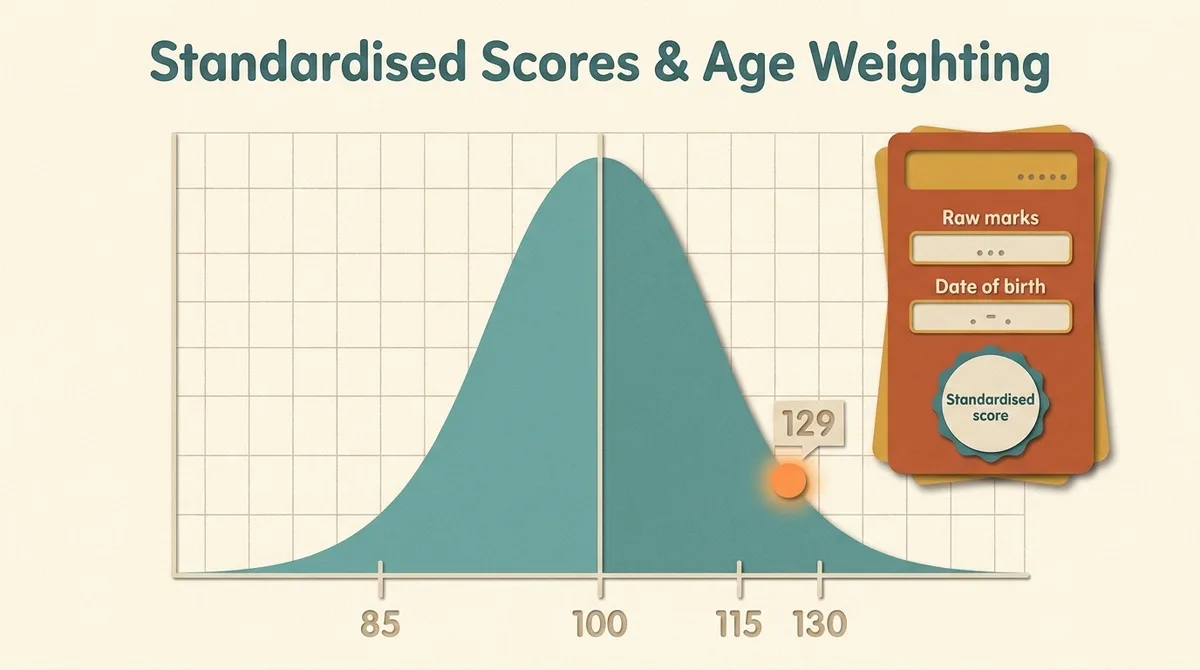
Your child comes home from an 11 plus paper and says they got 38 out of 50. That raw mark shows performance on that paper, but it does not establish an admissions outcome. It will be converted into something called a standardised score, and that conversion depends on how hard the paper turned out to be, how the rest of the cohort performed, and, in most areas, exactly how old your child was on the day of the test. A child who scores 38 in September and a child who scores 38 in a different year can end up with very different standardised scores.
A useful calculator must identify the test year, the published conversion method and any age adjustment. A raw practice percentage cannot supply missing cohort statistics. Check these inputs before treating an output as an official-style score.
CSSE has now published its 2027 Entry Standardisation Report, covering the September 2026 test. The exact formula, that cohort's mean and standard deviation for each paper, and the per-day age adjustment coefficients are in the PDF. The calculator below uses those figures. If you already have your result, use our CSSE Essex results and application guide to decide what to do before your home council's school application deadline. Your results email, the CSSE 2027-entry information guide and each school's current policy are the official sources.
How do you work out your child's standardised score?
You can follow the published calculation by hand or with a calculator. Which method you use depends on your region, because 11 plus formats and scoring differ significantly across England.
If your child sat the CSSE paper in September 2026 for 2027 entry, use the published figures. The 2027 Entry Standardisation Report covers 4,994 candidates. The English raw-mark mean is 33.39275 with a standard deviation of 7.99467; the maths mean is 25.79892 with a standard deviation of 12.79306. Then:
- Standardise each paper on its own: subtract that paper's mean from your child's raw mark, divide by that paper's standard deviation, multiply by 15, then add 100.
- Work out "days younger": your child's date of birth minus 01/09/2015.
- Add the age allowance to each paper. Multiply days younger by 0.011920655 for English and by 0.004737682 for Maths, then add each result to the matching standardised score.
- Add the two adjusted scores together and multiply by 1.5. That is the total score CSSE uses.
Or let the calculator below do the arithmetic, using the same published 2027-entry figures. The widget displays totals to one decimal place; the worked example later in this guide uses two. Your result email is the official record; check any discrepancy with CSSE.
This part of the guide is a score calculator. It works in your browser.
For other tests, use the method published by the admission authority. GL Assessment explains standard age scores for its nationally standardised school assessments, such as NVR. Those reference norms are not a raw-mark conversion table for every selective 11+ test (GL Assessment score guidance). A selective test can use its own reference group, subject weights and score range.
Without the relevant conversion and age adjustment, you cannot turn a home practice percentage into the official result. Guessing the mean and spread produces a mathematical illustration, not an admissions forecast. Our 11+ score calculator by area uses published methods and thresholds, and explains where a calculation is unavailable.
The CSSE calculation above applies only to the named 2026 test cohort for 2027 entry. Do not apply those coefficients to another paper or year.
What does a standardised score actually measure?
A standardised score expresses performance relative to the reference group used for that test. Where the test is age-standardised, it also allows for age differences. The reference group may be a national sample or an admissions cohort; check the provider’s explanation.
It rescales the raw mark against the reference group for that paper. A paper with an unusually tricky comprehension may produce lower raw marks across the cohort, so a 38 on one paper and a 44 on another can lead to similar standardised scores. CSSE's 2027-entry guide says its results email includes the raw English and maths scores as well as the overall standardised score. Use that email as your child's official result; a mock mark from a different provider cannot be converted with the CSSE formula.
GL’s NVR school-assessment guidance describes a national reference scale with an average of 100 and a standard deviation of 15. It explains why scores in that assessment are clustered around the average. A local 11+ total or weighted score can use a different scale.
For the GL NVR school-assessment reference scale described in that source:
| Reference band | Approximate proportion of the national sample |
|---|---|
| 85 to 115 | Two-thirds |
| 70 to 130 | 95% |
| 60 to 140 | More than 99% |
These are reference bands for that assessment, not admission cut-offs or a lookup table for CSSE totals.
Read the scale on your child’s results letter before interpreting a number. Neither a national reference curve nor a raw practice percentage tells you whether a particular school will offer a place.
Why does the 11 plus adjust scores for your child's age?
Children born in August sit the same paper as children born the previous September, and there is nearly a full year of development between them. GL Assessment puts it plainly: the oldest pupils in a class are very nearly twelve months older than the youngest and typically achieve higher raw scores (GL Assessment). Age adjustment aims to account for an age-related difference in performance, where the assessment’s evidence supports it.
Some assessments use age-specific norms to compare performance. GL does this by building age bands into its norms, which is why an older pupil can post a higher raw score than a younger pupil and still receive a lower standardised score. Buckinghamshire Council describes the same principle for its secondary transfer test: each child's score is standardised to account for their age when the test was taken, then weighted according to the different sections (Buckinghamshire Council).
CSSE does it differently and, unusually, transparently. Rather than baking age into the norms, it standardises each paper first and then adds an explicit allowance per day of age. It also does not assume the adjustment is needed. The published report says a statistical test was used to assess whether age adjustment was necessary to take account of any apparent bias against younger candidates. For the 2026 test the result was statistically significant for both English and Maths, so coefficients were calculated for both papers.
For this CSSE cohort, both papers receive an age adjustment. The published coefficients and reference date show exactly how the allowance is calculated.
What happens when two children get the same marks but different birthdays?
This is where the published coefficients stop being an abstraction. The example below is our own, worked from the figures in the CSSE report.
Two children sit the 2026 CSSE paper for 2027 entry. Each receives 33 raw marks in English and 26 in Maths. First, standardise the papers using the published means and standard deviations:
- English: ((33 - 33.39275) / 7.99467) × 15 + 100 = about 99.2631
- Maths: ((26 - 25.79892) / 12.79306) × 15 + 100 = about 100.2358
The first child was born on 1 September 2015, the reference date. With no days-younger allowance, the total is 1.5 × (99.2631 + 100.2358), or about 299.25.
The second child was born on 31 August 2016. The dates span a leap day, so this child is 365 days younger than the reference date:
- English allowance: 365 × 0.011920655 = about 4.3510
- Maths allowance: 365 × 0.004737682 = about 1.7293
- Adjusted papers: about 103.6141 and 101.9650
- Total, calculated before rounding: about 308.37
The official report also gives a separate mathematical reference example: average raw inputs on both papers and a 1 September 2015 birthday produce 300. Those average inputs contain decimals; the example above uses whole raw marks that can be entered in the widget.
Now read the threshold. CSSE states that secondary school offers are not made to any child scoring under a total standardised score of 303, with successful appeals and special consideration places falling outside that criterion (CSSE guide for 2027 entry).
With the same two raw marks, the older child’s illustrative total is below 303 and the younger child’s is above it. This shows what the published age adjustment does for two children with the same raw marks. It does not predict either child's chance of an offer at a particular school.
One caution: the coefficients change every year, because they are recalculated from that year's cohort. Do not carry the 2026 numbers into a future paper. Check the CSSE Freedom of Information page and the report for the exact test year before calculating anything.
Can an 11+ score tell you a national percentile?
Only when the provider supplies a valid percentile interpretation for that assessment and reference group. GL’s national percentile ranks for its school assessments compare pupils with the assessment’s national sample. They are not a universal lookup for selective entrance-test scores.
A score of 129 on a national 100-centred scale and a score of 129 in a local admissions system need not mean the same thing. Use a percentile printed on the report or published for the specific test. For admissions, check the area’s qualification rule and the school’s oversubscription policy separately. Our guide to 11+ pass marks and qualifying scores by area explains that distinction.
Why can't you compare a 121 with a 303?
The important distinction is that areas can use different tests, reference groups and scales. Their scores do not directly compare test difficulty or a child's performance across areas.
Buckinghamshire produces one standardised score across the whole test, and states that children who achieve a standardised score of at least 121 are eligible to be considered for a Buckinghamshire grammar school place. That number lives on the familiar 100-average scale.
CSSE produces a total built from two standardised papers, each already on the 100 scale, added together and multiplied by 1.5. The report’s reference example gives 300 for average raw inputs and the oldest reference birthday, before any age allowance. A younger candidate with those inputs has a higher adjusted total. A 303 is not a harder or easier achievement than a 121 in any straightforward sense. It is a different unit.
| Test | Published scale or calculation | What the qualification figure means |
|---|---|---|
| Buckinghamshire STTS | Standardised scale from 60 to 170 | 121 qualifies; a higher score does not itself give extra admission priority. |
| CSSE 2026 test for 2027 entry | 1.5 times the sum of two age-adjusted paper scores | 303 is the published minimum for an ordinary offer, rather than a school-specific offer score. |
The reference groups and admission rules differ. These figures do not describe the same children taking the same test.
In Essex, clearing 303 does not mean an offer. School cut-offs depend on the year's applications, priority areas and each school's admissions policy. The newly published 2027-entry historical guidance sheet shows March 2026 offers for September 2026 entry. Use it as context, not as a cut-off for your child's 2027-entry application.
Three checks before using a score calculator
Check the assumptions as well as the arithmetic.
They invent the mean and standard deviation. Standardisation is meaningless without the cohort statistics. An output based on assumed means and standard deviations is only an illustration. It cannot reproduce the official calculation without the correct inputs. Ask any tool to show its inputs.
They skip age adjustment or apply the wrong one. Some tools drop it entirely on the false premise that CSSE does not age standardise. Others apply a generic monthly adjustment borrowed from a different board. For CSSE in 2026, the per-day English coefficient differs from the maths coefficient, so a flat adjustment across both papers is wrong even when the total is roughly right.
They reuse last year's numbers silently. Because the mean, standard deviation and coefficients are recalculated annually, an old paper’s coefficients do not calculate another cohort’s result.
Our test for any calculator, including our own: can you see the year, the source, and the exact figures, and could you reproduce the result on paper? If not, treat the output as a rough indication only.
What should you do with your child's score now?
If your child took the 2026 CSSE test for September 2027 entry, compare the calculated number with the official results email. CSSE says the email includes each raw subject score and the overall standardised score. If they differ, check the date of birth and raw marks you entered, then ask CSSE about any remaining discrepancy. The calculator cannot change the official result.
Next, read the CSSE results and application steps. CSSE's 303 minimum is a floor for a normal offer, not a school-specific offer score. Its historical guidance sheet shows earlier allocations, not what will secure a 2027-entry place. Read each school's current policy and name the schools you genuinely prefer on your home council's Common Application Form. Check the council's deadline and any school supplementary-form requirement; registering for the CSSE test did not apply for a school place.
If your child is preparing for a later test, use repeated practice to find topics to work on, keeping the paper, timing and marking method clear. Practice scores from different providers are not automatically comparable and the 2026 CSSE coefficients cannot predict another cohort's result. Our 11 plus mock-exam guide explains how to review a paper after sitting it.
Frequently asked questions
How is an 11 plus standardised score calculated?
The method depends on the test. CSSE's 2027-entry report standardises each 2026 paper using its cohort mean and spread, adds the published per-day age allowance, then multiplies the two-paper total by 1.5. Other providers can use age-specific conversion tables and different weightings. Use the method for the correct test and year.
What is a good score on the 11 plus?
Check the qualifying rule for the relevant area, then the allocation rules for each school. Qualification and an offer are separate decisions. A higher score matters in a score-ranked policy; in another policy, priority area or distance may decide between qualified applicants.
Is 129 a good 11 plus score?
It depends on the test’s scale and the school’s rules. Compare 129 with the qualifying score for that specific test. Do not assign it a national percentile unless the provider publishes one for the assessment, and do not treat qualification as a guaranteed offer.
What is the standardised age score for 11 plus exams?
Age-standardisation allows for the age differences within a school year. The reference scale and any combined total depend on the assessment. GL’s national school-assessment norms and a local selective-test result are not interchangeable.
Are CSSE tests age standardised?
Yes. Some widely shared pages claim otherwise, but CSSE's own published standardisation report describes the statistical test it uses to decide whether age adjustment is needed and gives the per-day coefficients applied for each paper. For the 2026 test, adjustment was applied to both English and Maths.
Can I check the score in my child's results email from the raw marks?
For the 2026 CSSE test, yes: enter the English and maths raw marks and your child's date of birth into the calculator above, which uses CSSE's published 2027-entry formula. The email is the official result. For another test or year, use its own published method; a previous CSSE report cannot verify or predict a later cohort's score.
If you are still building towards the test rather than decoding a result, our overview of how the 11 plus works is the better starting point, and you can start a free account to see how your child's practice scores track over a term.
Topics
- standardised scores
- csse
- gl assessment
- age weighting
- results