


11 Plus Results Day: Understanding the Letter and Your Options
Examples of 11+ results dates and scores, plus the steps from your result to the council application deadline, National Offer Day and any school-place appeal.
 Elspeth Marlow
- 11 min read

A selective-test result may arrive by email, post or an online portal, depending on the area. It may include paper scores, an overall score and a decision about whether the child meets that area's selective standard. The result format and any review process vary, so use the council or school guidance for the test your child sat.
The time between results and the common application form (CAF) deadline is short. Check your home council’s actual deadline: for 2027 entry, Kent closes on 2 November 2026, while Warwickshire closes at 4pm on 31 October 2026. Use that date to plan a considered list of preferences. A place appeal is possible after an admission authority refuses an application. Keep to your home council’s application deadline and include each school you want considered.
This guide picks up where our overview of how the 11 plus exam works leaves off. It gives selected area examples, explains common result terms, and outlines what to check if a child qualified, fell short or wants to appeal after a place is refused.
When 11 plus results day falls, and how the result reaches you
These examples show some result arrangements for September 2027 entry. Dates and delivery methods differ by area, and councils publish confirmed dates for each cycle.
- Kent: results emailed on Thursday 15 October 2026 to the address used at registration. Families who gave no email address get a first class letter on results day, and can ask the child's primary school for the scores the day after (Kent County Council).
- Buckinghamshire: Secondary Transfer Test results emailed after 4pm on 9 October 2026 (Buckinghamshire Council).
- Medway: Medway Test results emailed after 10am on Wednesday 14 October 2026, posted the same day where no email address was registered (Medway Council).
- Warwickshire: results published via the Parent Portal on 16 October 2026, after tests on 12 and 13 September 2026 (Warwickshire County Council).
- Bexley: results by email from 4pm on Friday 2 October 2026. The result is a weighted age-standardised score built around a scale centred on 200 (London Borough of Bexley).
- South West Hertfordshire Consortium: for 2027 entry, final results were due on the Parent Portal on Thursday 15 October 2026 at around midday, with an email alert. Log in to the portal for the result itself (consortium FAQ; test calendar).
- Redbridge: the council’s current page says results are emailed in the middle of October; it does not confirm an exact release date or time. Check the council portal or contact the council if you have not received the result. The test is provided by GL Assessment (London Borough of Redbridge).
These regional examples release results in October. Other tests can have different schedules. Use our sourced 11+ dates calendar and your home council’s application guidance to check the dates that apply to your child.
If your child sat the South West Herts Consortium test
The South West Herts Academic Ability Test covers Mathematics and Verbal Reasoning. The consortium says each raw score is age-standardised using the child’s age in completed months. It does not set a pass mark: each school applies its own admissions rules, and a score by itself is not an offer. Historical lowest scores offered can help with context, but the consortium cautions that standards can vary between years (consortium FAQ).
If you think there may have been a marking error, the consortium’s marking-review window for September 2027 entry is 15 October at noon to 2 November 2026. The published administration fee is £50, and responses are expected within 15 school days after the window closes. This is a check of marking, not an appeal against a school place decision (marking-review instructions).
Keep the school application moving while a marking review is pending. The consortium says test registration is separate from the Common Application Form (CAF), which goes to the local authority where you live. Hertfordshire’s on-time secondary application deadline is 31 October 2026; if you live elsewhere, use your own council’s deadline. You can apply to consortium schools without a qualifying pass mark because there is none, but each school’s postcode, priority and oversubscription rules still decide who receives an offer. See the South West Hertfordshire area page for the school-by-school differences.
What the numbers in the letter mean
Result formats vary. For example, a Kent result gives standardised scores for English, maths and reasoning plus a total; a Medway result gives a total and a paper breakdown. In Kent, children receive three standardised scores (English, maths and reasoning) plus a total, and each individual score falls between 69 and 141, so the highest possible total is 423. Medway's notification gives the total, a breakdown per paper, a decision on suitability for a grammar or non-grammar school, and next steps.
Some authorities report standardised scores rather than raw marks. Check the explanation supplied with the result. Standardisation, as Kent describes it, is "a statistical process which compares your child's performance with the average performance of other children in each test", with "a slight adjustment made to take account of each child's age so that the youngest are not at a disadvantage". Age standardisation may affect the reported score; check the test authority’s explanation of how its scores are calculated.
One warning that applies to every area: a suitability assessment is not an offer. Medway states plainly that being assessed as suitable "does not guarantee them a grammar school place". Meeting a test threshold can make a child eligible to be considered, but the school's oversubscription criteria decide how eligible applicants are prioritised and do not guarantee an offer.
Myth: a standardised score is always out of 100
Reality: the scale depends entirely on the area, and assuming 100 is average will make you misread your own child's letter. Authorities may report paper scores, aggregate scores or weighted averages on different scales. Do not assume that 100 is the average or that two areas’ scores are comparable.
The published thresholds show how far apart these systems are:
- Kent (2026 test): a grammar assessment required a total of 345 or more, with no single score below 111.
- Buckinghamshire: a standardised score of at least 121 qualifies a child for grammar school consideration. A successful Selection Review or appeal may also qualify a child. Some grammar schools have separate Pupil Premium arrangements with a lower score threshold; check the individual school's policy.
- Bexley: the council reports a weighted age-standardised average of 200, with approximately two-thirds of candidates between 170 and 230.
A score of 121 has a specific meaning in Buckinghamshire and should not be interpreted as a Bexley score. Kent's 2026 rule also required both the aggregate threshold and the minimum score in each paper. Our grammar school league table puts published school outcomes in context, but it does not replace checking each school's current admissions policy.
Use the 11+ score calculator by area to check a reported result against its published method and qualification rule. A selective-test score is not automatically a national percentile, and qualification does not guarantee a school place.
Myth: if the score is disappointing, you appeal now
For the normal September 2027 admissions round, the October test result is not a refusal of a school place. An admission appeal challenges a refused application, rather than the test result itself. Kent puts it directly: a child who was not tested or not assessed as suitable can still be named on the application, and "your application to that school will be refused when school places are offered on 1 March 2027". The right to appeal that refusal arises at that point.
The practical consequence is the single most important thing on this page. An appeal is against a refusal of an application. If you do not name a school on the CAF, there is no decision refusing that application to appeal on National Offer Day. You may be able to apply later and appeal if refused, but the late-application rules and timing will apply. For an on-time application, meet your home council’s deadline, receive the school decision on National Offer Day, then follow the refusal letter’s appeal instructions. An appeal can include a case for admission despite a non-qualifying test result, but the panel decides it under the applicable rules.
This example uses Warwickshire’s published 2027-entry application schedule; it is not a national timetable:
- Tests sat in September 2026.
- Results released 16 October 2026.
- Secondary application deadline 4pm on 31 October 2026.
- Extended deadline for eligible address changes: 31 December 2026.
- National Offer Day 1 March 2027.
- Appeals lodged with the individual schools after 1 March.
If your child qualified: complete the school application
Qualifying is the start of the application, not the end of it. Rank schools in genuine preference order. Schools consider each application against their own admission rules, then your council offers the highest preference for which your child qualifies, so there is no tactical benefit to demoting a first choice. Check each grammar school's oversubscription criteria individually, since catchment, distance, sibling priority and Pupil Premium rules differ between schools in the same county.
Name a realistic non-selective school too. A CAF listing only grammar schools can leave a qualified child allocated to whichever school has space in March. If you are weighing up how competitive a score is against a school's historic entry point, our regional guides set out which test each area uses and how places are allocated.
If the score is borderline: reviews are an autumn process
A Selection Review or Headteacher Review is separate from a school-place appeal. Review availability, timing, evidence and outcome vary by area. Admission appeals are heard after an application is refused, usually after National Offer Day in the normal admissions round.
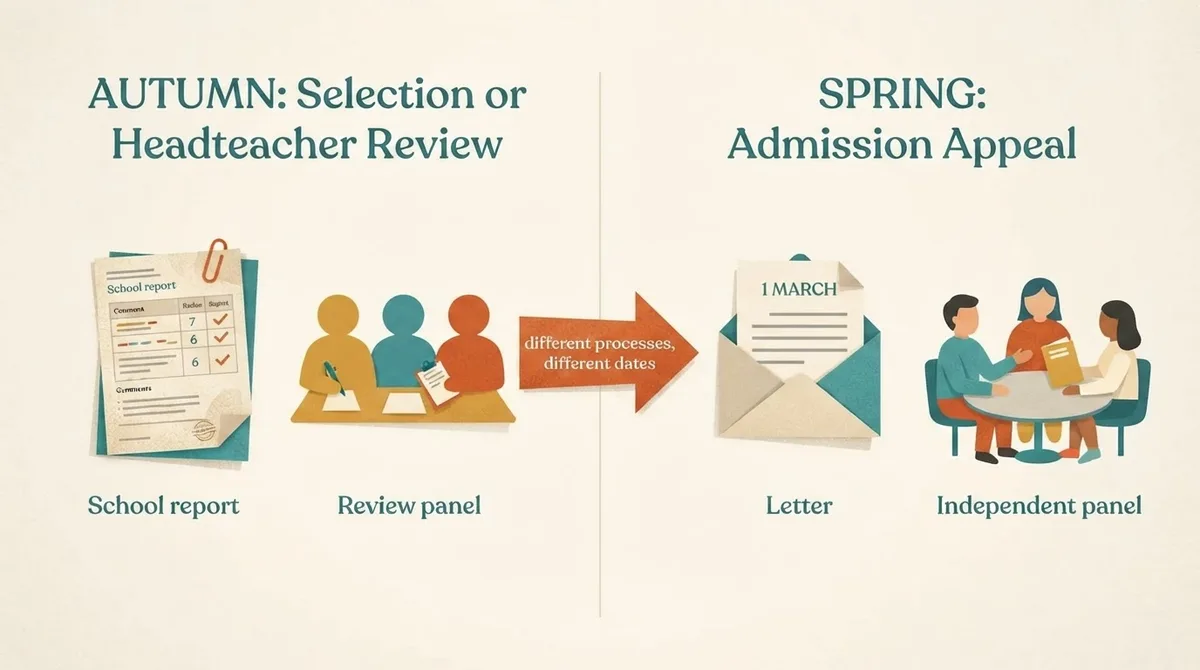
Evidence requirements depend on the review or appeal. For example, Buckinghamshire's unqualified grammar appeal guidance asks for academic evidence such as school reports, SATs results or a school letter, and says not to submit schoolwork. Follow the instructions for the relevant authority and stage.
Review processes differ. Buckinghamshire accepts parent-requested Selection Reviews after results. For Bexley's September 2027 entry, headteachers submit review requests in October and the panel considers them in November, after the application deadline; parents are advised to include a Bexley grammar preference so a successful review can be considered. Kent's Headteacher Assessment is different: primary headteachers can refer assessment decisions before parents receive their results. Check each authority's current instructions and deadlines.
Appeal outcomes vary by authority
Buckinghamshire reports that in 2025, 7 of 105 qualified Year 7 grammar-school appeals and 4 of 169 unqualified appeals succeeded, reported as rounded rates of 7% and 2% (Buckinghamshire Council). These figures describe Buckinghamshire's appeals that year and should not be applied to other areas or future years.
For a Buckinghamshire appeal after an unsuccessful Selection Review, the panel first considers whether the review was carried out in a fair, consistent and objective way. If it was, the council says the panel cannot then consider new academic evidence or the parent's reasons. If the review was not processed correctly, the panel can go on to consider evidence of grammar-school ability and the reasons for seeking that school. The School Admission Appeals Code sets out a different process when no local review took place, so do not assume every area follows Buckinghamshire's procedure.
What you are guaranteed is process, not outcome. Under the School Admission Appeals Code and GOV.UK guidance, the admission authority must allow at least 20 school days to appeal from when it sends the decision letter. It must give at least 10 school days' notice of the hearing; normal-round appeals must be heard within 40 school days of the appeal-submission deadline. The decision is usually sent within 5 school days. The panel has at least three independent members. In a standard secondary appeal, the panel examines the arrangements and the school’s case about admitting more pupils, then balances the family’s case where required. Selective non-qualification appeals have the additional academic and review rules described above.
Waiting lists, and the child in front of you
If you want a refused school, check how to join its waiting list while an appeal is pending. Waiting lists are ordered using the school's published admission arrangements, not simply by date of joining. Admission authorities must maintain a waiting list for at least the first term of the school year, but local arrangements can keep lists open longer.
Help your child see the result as information about that assessment. Ask how your child feels about the result and make clear that a test score is not a judgement of their worth. Whatever the number, the useful next conversation is about the secondary school they will actually attend and what they want to be good at there. If you are supporting a younger sibling through the same cycle, regular practice can help them learn the question formats and topics they need. Keep it suited to the child's age, interests and target test.
Topics
- 11 plus results
- results day
- appeals
- admissions
- grammar schools