

What Is the FSCE 11 Plus Exam? Format, Skills and Preparation
FSCE specifications vary by school. Read the CCHS 2027-entry familiarisation example, distinguish it from other schools’ tests and check current entry arrangements.
 Elspeth Marlow
- 9 min read
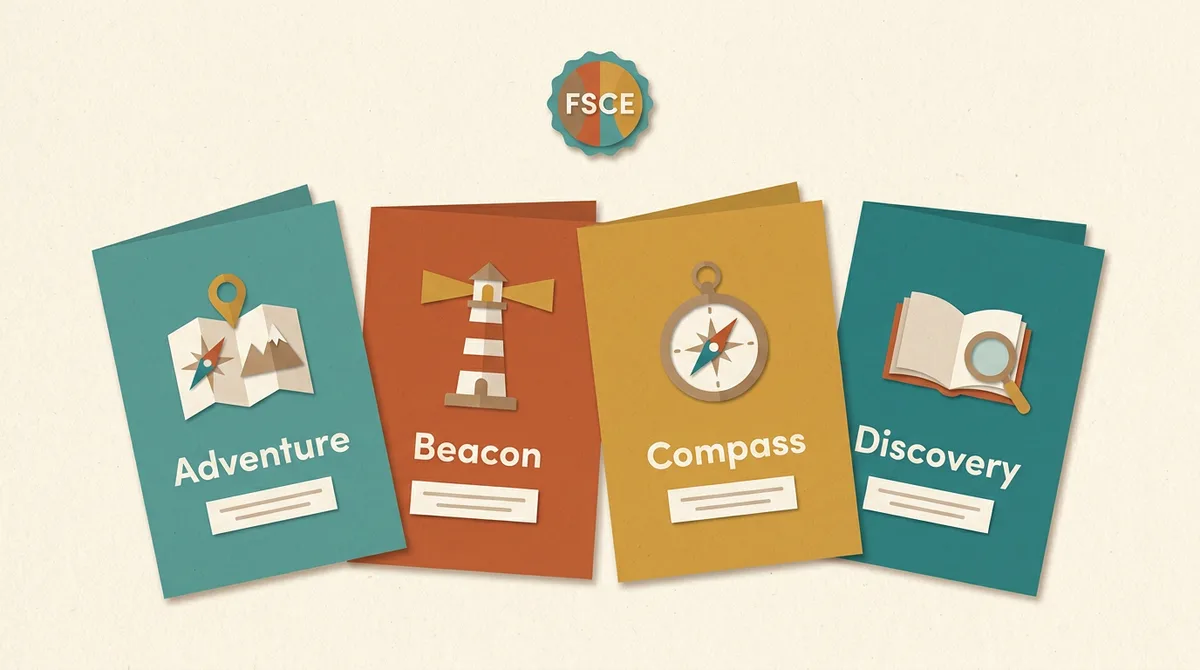
FSCE is a test provider, not one entrance-test specification used by every school. Its official parent page tells families to read the target school’s admissions guidance because specifications differ.
This guide uses the children’s and parents’ familiarisation documents linked from Chelmsford County High School’s 2027-entry page as a detailed example. The documents carry a 2026 copyright date and describe the test for September 2027 entry, which was sat in September 2026. Their four-paper structure and answer rules describe that CCHS example, not every FSCE school or the next entry year.
Start with your own school’s current guide. Check its subjects, paper structure, answer materials and entry year before using any practice pack. Use the grammar school directory to find the school’s admissions information. Sharing a provider does not always mean sharing a test or score.
What FSCE actually is, and what it is not
FSCE stands for Future Stories Community Enterprise. It describes its work as "bespoke and accessible 11+ and In-Year tests, written by Grammar Schools, for Grammar Schools".
FSCE draws on the Key Stage 2 curriculum taught up to the end of Year 5. The school’s specification determines which content and answer formats apply. For example, Trafford’s announced test for 2028 entry draws on the KS2 programmes of study, with one paper on English and mathematics and a second on other subjects; CCHS’s linked guide describes a wider range of curriculum subjects.
The CCHS example: four named papers
The children’s guide linked from CCHS’s 2027-entry page states that there are four different papers, "which might be sat in any order":
- Adventure Paper: any of the listed subjects, answered with multiple choice answer options
- Beacon Paper: any of the listed subjects, answered with short written answers
- Compass Paper: any of the listed subjects, answered with multiple choice answer options
- Discovery Paper: "a paper which will require a Creative Response"
Each paper has its own question booklet and its own separate answer sheet, and the booklets are branded by entry year, for example "Adventure Paper 2026 Entry" (CCHS Information for Children, copyright 2026).
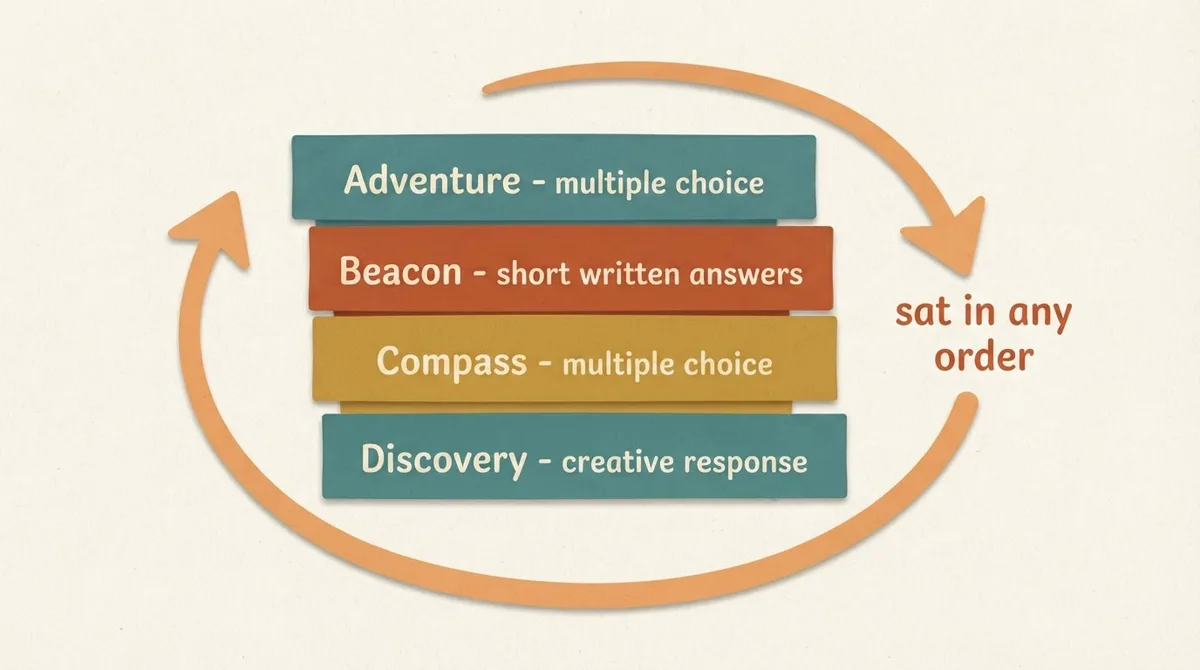
Read that carefully, because it changes how you prepare. The papers are named after the answer format, not the subject. Adventure, Beacon and Compass can each draw on any listed subject, and the guide says papers may be sat in any order. This describes the CCHS example. The school’s guide is the source to use for its own entry year; do not assume another FSCE school follows it.
The eleven subjects listed in the CCHS guide
The CCHS guide lists eleven Key Stage 2 subjects its test may include: Art and Design, Computing, Design and Technology, English, Geography, History, Languages, Maths, Music, Physical Education and Science. The guide stresses this "shouldn't be anything new or extra to what you have already been taught up until the end of Year 5 only".
That list is in the CCHS parent guide, which also says children do not need to play an instrument for its Music questions and that its PE questions are not a practical sports test. These statements apply to that CCHS familiarisation guide. The guide says its example questions are made up, may not appear on the test, and are not indicative of tested content. Do not use an invented example to predict what a future paper will ask. FSCE and CCHS advise families to focus on ordinary primary-school learning and the familiarisation information supplied by the target school.
Audio instructions and answer rules in this example
According to the CCHS children’s guide, instructions are not read out by an invigilator: they come from a voice recording. The recording tells candidates when they may open the question booklet, which page to turn to, the section and page number, how to answer, an example question, how much time is allowed for that section, when to start, and it gives warnings towards the end of each section. FSCE links to a sample of the audio so children can hear it in advance, which is worth doing once.
For this CCHS example, the answer rules are:
- Answers go on separate answer sheets "using a black biro or ballpoint pen", not pencil.
- For multiple choice, one oval must be fully shaded. A horizontal or vertical line through the oval is not accepted.
- To change an answer, cross through the incorrect oval and shade the correct one.
- There is no negative marking: "You will NOT lose any marks for incorrect answers!"
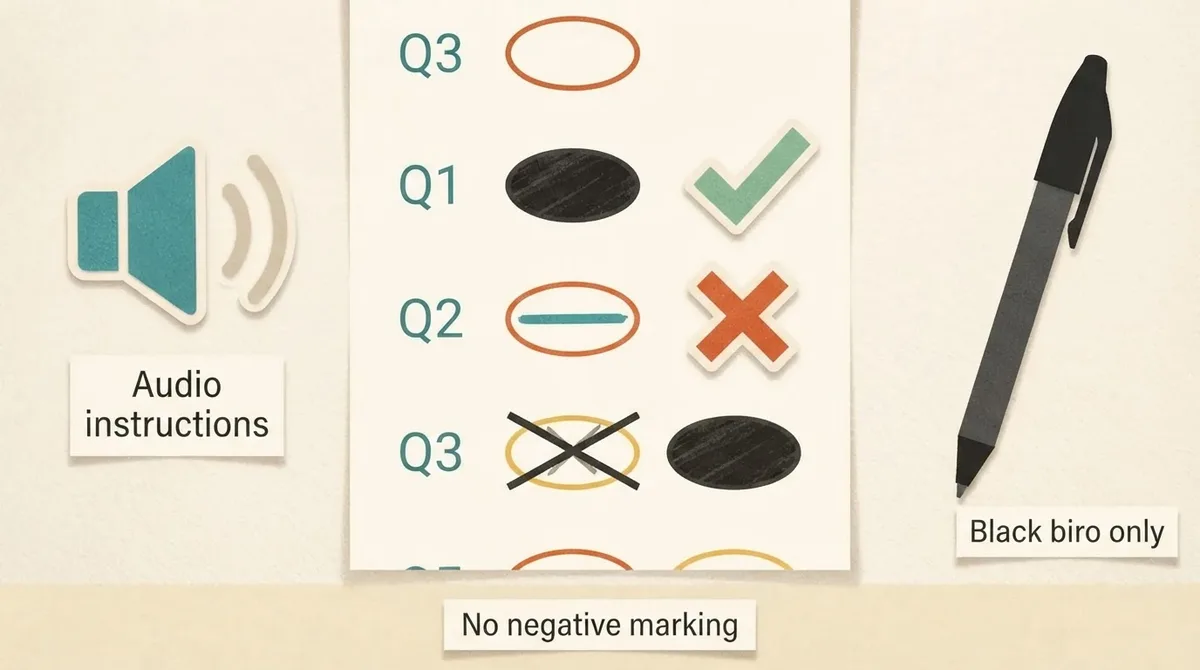
The CCHS guide says candidates must stay within the section named in the recording: they cannot go back to an earlier section or look ahead to a later one. They may return to questions within the current section if time remains. Follow the instructions in the test your child will sit. The guide offers sample audio and answer-sheet examples for familiarisation.
The Discovery response in the CCHS example
For the creative response, candidates may plan in the question booklet, but "ONLY the answer sheet will be marked", and it is written by hand.
The CCHS guide states that only the answer sheet is marked and that the response is handwritten. Its answer sheet and the school’s current instructions should determine what space and constraints apply. This is an example for that entry year, not a universal FSCE writing requirement.
Which details must you check at the school?
Do not assume one FSCE-wide paper count, duration, subject weighting or qualifying score. A familiarisation example shows formats and instructions; it does not establish all the contents of the test your child will sit.
Read the school’s current guide and published admissions policy. Where the school publishes timings or qualification rules, use those for the named entry year. Where it does not, leave the detail unknown rather than borrowing a figure from another FSCE school.
Use your school's current guide
FSCE formats can change. An older guide hosted by CCHS describes three papers, and its current guide describes four named papers. Other FSCE schools may not use the same format, so check your target school's current guide.
Decision 1: should you buy "FSCE past papers"?
FSCE and the CCHS familiarisation guide say that FSCE does not authorise past or practice papers, and that the test content and format can change by year and school. The free familiarisation guide is the official resource for the CCHS example. A third-party resource may still offer general practice, but its “FSCE-style” label does not make it an official FSCE paper or confirm that it matches a particular school’s test. Check the target school’s current guide and policy before choosing materials. See our guide to free 11 plus practice papers.
Decision 2: keep drilling reasoning, or switch to curriculum work?
The Trafford Grammar School Consortium’s published statement says that its test sat in September 2027 (for September 2028 entry) will move from verbal, non-verbal and mathematical reasoning to the Key Stage 2 national curriculum up to the end of Year 5. The consortium says one paper draws on English and mathematics and a second draws on other subjects, and that subjects, question types and format may vary from year to year. This change applies to the Trafford consortium test; it is not a universal FSCE specification.
Choose practice from the subjects and tasks your target school specifies. Do not drop or add a question family solely because the provider is FSCE. If they are also sitting a GL Assessment area test or an independent school test, keep reasoning in the mix, because those boards still use it. Formats vary considerably by region, so start from our 11 plus exam explained overview, and see the full GL, CEM and ISEB comparison rather than assuming one area's format travels.
Decision 3: when to start, now that testing is moving to Year 5
Two school or consortium announcements set different calendars for future FSCE rounds:
- The seven Gloucestershire Grammar Schools (G7) appointed FSCE as admissions test provider for Year 7 entry from 2028 following a competitive tender, and moved the test from September of Year 6 to the latter part of the summer term of Year 5, effective summer 2027 (Pate's Grammar School announcement). Sir Thomas Rich's confirms GL Assessment remains the provider for 2027 entry, with that test on 12 September 2026.
- The Trafford Grammar School Consortium (Altrincham Grammar School for Boys, Altrincham Grammar School for Girls, Sale, Stretford and Urmston) announced on 14 July 2026 that FSCE becomes its admissions test provider from 2028 entry, tested in September of Year 6, moving to the latter part of the Summer Term of Year 5 from 2029 entry.
For Gloucestershire 2028 entry, the test is scheduled for July 2027 in Year 5. For Trafford 2028 entry, the consortium says its first FSCE test will be in September 2027 in Year 6. The Trafford consortium says its move to the latter part of the summer term of Year 5 applies from 2029 entry onwards. These are different dates and year groups; check the participating school’s current admissions page for any later updates.
What to do next
A practical starting plan:
- Download the current parent and child familiarisation guides from your school’s admissions page. Read the child version together.
- Listen to sample audio instructions if the school provides them.
- Use the pen, answer-sheet method and correction rules specified in that guide.
- Practise a short handwritten response if the school includes one, using its stated space and timing.
- Keep school learning, reading and ordinary problem-solving central. Use the school’s subject scope rather than assuming all FSCE tests assess eleven subjects.
Our exam plan can help you organise a schedule around a target date. Recheck that date and the test specification on the school’s official site before committing to the plan.
Topics
- fsce
- 11 plus
- exam boards
- grammar schools
- parent guide