


11 Plus Interview Questions and How Schools Use Them
State grammar schools cannot interview applicants for Year 7 day places. Independent schools may interview, but their formats differ. Check the school process and try forty example practice questions.
 Elspeth Marlow
- 11 min read
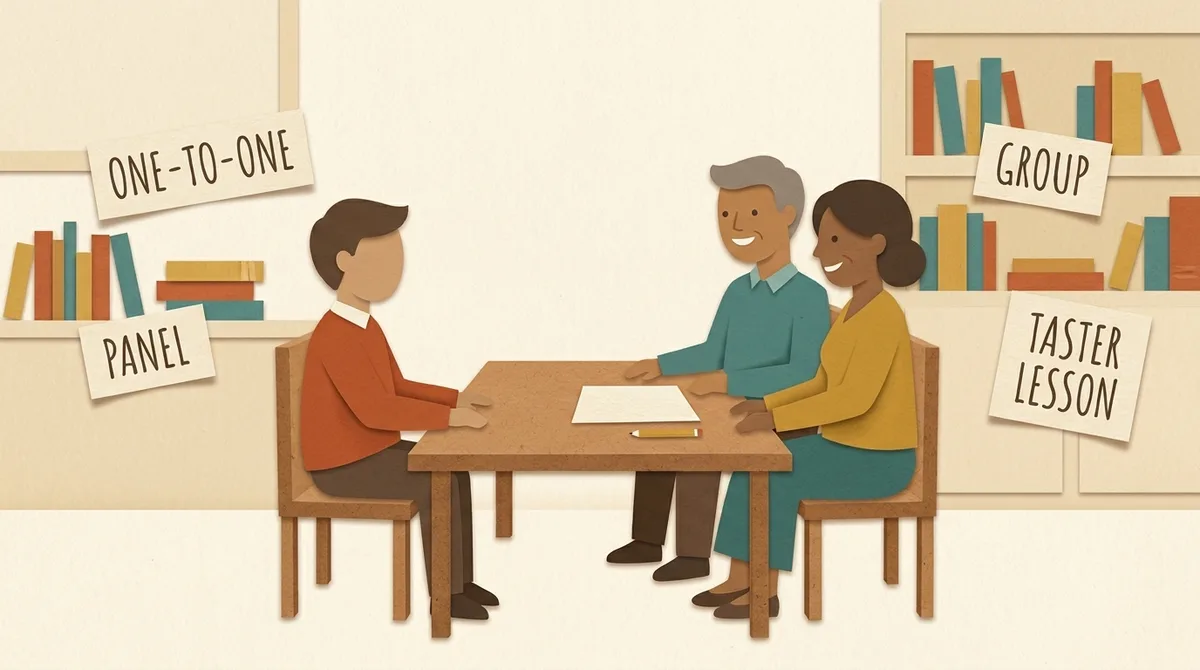
Search for 11 plus interview questions and you will find plenty of lists. Start by checking whether the school you have applied to interviews Year 7 candidates at all, what its interview involves, and what happens afterwards.
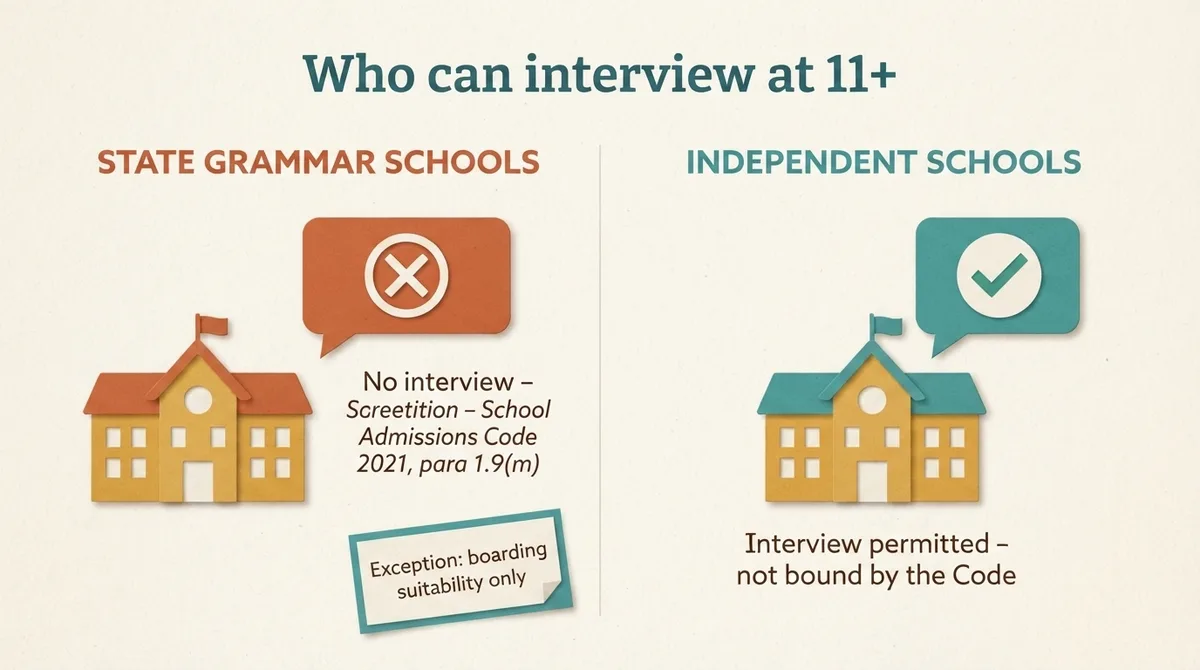
If your child is applying for a Year 7 day place at a state grammar school in England, the admissions authority cannot interview them or you as part of admissions. There is a narrow exception for suitability for boarding at maintained boarding schools. An independent school may interview, but you should check its current admissions page before preparing. Published examples include an individual conversation, a two-staff interview, a group interview and classroom activities.
Work through the checks that apply to your child. The forty questions in step five are our practice examples, not questions supplied or promised by any school.
Step 1: Check whether the school is legally allowed to interview at all
Admissions to maintained schools and academies in England are governed by the statutory School Admissions Code 2021.
Paragraph 1.9(m) says admission authorities must not interview children or parents as part of admissions. It allows a sixth-form meeting about course options and entry requirements only if that meeting does not affect the offer decision. Boarding suitability is a separate exception below. Paragraph 1.9(n) says admission authorities must not request financial contributions, including voluntary donations or refundable deposits, as part of admissions or for tests.
State grammar schools are maintained schools or academies and must follow the Code. A selection test establishes academic eligibility; when more children qualify than there are places, each school applies its published oversubscription criteria. Read the School Admissions Code 2021 alongside the school's current admissions policy.
Buckinghamshire is one example: its grammar school process uses the Secondary Transfer Test, followed by each school's admissions criteria for qualified applicants. There is no Year 7 day-place interview. Other selective areas use their own tests and oversubscription rules, so check the particular school's policy. Our guide to the 11 plus exam explains the regional tests.
Paragraph 1.32(c) requires admission authorities to take all reasonable steps to share selection test outcomes before the secondary application deadline, so parents can make an informed choice. A qualifying result does not guarantee a place. Check your local authority's actual application deadline and contact the admissions team promptly if your result has not arrived.
The boarding exception, and what it is not
There is a narrow exception. Paragraph 1.43 permits a maintained boarding school to interview an applicant only to consider a serious health and safety risk to other boarders or whether the child can cope with and benefit from boarding.
That exception is about suitability for boarding, not academic selection. If a maintained boarding school invites your child to an interview, ask it what the conversation will cover.
Step 2: Locate the interview in the school's published timeline
Independent schools are not bound by the School Admissions Code's interview ban, so they may include an interview. The stages and timing vary. Read the current admissions page for each school you are considering.
Three published examples, all for 2027 entry:
- Bancroft's runs entrance assessments on 5 January 2027, comprising an online reasoning test, a short English paper and a short mathematics test. Interviews for selected candidates follow on 23 January 2027, for roughly 65 external places.
- Westminster Under School sets ISEB Common Pre-Tests for November to early December 2026, further written papers on 9 January 2027, then interviews and classroom activities for selected children on 20 or 25 January 2027. Offers are due by 1 February.
- Highgate sets entrance exams in early December in English and Mathematics, alongside a confidential reference from the child's current headteacher, then a second stage in January.
These are examples of published processes, not a common timetable for every independent school. Check the school's current booklet for exact dates, access arrangements and any additional activities.
In these examples, the interview follows written assessments. It remains part of the school's assessment, so do not assume that test scores alone decide the offer. Westminster's booklet describes the shared ISEB Common Pre-Test. ISEB's current school guidance confirms that pupils sit it only once in an academic year and share the results with the schools they apply to. Our ISEB Common Pre-Test guide covers that stage.
Step 3: Find out what the interview day involves
Schools can combine conversations with other activities. These published examples show why it helps to ask about the whole visit:
- An individual conversation. Bancroft's describes its interviews as one-to-one and says no special preparation is needed.
- Two members of staff. Westminster Under School says selected children speak with a senior member of staff from each of its two schools. Its 2027 booklet also lists classroom activities.
- A group interview and taster lessons. Highgate lists both for its January second stage.
Ask the school what it has published for your child's entry year. The same visit may contain more than one activity.
Step 4: Be clear about what the interview is and is not deciding
Schools may use an interview to learn about a child's interests and how they respond to conversation. Some also consider written assessments and a school reference. Read your chosen school's admissions policy to see how its stages contribute to the final decision.
An interview can include academic discussion or an unfamiliar task. There is no universal question list, so encourage your child to explain their thinking and ask for clarification if they need it.
An invitation to a later stage does not itself guarantee a place or a bursary. Highgate's admissions process describes the group interview and taster lessons before offers are made.
Step 5: Work through forty questions, grouped by type
These are practice prompts we wrote, not questions taken from a school's interview. Pick a few that suit your child and let them answer in their own words. A memorised script is less useful than a conversation.
About your child and their current school
- Tell me a bit about yourself.
- What do you enjoy most about your current school?
- Which subject do you find hardest, and how do you deal with that?
- Describe a time you found something difficult and kept going.
- What would your teacher say about you if I rang them tomorrow?
- Do you have any responsibilities at school?
- What do you do when you disagree with a friend?
- Tell me about something you have made or built.
Reading, hobbies and interests
- What are you reading at the moment?
- Tell me about a book you did not enjoy, and why.
- Who is your favourite character in anything you have read, and why?
- What do you do on a Saturday when nobody has planned anything?
- Do you play an instrument or a sport, and what have you learned from it?
- If you could learn one new skill this year, what would it be?
- What is the best film or programme you have watched recently?
- Tell me something you know a lot about that I probably do not.
About this school
- Why do you want to come here?
- What did you notice on your visit?
- Which of our clubs or activities would you join?
- What are you hoping will be different from your current school?
- What could you contribute to the school?
- How would you feel about a longer journey each morning?
Opinions, ethics and the wider world
- What is something in the news you have thought about recently?
- Should children have homework at weekends?
- Is it ever right to break a rule?
- What is the most important invention of the last hundred years?
- If you could change one thing about your town, what would it be?
- Should everyone learn a second language?
- What does fairness mean to you?
- Is it more important to be clever or to be kind?
Thinking on your feet
- How many pairs of shoes do you think are in this building?
- Explain how to make a cup of tea to someone who has never seen a kettle.
- If you could have dinner with anyone from history, who and why?
- Would you rather be able to fly or be invisible?
- What would you put in a time capsule for children in 2126?
- If you ran this school for a day, what would you change?
- What question would you ask a scientist?
- Design a new subject for the timetable and tell me what happens in the first lesson.
Questions your child asks
- What do pupils here find hardest in Year 7?
- What is something about the school that visitors usually do not notice?
For question 9, your child might name a book and say what caught their attention: a character's choice, a surprising fact or a question the story raised. Let the answer come from a book they have actually read.
Step 6: Check the award process for your child's entry age
An independent school's music or academic award may have additional assessments. Check the entry age carefully. For example, Westminster's King's Scholarships are for 13+ or 16+ entry to Westminster School, not 11+ entry to Westminster Under School. The Challenge is a 13+ examination sat in Year 8, so it does not belong in an 11+ interview plan.
For 11+ entry, Westminster Under School's 2027 booklet offers music awards of up to 10% fee remission with instrumental tuition. It describes a Grade 5 standard on the main instrument, a January audition, and a separate application deadline of 11 December 2026. Music applicants must also take the entrance assessments. If this applies to your child, prepare for the published audition and admissions stages.
For any other award, ask the school which tasks, interviews or auditions apply to the entry year. Award terms and application dates differ by school.
Step 7: Check the separate bursary application
An independent school bursary is usually means-tested and requires information about household finances. The school may also require your child to qualify through its normal admissions assessment. Follow the bursary deadlines as well as the place application deadline.
For 2027 entry, Highgate's 11+ bursary page says to declare a bursary request on the application form and submit the financial form by 4 November 2026, with further documents due by early December. It offers a reduced application fee for some families below £45,000 income and says families invited to the January second stage will have an online financial meeting. Its published income figures are only rough guidance; assets, outgoings and available funding also matter. The financial information is confidential and does not change the child's academic assessment.
Westminster's 11+ bursary process has an eligibility check, two financial assessment stages and a possible physical or virtual home visit. Its 2027 booklet lists 23 September 2026 as the bursary application deadline, earlier than the non-bursary deadline of 30 September.
Prepare the requested documents and check deadlines directly with the school. A place and a bursary are separate decisions, so ask what costs would remain before accepting an offer.
Step 8: Have a short practice conversation if it helps
If your child wants to practise, keep it relaxed. Bancroft's says no special preparation is needed for its one-to-one interview. There is no prescribed number of practice sessions.
- Start with something familiar. Ask what your child enjoys at school or what they are reading.
- Ask one follow-up. Try 'what makes you say that?' and allow time to think.
- Let them ask you a question. Talk about something they noticed on the school visit or read on its website.
- Finish with encouragement. Mention something specific you enjoyed hearing. Stop if the practice becomes stressful.
There is no ideal answer length or required greeting. Your child can pause, ask for a question to be repeated, or say they need a moment to think. Follow any preparation advice from the school itself.
If the written stage is still ahead, follow the school’s advice about familiarisation and the actual paper format. Keep interview practice proportionate. For state-school applications, our results day and appeals guide explains the separate steps after a test result.
The week before, in four lines
Confirm the time, place and activities with the school. Ask about any access arrangements well before the visit. Let your child choose a book or interest they genuinely enjoy talking about, and make sure they know they can ask the interviewer to repeat a question.
Topics
- 11 plus
- interviews
- independent schools
- grammar schools
- bursaries