


UK Home Education Statistics: What the Latest Data Shows
Understand the difference between England’s 126,000 census-day figure and 175,900 annual count. Check their dates, coverage and data-quality limits before comparing them.
 Elspeth Marlow
- 12 min read
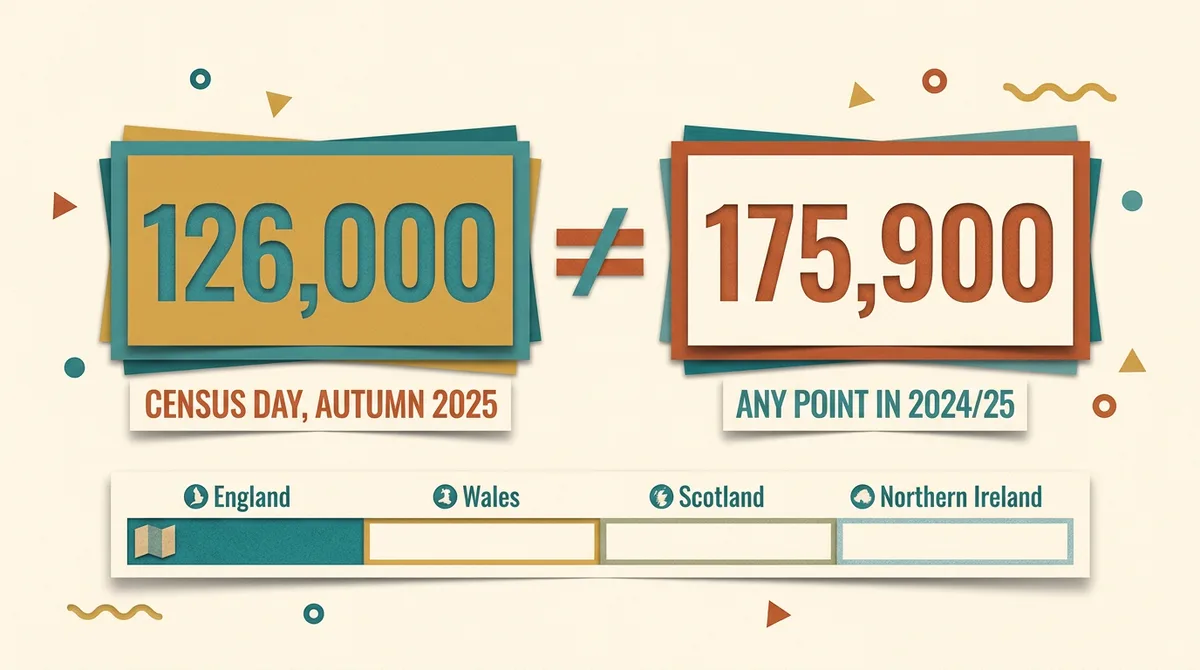
If you search for how many children are home educated in the UK, you may see two different figures: 126,000 and 175,900. Both are England figures from the Department for Education (DfE), but they count different things. They are not a UK total.
126,000 is the number of compulsory-school-age children local authorities in England reported as EHE on the autumn 2025 census day. 175,900 is the number of distinct children reported as EHE at any point during the 2024/25 academic year, counting each child once even if reported more than once. One is a snapshot; the other is a cumulative count. DfE says these measures are not directly comparable. Neither is a UK total: Wales, Scotland and Northern Ireland have different rules and data collections.
This page is a method for reading the figures, not a single UK count. The latest DfE England release available on 24 October 2026 is Elective home education, autumn term 2025/26, published 15 January and updated 29 January 2026. DfE says its figures are official statistics in development. Check the release for later updates before reusing them.
Step 1: Decide which of the two numbers answers your actual question
Before quoting anything, name the question. For a census-day snapshot, use 126,000 in autumn 2025. DfE estimates this was 14,300 more than autumn 2024, and 1.5% of the population aged 5 to 16 used as the comparison. For the number of distinct children reported at any point during the academic year, use 175,900 in 2024/25, compared with 153,300 in 2023/24. These answer different questions; neither is a count of families or a market estimate.
Worked example. A local paper writes: "Home education has risen from 126,000 to 175,900." That comparison is invalid: it compares a one-day snapshot with a cumulative annual count. For like-for-like comparisons, compare autumn snapshots (126,000 in 2025 with 111,700 in 2024) or annual cumulative counts (175,900 in 2024/25 with 153,300 in 2023/24). DfE cautions that changes over time may partly reflect improving data quality.
Step 2: Check what the count excludes before you build an argument on it
EHE means a parent has chosen to educate a child of compulsory school age otherwise than at school, and the local authority is aware of it. Three exclusions matter.
- Education otherwise than at school (EOTAS) is different: it is provision arranged by a local authority for a child who is not receiving suitable education at school, for example because of illness. It is not a parent choosing EHE.
- Children missing education (CME) is a separate count: 34,700 in England on census day autumn 2025, down 4,500 on the year, with an estimated 143,500 CME at some point during 2024/25. CME is not a measure of suitable home education. See the DfE CME release.
- Children the authority does not know about. There is currently no duty in England to notify an authority when a child has never been on a school roll, so the census-day figure is a count of known cases, not of all cases.
That third point is why the honest phrasing is "126,000 children reported by local authorities as known to be in EHE". The Education Policy Institute has separately estimated that many more children may be missing from education, using a different method and a broader measure. That estimate is not an adjustment to DfE's 34,700 CME figure, and the two should not be combined. As of 24 October 2026, parents in England do not have a general duty to notify the local authority when a child has never been registered at a school. The Children’s Wellbeing and Schools Act 2026 includes future children-not-in-school provisions, but no commencement date for the relevant register provisions was identified in the legislation text used for this guide. Check current law and official guidance for updates. Our guide to what suitable education means in law explains the current duties.
Step 3: Consider changes in data quality
The collection became mandatory in autumn 2024. Local-authority response first reached 100% in summer 2024; earlier figures include estimates adjusted for non-response. DfE describes the release as official statistics in development and says changes over time are likely to be partly due to improving data quality.
A defensible summary is: DfE reports more children in the autumn 2025 snapshot than in autumn 2024, but the collection is still developing and some change may reflect improved data quality. The two autumn figures are a closer comparison than a snapshot and annual total, but DfE still cautions that data quality affects interpretation.
Step 4: State which terms you are comparing
The autumn 2025 snapshot of 126,000 was 11,200 lower than the summer 2024/25 snapshot. DfE says that seasonal decrease is expected in part because some children obtain their preferred school place and previous Year 11 pupils cease to be of compulsory school age. A term-to-term comparison can describe a seasonal change, but it does not answer the same question as autumn-to-autumn change.
Worked example: comparing summer 2024/25 (137,200) with autumn 2025 (126,000) shows a lower snapshot after the summer term. Comparing autumn 2024 (111,700) with summer 2024/25 shows a higher snapshot. Those comparisons are not meaningless, but they span different points in the school year. State the dates and use autumn-to-autumn when discussing year-on-year autumn change.
Step 5: Read flow, not stock
During 2024/25, local authorities reported 78,000 children starting EHE and 28,100 returning to a school setting. These are separate counts of reported events, not a linked cohort. They cannot show how many children who started later returned, how long children spent in EHE, or what share of families used EHE temporarily.
If you are planning a return to school or an application, ask the receiving school or local authority which records it needs. Our guide to adding structure without recreating school is an optional practical resource; this national dataset does not establish which records make re-entry easier.
Step 6: Use the characteristics data before assuming your child is unusual
The autumn 2025 census records characteristics of children known to local authorities. Of children in EHE on census day, 52% were reported as female and 48% male, with less than 1% unknown. Year 11 was the most common year group at 19%; Year 1 accounted for 3%. This describes this census snapshot, not every home-educated child.
On need and background: 16% were recorded as receiving SEN support and 7% had an education, health and care plan. These statuses were as known to the local authority on census day and may exclude children whose previous status or needs were not known. 67% were recorded as White, with 18% unknown or refused. English as an additional language was collected for the first time in this release; 4% were recorded as having a first language other than English, and DfE cautions this may be under-reported.
Among reasons known or provided, the most reported primary reasons in autumn 2025 were mental health (16%) and philosophical or preferential reasons (12%). Almost 3 in 10 reasons were recorded as unknown to the local authority or not provided by the parent. This release does not establish why any individual family chose EHE. If you are considering school assessments, our 11+ access arrangements guide is a separate resource and does not follow from these population statistics.
Step 7: Read enforcement counts without turning them into rates
If a local authority has reason to believe that a child is not receiving suitable education, section 437(1) of the Education Act 1996 provides for it to begin the process towards a school attendance order. In 2024/25, DfE estimated 7,400 section 437(1) notices, around 6% more than the previous academic year, alongside 2,500 orders issued and 600 revoked during that year.
22 local authorities reported issuing no section 437(1) notices, and 38 reported issuing no school attendance orders. These counts vary by authority, but the national table alone cannot show that two families in similar circumstances would receive different treatment.
The practical step: consult the local-authority tables in the DfE release if you need local counts. Do not divide annual notices by the autumn snapshot, or treat orders and notices as a linked case pathway: the release does not establish that these events involve the same children. Counts alone do not rank authorities by enforcement intensity or predict what will happen in an individual case.
Step 8: Stop saying "UK" when the data is England
England's figures are not UK totals. The nations publish different measures, so do not add unlike counts together.
- England runs a mandatory termly local-authority collection with a defined census day. The latest release reports 126,000 on the autumn 2025 census day and 175,900 at any point in 2024/25.
- Wales publishes a separate release, pupils educated other than at school, most recently on 26 August 2025. It records 7,176 children known to be home educated, a rate of 15.3 per 1,000 pupils, up from 1.6 per 1,000 in 2009/10. Crucially, home educated children are counted separately from and not included in the EOTAS total of 3,014 pupils, and the release warns that parents notify voluntarily unless they have withdrawn a child from school, so the figures "might not include all electively home educated children". Rates vary by authority; Ceredigion had the highest rate at 32.6 per 1,000. See the Welsh Government release.
- Scotland requires local-authority consent before a parent withdraws a child who has attended a public school, and consent must not be unreasonably withheld. The Scottish Government guidance lists situations where consent is not required. In those cases there is no statutory duty to notify the authority, so administrative records cannot be treated as a complete count.
- Northern Ireland has no comparable routine statistical series identified for this review, but a one-off Assembly answer on 9 February 2026 reported that the Education Authority had been informed of 1,150 children as at January 2026 and 1,220 during 2024/25. The answer explicitly says there is no complete record because parents have no duty to notify. These figures are not directly comparable with England's census or annual counts.
Adding 126,000 and 7,176 would mix an England census-day snapshot with a Wales annual count of children known to authorities, then omit Scotland and Northern Ireland. It would not produce a meaningful UK total.
What the data does not say
The DfE EHE release does not report linked attainment or post-16 outcomes. It contains counts, characteristics, reported reasons and enforcement activity, not a cohort analysis of exam results, destinations, earnings or university entry. The figures on this page therefore cannot show how home education affects a child's later outcomes. This statement is limited to the cited England release; it is not a claim that no such evidence exists anywhere in the UK.
Do not use unsupported percentage claims about academic outcomes to fill that gap. This article has not established a reliable, representative UK-wide comparison from which such a percentage could be calculated. Exam entry and selective-school procedures vary by qualification, provider and local admissions policy; check the relevant provider or school directly. The population data here cannot tell a family which records an authority, school or tutor will accept.
Methodology, limitations and how to check these figures yourself
Sources checked on 24 October 2026. England EHE: DfE Elective home education, autumn 2025/26, published 15 January 2026 and updated 29 January 2026. CME: DfE Children missing education, autumn 2025/26. Additional estimate: Education Policy Institute report. Wales: Welsh Government Pupils educated other than at school: September 2024 to August 2025, published 26 August 2025. Scotland: Scottish Government Home education guidance, published 23 January 2025. Northern Ireland: Assembly written answer AQW 38773/22-27, answered 9 February 2026. England law: Education Act 1996 section 437 and the Children’s Wellbeing and Schools Act 2026, checked alongside commencement instruments available on the review date.
Limitations you should carry with every number on this page.
- These are official statistics in development, not accredited official statistics.
- Published figures are rounded, so components may not sum to published totals. Do not treat a small discrepancy as an error.
- Pre-2024 national figures were uprated for non-response and are not directly comparable with later ones.
- EHE headcounts refer to children known to local authorities. Flow and enforcement figures count separately reported events; they are not automatically linked to the EHE census cohort.
Refresh checklist, roughly each January when the autumn release lands:
- Update the autumn census-day figure and recompute the change on the previous autumn only.
- Update the academic-year total and its own prior-year comparator, kept visibly separate from the census figure.
- Update starts and returns as separate totals; do not present them as linked people or calculate a return rate from unlinked counts.
- Update section 437(1) notices, attendance orders issued and revoked, and the count of authorities reporting zero of each.
- Check whether the statistics have been reclassified from "in development" to accredited.
- Check the Welsh release separately and review the latest Northern Ireland evidence, noting whether it is a routine series or a one-off answer.
- Check whether the Children Not in School provisions of the Children’s Wellbeing and Schools Act 2026 have commenced. The Act received Royal Assent on 29 April 2026, but the register provisions were not shown as in force in the legislation and commencement materials checked on 24 October 2026. Do not assume a start date or predict how counts will change. The Act and any later commencement regulations are the primary sources.
If you are home educating and preparing for selective entry, these national figures cannot predict an individual school's process or what records it will ask you to provide. Check the current admissions policy and contact the school or local authority about your circumstances. Our home education structure guide is a separate practical resource.
Topics
- home education
- statistics
- school admissions
- england
- policy