


How to Add Structure to Home Education Without Recreating School
The law does not prescribe a timetable, set hours or marked work. This guide offers optional ideas for planning and keeping examples of learning, not a required system or a guarantee about whether provision is suitable.
 Elspeth Marlow
- 11 min read
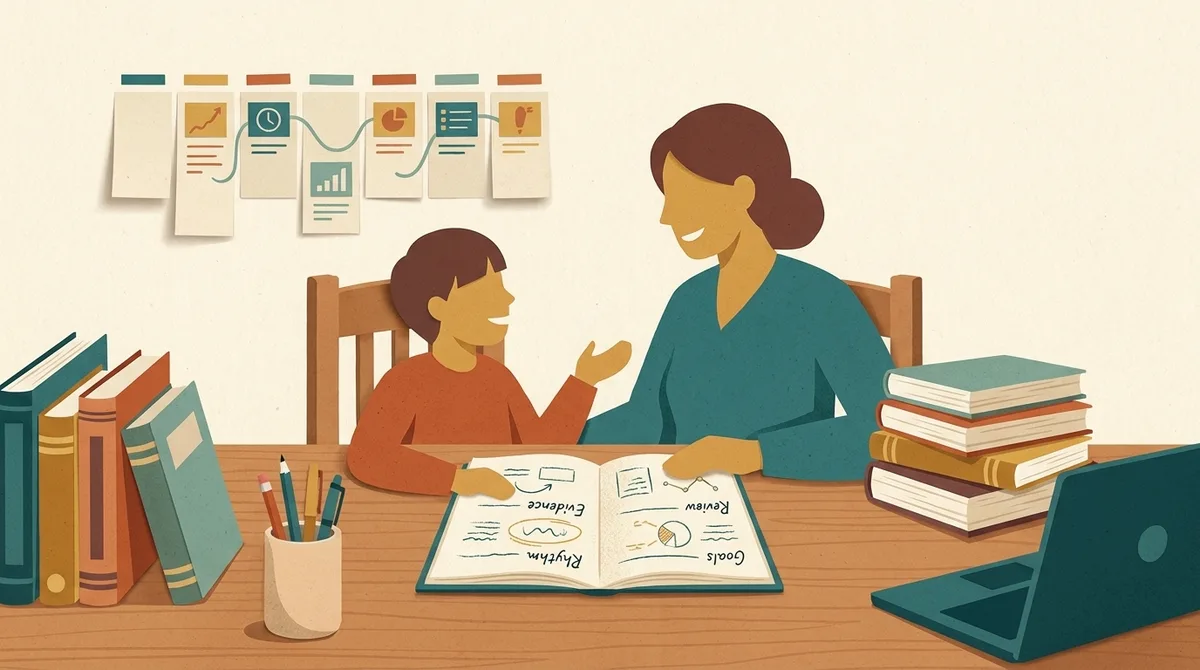
The Department for Education estimated 126,000 children known to local authorities as electively home educated on the autumn 2025 census date (official statistics). The collection is labelled statistics in development and its figures do not describe every family’s circumstances. Home education can take different forms, so any routine should fit the child and family.
There is no single planning method that suits every family. The ideas below are optional prompts: you can use, adapt or ignore them. A written plan or record may help you describe what your child is learning, but it does not by itself establish that the education is suitable.
Week one: the question that unlocks everything
Before you design anything, read two paragraphs. Section 7 of the Education Act 1996 requires a parent to cause their child to receive "efficient full-time education suitable to his age, ability and aptitude, and to any special educational needs he may have, either by regular attendance at school or otherwise" (legislation.gov.uk). That is the whole duty. Efficient, full-time, suitable.
The official guidance distinguishes a suitable education from a school timetable. The Department for Education's guidance for parents states at paragraphs 2.8 and 2.11 that home-educating parents are not required to have a timetable, to set hours during which education takes place, or to observe school hours, days or terms, and that there is no legal requirement to hold teaching qualifications, teach the National Curriculum, make detailed lesson plans in advance, give formal lessons, mark your child's work, formally assess progress, or match school-based age-specific standards (EHE guidance for parents). Paragraph 2.7 adds that there is no legal definition of full-time, and that home education does not have to mirror the roughly five hours a day, 190 days a year that school children receive.
The 32.5-hour minimum expectation in DfE's guidance on the length of the school week applies to state-funded mainstream schools. It is not a home-education requirement. The parent guidance says home education does not have to copy school hours, days or terms.
So the first question is: what is structure actually for, if the law does not require it? Paragraph 2.12 answers it. It is likely to be "much easier for you to show that the education provided is suitable if attention has been paid to the breadth of the curriculum and its content, and the concepts of progress and assessment in relation to your child's ability." Paragraph 2.9 adds that you should at least be able to quantify and demonstrate the amount of time for which your child is being educated.
A routine can make family life easier and help you explain your approach if asked. It is not a legal duty or a guarantee of a particular decision by a local authority.
Weeks two to three: write the one-page plan
If planning on paper helps, you could note a few aims and activities. Nothing here is required.
- A few aims, if useful. For example: reading a chapter book independently, explaining a multiplication method, or finishing a chosen project. Choose a number of aims that works for your family; there is no official limit.
- Breadth, named. The areas you intend to touch across a term: literacy, numeracy, science, humanities, arts, physical, practical life, and something the child chose. This answers paragraph 2.12's "breadth of the curriculum" without adopting the National Curriculum, which you do not have to follow (gov.uk/home-education).
- The minimum standard you are aiming at. Paragraph 2.10a expects education to enable the child, when grown up, to function as an independent citizen in the UK, and 2.10c notes that local authorities may use minimum expectations for literacy and numeracy when assessing suitability. Write one line each on what reading and number should look like by July.
- Social opportunities, if relevant. The guidance says education may be unsuitable if it causes excessive isolation from peers and impedes social development. There is no prescribed club, activity or record to meet this consideration.
You might revisit the page from time to time. If you are also preparing for selective entry, the same one-page discipline underpins a longer arc, and our year-by-year 11+ preparation plan shows what that looks like when there is a fixed test date at the end of it.
Weeks two to six: build a rhythm, not a timetable
A timetable might set a time for maths; a flexible routine might leave the timing open. The schedule below is one possible shape, not a recommendation for every child.
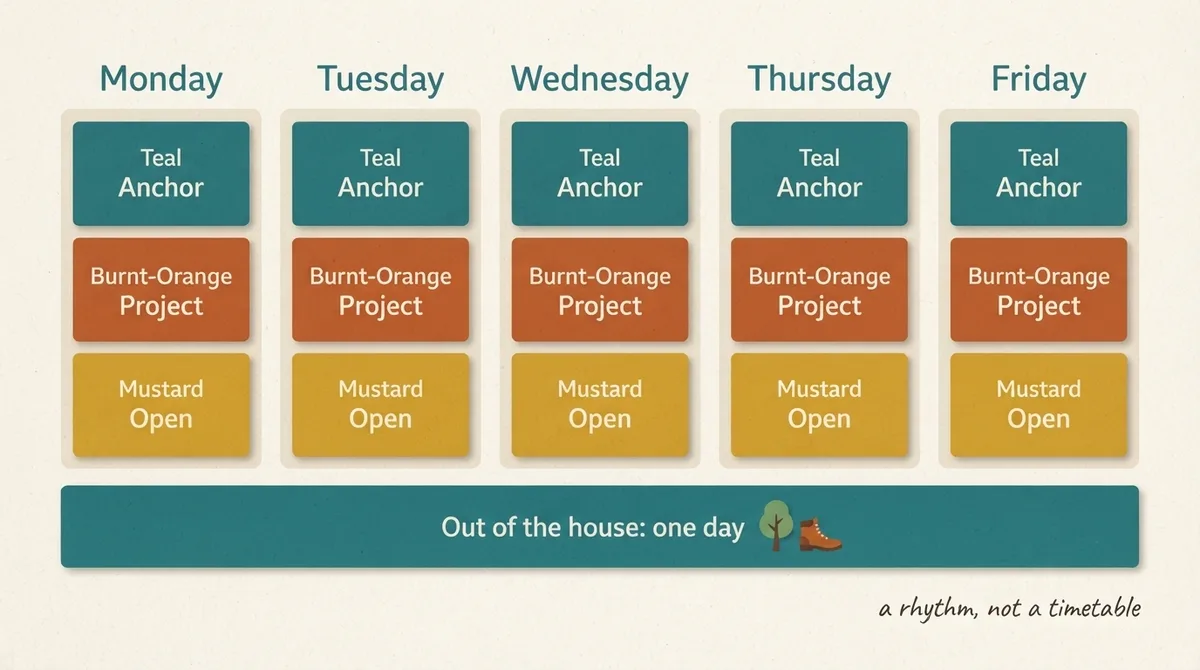
One way to sketch a week is to mark regular activities, projects and open time. These are just planning labels; they are not required parts of home education.
- Early primary (5 to 7). For example, a family might include shared reading, number activities and a project. This is an illustration only, not a legal measure of full-time education.
- Upper primary (8 to 11). A family might combine reading, maths, writing, projects and other activities in a way that suits the child.
- Secondary (11 to 16). Some families may involve a teenager in planning their activities and responsibilities. The approach should suit that young person; no weekly structure is prescribed.
- A child recovering from school. A family may choose a gentler pace or different activities. There is no fixed “deschooling” timetable. If you are worried about a child’s wellbeing or learning needs, seek appropriate support.
You can change the routine whenever it stops working for your family.
From week six: the review cadence
If helpful, you might occasionally ask what is working, what the child is learning and whether your plans still suit your family. No particular schedule or written report is required. Government guidance recommends that a local authority ordinarily makes contact with home-educating parents at least once a year, so it can inform itself of the current suitability of the education; that describes recommended authority practice, not a parent reporting duty.
Families can choose whether and how often to review their plans.
Term one onwards: measuring progress without a test centre
There is no legal requirement to formally assess progress. If you want to reflect on learning, these are a few possible prompts.
Compare examples over time. If useful, keep examples of similar work from different dates. They may help you discuss what has changed, though no single example proves overall progress.
Watch the transfer, not the score. You might notice a skill being used in a different setting, such as measuring ingredients or editing a note. These are examples to consider alongside other information, not a formal assessment.
Use a standardised measure sparingly, and read it correctly. A GL Assessment Standard Age Score has a mean of 100 for any age group and a standard deviation of 15 points, and approximately two-thirds of pupils score between 85 and 115 (GL Assessment). A National Percentile Rank of 70 means the pupil did as well as or better than 70% of same-age peers, with 50 being average. A standardised score is one measure taken under particular conditions; interpret it using the test provider’s report and other relevant information.
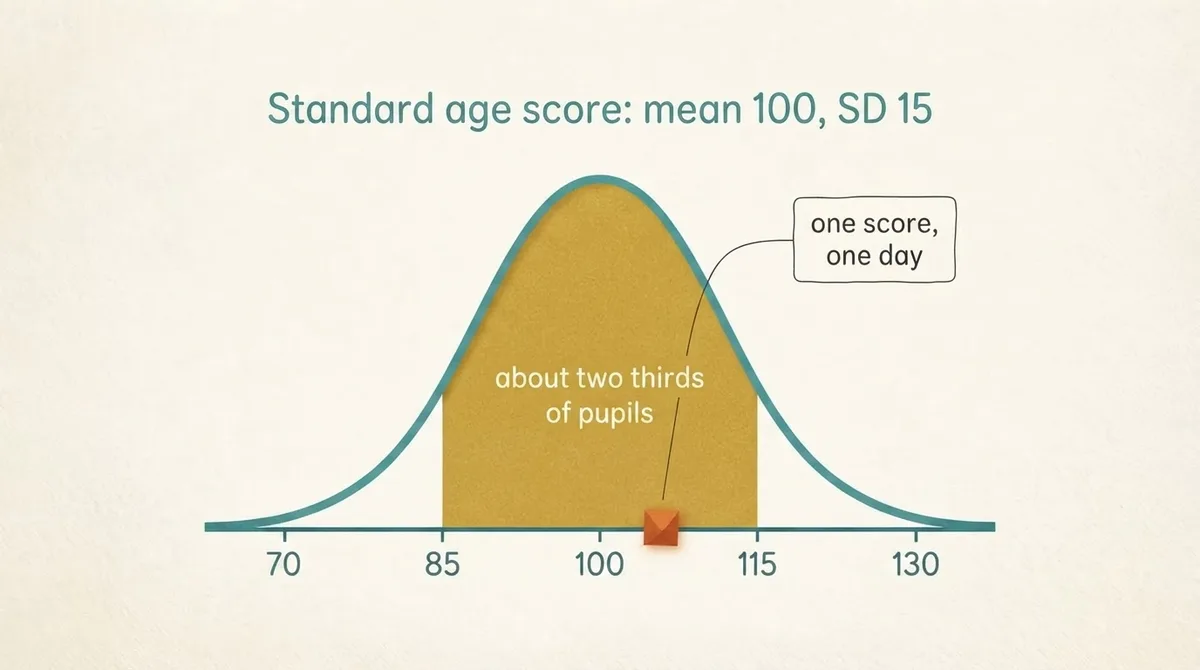
A score from one sitting cannot by itself describe a child’s overall learning or explain a difference between results. If you have questions about a test score, consult the test provider or the professional who administered it.
Building the evidence file before anyone asks
There is no national evidence template or required number of work samples. The examples below are possible ways a family might keep information; what is relevant depends on the child and circumstances.
- A short written account. Your own description of the education, if useful.
- Dated samples of work. A few dated examples, if you find them useful. Photographs of models, gardens and cakes count.
- A learning log or journal. Notes about activities, if you choose to keep them.
- Other information. Optional details from a tutor, club or course, if relevant.
The following fictional example shows one possible way to describe learning. It is not a recommended format or a council template.
Education report: Maya, age 9, autumn term 2026. Maya has been home educated since May 2026. Our approach is project-based with daily short sessions in reading, writing and mathematics. This term: read four chapter books, two independently; wrote a four-page illustrated guide to Roman roads following a visit to Chedworth villa; worked through short division and equivalent fractions, currently secure with two-digit divisors; ran a six-week weather project including daily rainfall recording and a bar chart of the results; weekly swimming lesson (level 5) and Thursday forest school group with eight other children. Structured work averages around three hours a day, four to five days a week, plus reading and practical activity. Next term: written multiplication of decimals, a local history project, and starting recorder. Samples of dated work and a weekly log are available on request.
This fictional example is only an illustration. No particular word count, folder or review interval is required.
What learning software can and cannot do
Some software can organise activities and record a learner’s use of it. A quiz result may highlight a question to revisit, but software activity alone cannot diagnose a learning need or establish whether an education is suitable. A progress-tracking view can be one source of information about activity, not a complete account of a child’s education.
Software does not replace teaching, practical activities, specialist assessment or support. App activity is not proof of a suitable education. A local authority considers the overall circumstances, not usage statistics alone. Any app record is only one possible source of information. If you are weighing tools against tutoring or doing it yourself, use the disclosed framework in how to choose an 11 plus learning platform.
When the letter arrives: enquiries, the 15-day notice and the register
The Children’s Wellbeing and Schools Act received Royal Assent on 29 April 2026. As at 23 October 2026, its new children-not-in-school register and related parent notification and information duties have not commenced in England. Existing section 436A enquiries and section 437 notices remain in place.
A local authority "has no formal powers or duty to monitor the provision of education at home", but it does have a section 436A duty to identify children not receiving a suitable education, and it is entitled to make informal enquiries. Parents "are under no legal obligation to respond", and need not agree to a meeting or produce specific evidence. But the guidance is equally clear that if you do not respond, the authority "is entitled to conclude from the absence of any response that it appears that your child is not receiving a suitable education" (paragraphs 5.1 to 5.5).
If the authority considers it has insufficient information, it must serve a notice under section 437(1) requiring you to satisfy it, and you will have at least 15 days to respond (paragraph 5.6). The law does not require a particular folder or weekly record; consider responding with information relevant to the education and seek advice if unsure. Beyond that sit school attendance orders, the council's formal route if it believes a child is not receiving suitable education. Worth knowing: paragraph 5.26 confirms "Ofsted has no role in the oversight of education received by individual children who are educated at home."
Two practical points on cost and SEND. Parents "must be prepared to assume full financial responsibility for the child's education, including bearing the cost of any public examinations (which would have to be entered via an external examinations centre)", with any local authority help being discretionary (paragraph 3.6). And if your child has an EHC plan and the home education is suitable, the authority has no duty to arrange special educational provision, though it keeps checking suitability (paragraph 5.21); a parent already home educating can still request a statutory assessment of SEN (paragraph 5.24). A separate consent exception applies where the child attends a special school and the local authority arranged the placement. Check the circumstances and current statutory rules.
When a routine needs changing
A routine can stop suiting a family. You can adjust it to fit the child’s needs and circumstances.
If a child is finding an activity difficult, try to understand what is getting in the way. A teacher, specialist or other professional may be able to help where there are concerns about learning or wellbeing.
If a plan is hard to follow, simplify or change it. There is no required number of activities.
If home education is becoming difficult to manage, consider what support or changes might help. The right option depends on the family and child; this guide cannot diagnose the cause or prescribe a recovery timetable.
Choose whatever planning and record-keeping is useful to your family. No app or paper system can decide whether the whole of a child’s education meets the legal test.
Topics
- home education
- structure
- progress
- planning
- record keeping