
Practice Papers and Mock Tests
11 Plus English Papers: Comprehension, SPaG and Writing Tasks
Choose an English practice paper with the right instructions and answers. Review an original comprehension question and compare two story openings without treating a practice score as an admission prediction.
 Elspeth Marlow
- 9 min read
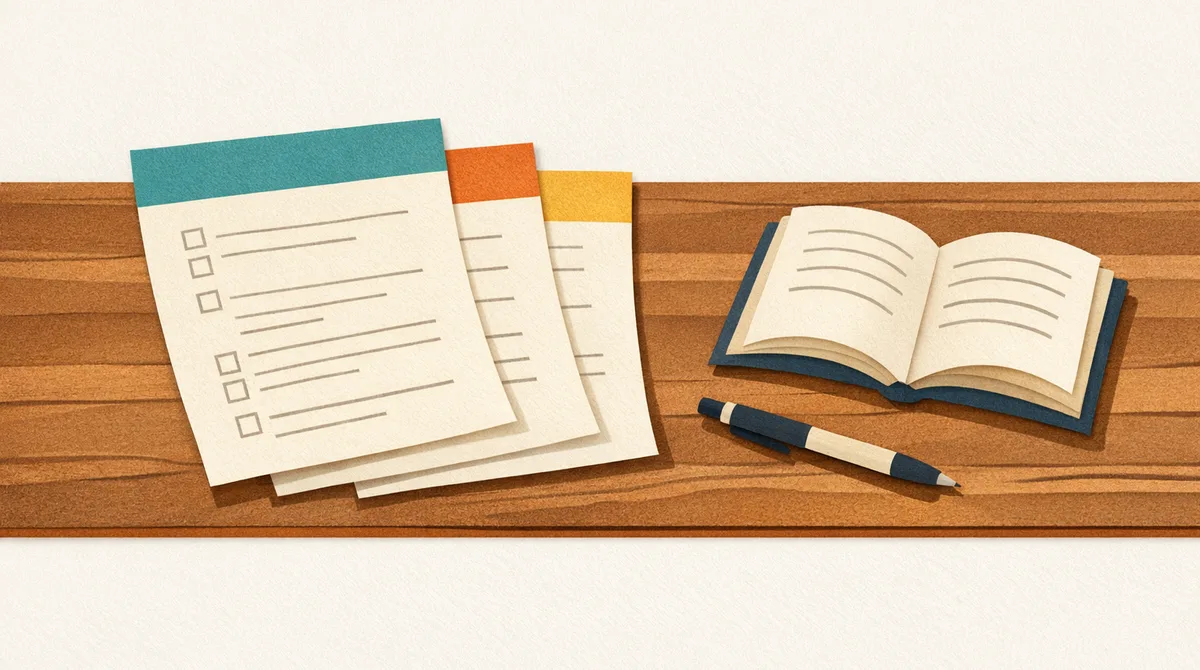
Before printing an 11+ English paper, check what it assesses and how its answers should be recorded. An answer key can be enough for a multiple-choice task. A written comprehension response or writing exercise may need a marking scheme or qualitative feedback.
This guide explains those different jobs, then provides an original comprehension example and two story openings. It does not supply a national writing score or predict selective admission.
Choose by task and entry year
“11+ English” is not one paper. Check the school or test organiser’s current information before buying a format-specific resource. Useful questions include:
- Is the response selected from options or written by the child?
- Does English include comprehension, spelling, grammar, writing or a combination?
- Is there separate reading or planning time?
- Does the paper have an answer key, a written-response scheme or a writing rubric?
- Which entry year does the guidance cover?
GL’s free familiarisation page explains that local timings and question counts can differ. Its sample materials are useful for their own questions, not a guarantee of every GL-administered paper’s specification.
The CSSE practice page lists past English papers, continuous-writing tasks and marking documents. A past paper’s entry year and instructions matter. Its 2027-entry guide describes the September 2026 test, not a later cycle.
Kent’s preparation page describes multiple-choice English and maths sections for its 2026 sitting, plus a 40-minute writing exercise including 10 minutes of planning. Writing is not part of the marked test score but may inform headteacher assessment. The page now labels its displayed familiarisation as previous material while a new provider prepares replacements. Do not assume the old format fixes the next test.
Latymer’s admissions page says it proposes to use Quest for the September 2027 assessment, for 2028 entry, with maths, English comprehension and writing, subject to a formal consultation from 10 November 2026. Its sample page separately lists specimen comprehension materials with answers and a writing scheme. Compare any specimen with the current entry-year instructions; a sample is not a promise of the next paper’s contents.
Read the marking information before using the paper
Check that the answers belong to that exact paper or edition. For written responses, read the guidance about accepted alternatives, copying, spelling, extra answers and partial credit. A plausible response does not automatically earn a mark, and a different wording is not automatically wrong.
Some questions reward several distinct details. Others reward a developed explanation. The mark total alone does not prescribe a number of sentences or quotations. Our comprehension guide gives a separate original example with explicit local rules.
If a resource has no writing rubric, you can still discuss the writing. Keep that feedback separate from a claimed school score. The publisher’s or school’s actual scheme takes precedence when marking its sample.
Decide whether you are teaching or rehearsing
For teaching, you might work on one question together, explain an unfamiliar word or remove time pressure. For a rehearsal, use the relevant paper’s own sections, response format, reading time and stop instructions. These are different activities; note any help or extra time given if comparing results.
There is no universal 30-minute comprehension plus 40-minute writing format. If using your own short writing task, state its practice duration rather than calling it an official allowance. A partly completed paper can still support a useful discussion.
Original comprehension example: 3 marks
Read this original sentence:
The gate had not been opened in forty years, and the ivy had stitched it shut so thoroughly that it looked less like a gate than a green wall with a memory of hinges.
Question: How does the writer make the gate seem permanently closed? 3 marks.
For this exercise only, use this three-part scheme:
- 1 mark: quote or precisely refer to a relevant image or detail, such as ivy stitching the gate shut, forty years without opening, or the memory of hinges.
- 1 mark: explain an image’s meaning, such as the ivy seeming to sew the gate firmly to its frame.
- 1 mark: explain the impression of lasting disuse, such as the gate seeming more like a wall than something expected to open.
A full-credit response could be: The ivy has “stitched it shut”, making it seem sewn fast rather than just overgrown. Calling it a wall with “a memory of hinges” suggests its old purpose has almost been forgotten, so opening it seems unlikely.
A relevant quotation alone earns one mark under this scheme. It does not earn the two explanation marks. A precise paraphrase can earn the reference mark too; it need not be a quotation. “The gate is closed” is too general for this scheme’s reference requirement.
This question asks about an effect, not proof that the gate can never open. Other explanations may earn credit if they meet these local criteria. Do not transfer this three-part scheme automatically to another paper.
Give writing feedback that fits the prompt
For informal practice, discuss a few of these areas:
- Task: has the child written what the prompt asks for? A story opening need not contain a complete plot or ending.
- Clarity: can a reader follow the events, viewpoint and relationships?
- Language: do the chosen words create the intended meaning or atmosphere?
- Sentences and organisation: do their lengths, openings and paragraphs help the reader?
- Accuracy: are spelling, punctuation and tense clear enough to convey the meaning?
These are conversation prompts, not a calibrated 25-mark scale. A school may use different criteria. Precision and control matter more than adding a conspicuously difficult word or a named technique for its own sake.
Compare two original story openings
Practice prompt: Write the opening of a story that begins with a locked gate. Choose a suitable practice time; no official test allowance is implied.
Response A
There was a gate. It was locked and it had been locked for a long time. I wanted to see what was on the other side so I went up to it and pulled it but it did not open. Then I got a stick and tried to move the lock but the stick broke. Then I went home and had my dinner and thought about the gate. The next day I went back to the gate again and it was still locked. I was annoyed about it.
Possible feedback: the sequence is clear and the tense is consistent. Much of the account tells events one after another. If the aim is an intriguing opening, try choosing one moment to develop with a detail about what the narrator notices or wants. It is an opening task, so a complete story ending is not required.
Response B
The gate had been locked for as long as anyone in our road could remember, and ivy had grown across it until it looked like a green wall. Mum said it led to the old orchard. Dad said it led nowhere at all, which is the sort of thing adults say when they know exactly where something leads.
On the Tuesday after my birthday, I found the key in the pocket of a coat that had never been mine. It was small, cold and unreasonably heavy.
I did not open the gate that afternoon. I stood in front of it for eleven minutes, holding the key, listening to something on the other side that sounded very much like someone waiting.
Possible feedback: the parents’ conflicting explanations and the unfamiliar coat create questions for the reader. The last paragraph delays opening the gate and ends on a deliberate hook. Discuss whether that is the effect the writer intended; it is one possible approach, not the required way to write an opening.
Both responses can be discussed without converting them into an admission prediction. You might ask the writer what they wanted a reader to wonder and which line best creates that effect. The creative-writing guide offers further practice ideas.
Try a short selected-response activity
The activity below draws from a fixed bank of twelve original English questions. A run may use a subset; questions and options are not newly authored for every attempt. Its local clock and score apply to that activity, not to a regional test.
This part of the guide is a free timed practice test. It works in your browser.
The bank includes comprehension, vocabulary and sentence grammar, with an explanation for each selected answer. It does not mark a child’s story opening or an arbitrary written comprehension response. Difficulty labels are editorial choices, not admission thresholds.
Choose the next step from the response
Discuss what the child understood before assigning a cause to a lost mark. A mistake could involve vocabulary, a missed instruction, an incomplete explanation or something else. A total score alone cannot distinguish them.
Choose an achievable next activity: revising one sentence, explaining one clue or trying a different short passage. Revisit it when useful. The timing can vary with the task and child.
Smart Cub Learning’s paper-tests page describes on-screen subject papers with automatic marking and topic results. It does not establish a published writing rubric for these original examples or automatically choose a child’s weekly writing targets. Our free practice-paper guide links more materials.
Questions parents ask
How many papers should my child do? There is no universal schedule. Match practice to the target test, what the child has learnt and their response to the activity. A discussion of one answer can be more useful for a particular need than another full timed paper.
Does a multiple-choice test require writing practice? Check whether that test includes a writing task or uses one separately. Writing can also be part of normal learning without being an entrance-paper requirement.
Should I use commercial or school materials? Compare the content, instructions and answers with the job you want the resource to do. Check edition and entry year; do not assume all commercial packs or all older school papers match the current format.
What score should I expect? There is no universal practice percentage that predicts admission. Raw scores, standardised scores, qualifying thresholds and school allocation rules are different. Use the resource’s own scheme and discuss learning rather than converting an informal writing judgement into a test result.
Topics
- 11 plus english
- comprehension
- creative writing
- practice papers
- marking