


What Grammar Schools Select For: Tests, Scores and Admission Rules
What do grammar schools look for? See how test qualification, score ranking, catchment and priority rules decide who gets a place, with real school examples.
 Elspeth Marlow
- 13 min read

The short answer: state grammar schools use a published selection process to assess academic ability. A qualifying result may make a child eligible to be considered, but the school's admission arrangements decide how places are offered. Depending on the school, those arrangements may rank scores or use priorities such as care status, siblings, pupil premium, catchment or distance. GOV.UK's admission-criteria guide gives examples of priorities, and each target school's policy is the rule to follow.
The useful distinction is between test qualification and place allocation. A school publishes admission arrangements that say who can be considered and how eligible children are ranked when there are more applicants than places. Some policies also publish limited lower-score priority or review routes. Two children with identical test scores can get different outcomes, and in some counties the higher-scoring child can be the one who misses out.
This guide walks the process in the order a Year 5 and Year 6 family actually lives it, from registration to National Offer Day and beyond, and reads one real published policy line by line so you can see exactly where the decision is made. Rules vary sharply by area, so treat the examples as models to recognise rather than as your local rulebook.
Start with your target school's rule. The school directory leads to individual admission guides. For the three allocation models explained below, compare Queen Elizabeth's School, Barnet, Chesham Grammar School and Beths Grammar School. If you are still choosing an area, use the Buckinghamshire and Bexley guides to find the shared test route before reading each school's priority list. Always use the admission arrangements for the year your child would enter.
The legal frame: who is allowed to select, and on what
Selection at 11 is not a school's private preference. Under section 104 of the School Standards and Framework Act 1998, a maintained school can only be designated a grammar school if the Secretary of State is satisfied it "had selective admission arrangements at the beginning of the 1997-98 school year", and the qualifying condition is that its arrangements "make provision for all (or substantially all) of its pupils to be selected by reference to general ability, with a view to admitting only pupils with high ability" (legislation.gov.uk). That phrase matters: the lawful basis is general ability, not character, not effort, not enrichment.
The School Admissions Code 2021 is statutory guidance for admission authorities in England. Schools must publish the arrangements they use to allocate places. The Code has a specific exception for grammar schools whose arrangements admit only candidates with the highest test scores: those schools do not have to put looked-after children first. Where a grammar school's arrangements use other oversubscription criteria, they must give priority to looked-after and previously looked-after children who meet the published test standard. Check the wording in the policy for the entry year.
The GOV.UK guide gives examples of priorities used in school admissions, including distance, siblings, faith, feeder schools, entrance tests, pupil premium and a parent's employment at the school. It is a summary, not a substitute for the full Code or an individual school's arrangements. For the schools discussed below, use the published test and oversubscription criteria rather than assuming that hobbies, personal statements or tutoring history affect the ranking.
Spring of Year 5: registration, and the first thing you must check
The first real milestone is registration, which typically opens in the spring or early summer of Year 5 and closes months before the test itself. Registering for the test is a separate action from applying for a school place, and missing the registration deadline usually removes the option entirely for that cycle. Our practical parent guide to the 11 plus shows where registration sits in the full application sequence.
At this point, do one piece of homework that most families skip. Download the admission arrangements PDF for each school you are seriously considering, and find the numbered oversubscription criteria. You are looking for one specific thing: does the school rank qualified children by score, or does it rank them by something else? That single answer changes what a sensible preparation and preference strategy looks like, and it is knowable eighteen months before the offer arrives.
Autumn of Year 6: the test, and how a raw mark becomes a score
Many areas test in September at the start of Year 6, but dates, subjects and formats vary by school and area. English, maths, verbal reasoning and non-verbal reasoning are common subject areas, not a standard national paper. Tests may use paper booklets, multiple choice with a separate answer sheet, or online delivery. Check the entry-year policy for each target school; the Smart Cub Learning grammar-school directory links to school-specific assessment information.
Some authorities convert raw marks into age-standardised scores; others publish a different scoring and ranking method. Buckinghamshire's Secondary Transfer Test is one example. The council says GL Assessment marks the papers and standardises each child's score for age in years and months on test day. Its published standardised scores range from 60 to 170. The Secondary Transfer Test Score combines 50% of the verbal-skills score, 25% of the mathematical-skills score and 25% of the non-verbal-skills score (Buckinghamshire Council).
In this Buckinghamshire model, age-standardisation means age in years and months is part of the score conversion; it does not let you predict two children's scores from their raw marks alone. The weighting also means one point in the standardised verbal component contributes twice as much as one point in the standardised non-verbal component. Other authorities may use a different method. The 11 plus exam explainer puts scores back into the wider test and admissions journey.
Use the 11+ score calculator by area to check a reported result against its published method and qualification rule. A selective-test score is not automatically a national percentile, and qualification does not guarantee a school place.
October: the results letter tells you less than you think
Results usually arrive in October, before the national application deadline. The letter tells you whether your child reached the qualifying standard. Buckinghamshire's is explicit: "Children who achieve a standardised score of at least 121 are eligible to be considered for a Buckinghamshire grammar school place."
Note the verb. Eligible to be considered. The council states plainly that "Qualifying in the test does not guarantee that a child will be offered a grammar school place" because "There are always more applications for grammar schools than available places" (Buckinghamshire Council).
There is no single national pass rate because there is no single national test. Buckinghamshire says it expects about 37% of children to reach an STTS of 121 or more. That is an expectation for this local test and threshold, not a national benchmark or a prediction for an individual child. The Smart Cub Learning grammar-school directory links to each school's published score policy.
The score of 121 in the page illustration is specific to Buckinghamshire's Secondary Transfer Test; it is not a national qualifying mark.
The three allocation models, and why your area's model changes everything
Qualification and allocation are separate decisions. Passing may make a child eligible, but how the score affects an offer depends on the target school's arrangements. The three broad patterns below are examples; a school can combine score bands with other priorities.
1. Rank order, score drives allocation. Queen Elizabeth's School, Barnet, has 180 places and ranks applicants by age-standardised entrance-test result. It has no catchment or sibling priority. Its current entrance-test FAQ says that when two applicants have the same mark, the child living closer to the school's main gate ranks higher. Distance can therefore decide a tie even at a score-ranked school. Read the school's September 2027 admissions guide for the complete policy, including any statutory priority, before treating a score as an offer.
2. Qualify, then the score stops counting. Buckinghamshire is the exact inverse. Once a child qualifies, "their test score has no further role" and "Achieving a higher score does not give a child any more priority for a place". A child on 121 and a child on 150 enter the queue on identical terms, and the school's own admission rules (siblings, catchment, distance) decide between them. Every piece of advice built on chasing a bigger margin above the threshold is, in this model, simply wrong.
3. A score priority band alongside other criteria. Bexley ranks all test takers by total age-standardised score and gives the top 180 a place in one of the highest-priority groups at their preferred grammar school. The council also says that meeting the selective standard alone does not guarantee a place; each school's other criteria, such as distance and siblings, still matter. The test weights verbal ability 50%, numerical ability 25% and non-verbal ability 25% (Bexley Council). A high score changes priority, but does not guarantee an offer at the school a family prefers.
One real policy, read line by line
Abstractions are easy to nod along to, so take Beths Grammar School in Bexley, which has a published admission number of 192 for Year 7. Its ranked criteria run in this order (Beths Grammar School):
- Children in local authority care.
- Students achieving one of the highest 180 scores in the selection tests.
- Siblings.
- Children of permanent staff.
- Up to 12 places for pupil premium and/or free school meals students.
- Proximity, by shortest radial distance.
- A separate published route for a child deemed selective in the Kent Test and within five marks of the Bexley selective mark, if its conditions are met.
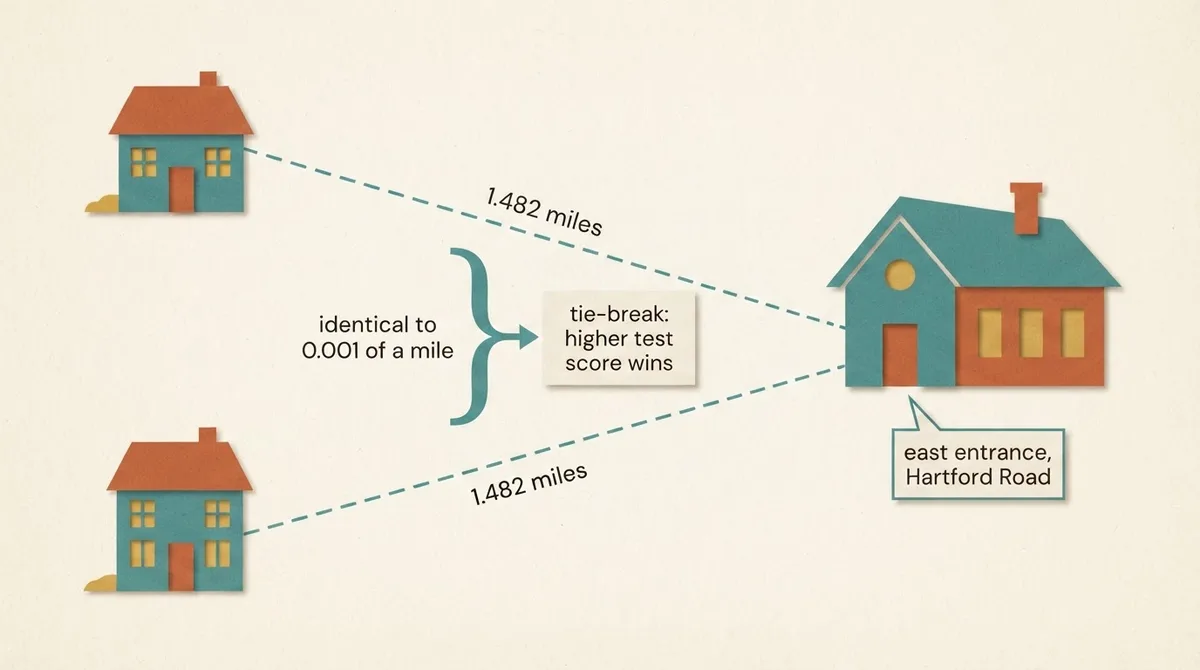
Read top down, remembering that children with an Education, Health and Care plan naming the school are admitted under a separate statutory process. The care-priority criterion applies to children who meet the school's required test standard. Then comes the borough-wide top-180 score group. This is a priority category for applicants who name Beths, not 180 places reserved at Beths. The pupil-premium/free-school-meals band has up to 12 places and ranks eligible children by distance. The general distance category follows, measured to the school's east entrance on Hartford Road, rather than by road distance or to the nearest gate. Beths also publishes a narrow Kent Test route in its September 2027 arrangements.
And the tie-break: where distance is identical to 0.001 of a mile, Beths uses the higher selection-test score. The number of places left for the general distance category depends on how many eligible applicants apply in the higher categories that year. Last year's distance or last-offer score cannot tell a family what the 2027 allocation will be.
Pupil premium and free school meals: check each school's policy
Some arrangements include priority for pupil premium or free-school-meals applicants. Beths' September 2027 policy offers up to 12 places in its pupil-premium/free-school-meals category to children who are selective; its supplementary form is due by 31 October 2026. This is separate from the home council's school application. Buckinghamshire says each grammar school admits at least six children who are eligible for pupil premium but have not qualified in the test. These are local policy examples, not a universal rule.
In Sutton, the council says the shared Selective Eligibility Test is a first stage; for several schools, a qualifying result makes a child eligible to sit a second-stage entrance examination. The current Sutton test information lists the participating schools and explains this distinction. Test content and any priority for pupil premium or free school meals must be checked in the individual school's arrangements for the entry year. The grammar-school directory separates each published school's route from its allocation rules.
If either status applies to your family, read the target school's policy and form instructions. Some schools require evidence or a supplementary form, with a deadline separate from the home council application.
What the published examples assess
The policies discussed here set out entrance tests and ranked admission criteria. They do not award priority for a child's hobbies or a parent's enthusiasm. Other schools may have different arrangements, so check the target school's entry-year policy for any test, form or evidence it requires.
The examples above do not use tutoring history as an admission criterion. Preparation choices should follow the actual test specification and the child's needs; a mock-test score cannot promise a place.
Late October to March: preferences, offers, and what happens if the answer is no
For September 2027 entry in England, secondary applications are due by 31 October 2026. That date falls on a Saturday, so check your home council's 2027/28 guide for its accepted closing time or any next-working-day arrangement. National Offer Day is 1 March 2027. Apply through your home council, even for a school in another council area, and check separately for any school test or supplementary-form deadline (GOV.UK). List schools in your genuine order of preference. Naming a more selective school first does not reduce consideration for a lower preference if the higher school cannot offer a place: the authorities assess each school's criteria and, where more than one offer can be made, the home council offers the highest preference possible (Buckinghamshire Council). Our school application order planner explains how preferences work.
If your child does not qualify, there are two distinct routes, and they are commonly confused. In Buckinghamshire, a Selection Review is "your opportunity to explain, in writing, why you think your child would be best suited to a grammar school even though they did not reach the qualifying score of 121". The council says panels consider school reports, headteacher summaries and evidence of exceptional reasons, but not samples of school work or extracurricular participation (Selection Review guidance). If a review fails, the appeal panel first considers whether the review was carried out in a "fair, consistent and objective" manner (appeal guidance).
Be realistic about the local figures. In Buckinghamshire's 2025 Year 7 appeal outcomes, 7 of 105 qualified appeals were successful; 4 of 131 unqualified appeals after a Selection Review were successful, and none of 38 unqualified appeals without a review succeeded (Buckinghamshire Council). These are outcomes in one authority and one year, not a guide to an individual case. Our grammar-school appeals tool explains the evidence, stages and limits of an appeal.
The short answer
Grammar schools use published selective admissions arrangements, but qualification and place allocation work differently from area to area. The score may rank applicants, establish eligibility or sit alongside other priorities. Read the target school's arrangements for your child's entry year, then use the published test format and dates to guide any preparation. Our exam plan is one planning tool, not a promise of an admissions result.
Topics
- grammar schools
- admissions
- 11 plus
- oversubscription
- appeals