


Short Daily 11+ Practice: Building a Flexible Routine
Use spacing and recall thoughtfully, choose a manageable task, and adjust practice around your child. No universal daily quota or guaranteed outcome.
 Elspeth Marlow
- 7 min read
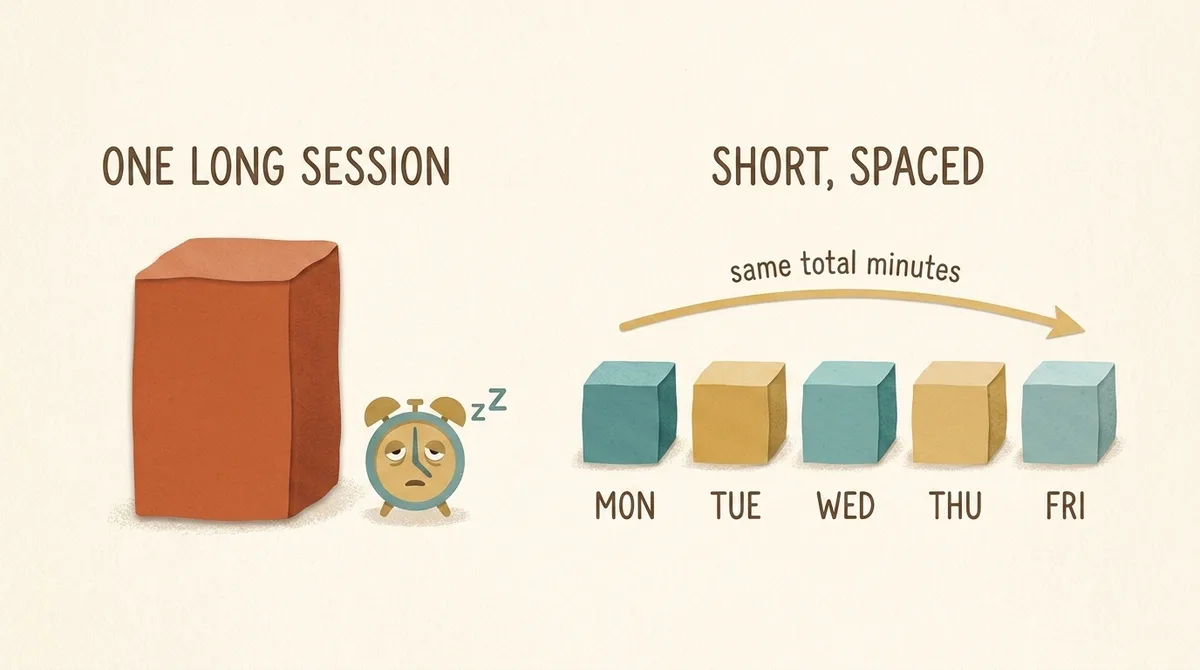
A short practice session can be easier to fit around school, rest and family life than a long block. That is a practical reason to consider one, not evidence that every child should practise for the same number of minutes each day.
Start with the test your child may sit, the material they already understand and how they respond to practice. A routine should be adjustable. Missing a session does not create a debt of questions to complete at the weekend.
What does the research support?
Spacing means returning to material on separate occasions rather than doing all the work in one sitting. Retrieval practice means trying to recall or use something before looking at the answer. These describe how learning is organised; neither supplies a universal session length.
Dunlosky and colleagues' 2013 review of learning techniques rated practice testing and distributed practice highly across the evidence it examined. That is broader learning research, not a trial establishing a daily 11+ routine or a guaranteed admissions benefit.
There are limits to transferring a principle straight into a home timetable. The Education Endowment Foundation's review of cognitive science in classrooms looks at cognitive science approaches in school settings. Read its findings in that context. A promising approach still needs suitable questions, prior teaching and attention to what a child understands.
Interleaving means mixing different types of problem. It is not a rule that every session must mix subjects. A child meeting a new method may need a clear example and some focused practice before choosing between methods. Nor does delayed marking make an attempt worthless: review the answer and reconstruct the reasoning when you can, without claiming that feedback expires after a fixed number of hours.
Choose one manageable task
Before starting, name the task in concrete terms: “We will look at how this fraction becomes a decimal”, rather than “We need to improve maths”. Choose material with a worked explanation or an answer you can check confidently.
Here is one possible session structure. It is an example to adapt, not a prescribed dose:
- Recall something previously taught, with a prompt if needed.
- Work through one example and explain the steps.
- Try a small number of similar questions.
- Compare the answers and discuss one point that needs attention.
- Decide whether to revisit it on another day.
If an answer is wrong, ask what the child tried. An incorrect answer alone cannot tell you whether the cause was unfamiliar vocabulary, a new method, a copying slip, uncertainty or tiredness. A note such as “read ‘more’ as ‘less’ on this question” describes the attempt; it is not a diagnosis.
A shared place for materials and an agreed time may make the plan easier to organise. Choose that time with your child and leave room to change it. Food, rest and reassurance should not depend on finishing a worksheet.
Keep the stage of learning in view
There is no age-by-age number of practice minutes that this article can validate. In earlier primary years, ordinary reading, conversation, schoolwork and play remain relevant parts of a child's day. Ask the class teacher about an underlying reading or maths concern rather than treating an 11+ practice set as an assessment of it.
For an unfamiliar question type, begin with instructions and an example. Ask the child to explain what the question wants before adding time pressure. Once a method is understood, returning to it later gives another opportunity to try it without simply copying the previous answer.
The relevant school's or consortium's familiarisation materials are the source for its format. Do not assume that every test uses the same subjects, answer sheet or timing. Our year-by-year preparation guide can help organise questions to ask, but local admissions guidance takes priority for dates and requirements.
Try a short sample, with clear limits
The widget below offers ten multiple-choice questions from a selected subject. Each subject bank currently contains 12 questions, so retakes can repeat items. It randomly selects ten while keeping their original relative order and the order of answer choices.
This part of the guide is a free timed practice test. It works in your browser.
The widget allows ten minutes for maths and eight minutes twenty seconds for English, verbal reasoning or non-verbal reasoning. These are sample-widget settings, not official entrance-test timings. Answers are recorded when the child advances with Next question or Skip. If the timer ends first, a selected choice on the open question has not been submitted.
The result shows the number correct, topic counts and worked explanations. It does not diagnose ability, estimate a standardised admissions score or establish that a retake improvement represents learning. Unsubmitted and unreached questions count as unanswered; their elapsed time is not recorded. The widget has no account or payment step, and it does not offer a saved account history of these sittings.
Use an explanation as something to discuss if it is useful. There is no need to complete a timed sample merely to keep a routine intact.
When might a longer paper be useful?
A short question set and a full familiarisation paper have different purposes. A relevant paper can show the instructions, answer format and length of the target test. It does not need to become a weekly obligation at a particular age.
Before using one, check that it matches the current route. Follow the published timing and any appropriate access arrangements. If you adapt it for teaching, such as pausing to discuss an example, label the result as supported practice rather than a comparable timed sitting.
Decide beforehand whether the aim is to learn a method, experience the format or review a completed paper. The amount and type of support can then match that purpose. This article does not prescribe a term-by-term mock schedule or promise that a certain number of full papers builds exam stamina.
Pause when practice is not helping
If your child is upset, unwell or too tired to engage, pause and check what they need. Repeated guessing or rereading may be a reason to ask whether the instructions or material are clear; these behaviours do not have one certain cause.
You could say, “Let's stop here and look at this another time.” There is no evidence-based threshold here for how many pauses a fortnight are acceptable. If difficulty or distress keeps recurring, review the plan with your child and, where helpful, their teacher. Adding more questions is not an automatic answer.
Make a flexible plan
Instead of a fixed weekly quota, write down the next small task, a possible time and what you need to check it. Leave space for school homework, activities and rest. Afterward, note what was attempted and any specific question to return to.
For example: “Next time, revisit how to find a quarter of a number. Use one worked example, then ask the child to show the method on another number.” That is a concrete next step. “Get 80% next week” does not say what to work on, and percentages from different small sets may not be comparable.
Keep the plan open to change. The purpose is an understandable task and a useful review, with a routine your family can manage. No particular number of minutes, repeated-question score or length of preparation can guarantee an admissions outcome.
Topics
- study routine
- daily practice
- spaced practice
- year 3
- year 5
- exam stamina