


11 Plus Spelling Rules and Word Lists
Review English spelling patterns in the national curriculum, practise word lists and try original proofreading questions. Check whether your local 11+ test includes spelling.
 Elspeth Marlow
- 14 min read
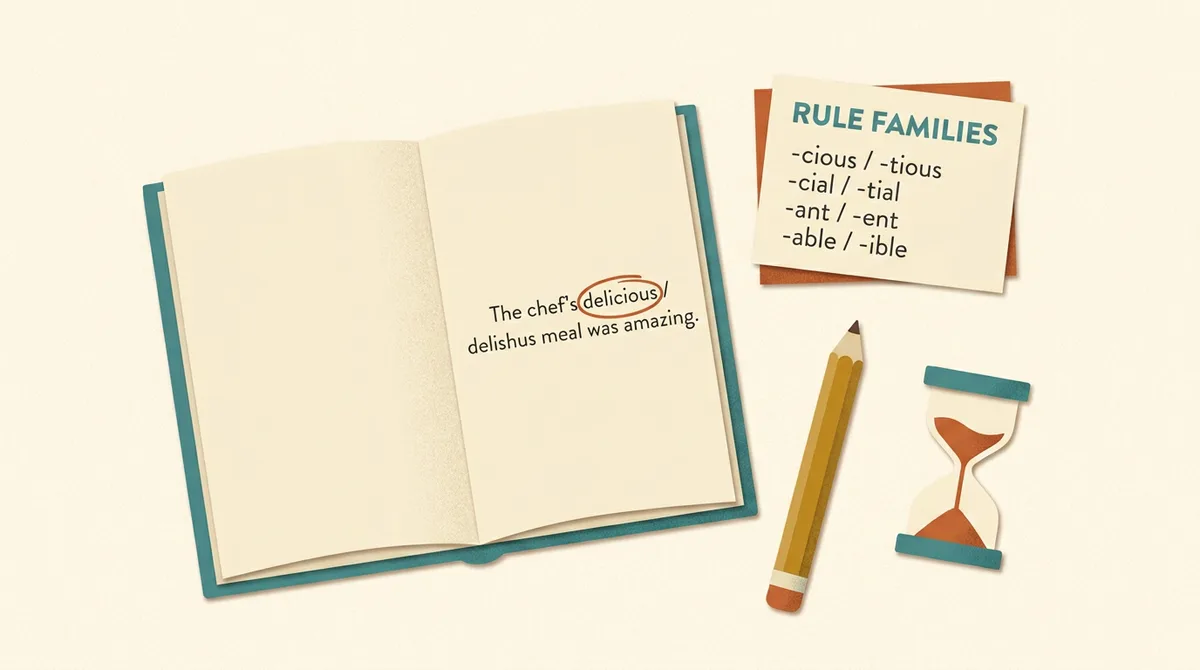
Spelling preparation can include both individual word practice and patterns that help explain how words are spelt. Which approach is useful for an 11+ depends on the test your child will sit.
The national curriculum is a useful reference for English spelling, but it is not an 11+ syllabus. Its English Appendix 1 gives statutory spelling requirements and lists of words often misspelt in Key Stage 2. Selective-test content is set locally, and schools may use different question formats or content.
This guide explains how to check whether your local test includes spelling, summarises selected curriculum spelling patterns and gives original proofreading examples. Learning a pattern can help with related words, but exceptions and word-specific practice still matter.
Does your child's 11 plus actually test spelling?
Start here, because it is the question that decides whether the rest of this page is worth your time. The 11 plus is not a national exam. Formats are set locally, and GL Assessment says so itself: "11+ tests vary from area to area", and the timings, topic combination and question count in your local test "may differ" from its own practice materials (GL Assessment).
For example, North Yorkshire Council says that for September 2026 testing at Ripon Grammar School, one paper combines KS2 reading comprehension and spelling with verbal reasoning. The English section is 25 minutes, includes spelling and grammar exercises and has 26 questions; the council says its content goes up to the end of Year 5 (North Yorkshire Council). This is a local example, not a national 11+ format.
Three checks, in order:
- Read your local authority's own admissions or selection-test page, not a tutoring site's summary of it. Councils publish the paper structure and timings.
- If a school has its own admissions test, read its admissions page separately. Some schools use a shared local or consortium test, so check which arrangement applies.
- Download the official familiarisation booklet for your test provider and look at the actual question types in it.
If spelling is not listed for your target test, treat it as part of general English learning rather than a confirmed exam section. You may want to focus test preparation on the listed content, such as vocabulary or comprehension.
What might an 11 plus spelling question look like?
GL Assessment's English practice materials include comprehension, capital letters and punctuation, spelling questions that ask children to spot mistakes, and word choice and grammar (GL Assessment English practice papers). The actual content of a local test can differ.
One GL English practice format gives a sentence broken into labelled parts, and the child marks the part containing a spelling error, or marks "N" if there is no mistake. That last option matters more than it looks: a child who assumes every question hides an error will invent one.
Three practical consequences follow.
Proofreading questions ask children to recognise an error in context. Spelling words from dictation or memory is another useful way to practise, but it is a different task.
In North Yorkshire's example, 26 English questions share a 25-minute section with a reading passage. The council does not state how that time is divided among question types.
The original examples below use both curriculum patterns and commonly confused words. They illustrate possible practice, not a claim about how test writers choose errors.
Where do the 11 plus spelling words actually come from?
The national curriculum's spelling appendix contains two statutory word lists, one for Years 3 and 4 and one for Years 5 and 6, and it is unusually candid about how they were picked: "The lists are a mixture of words pupils frequently use in their writing and those which they often misspell", and "the 100 words in each list can easily be taught within the four years of key stage 2". It also draws a clear line about what is binding: "In this spelling appendix, the left-hand column is statutory; the middle and right-hand columns are non-statutory guidance" (English Appendix 1: Spelling).
The Year 5 and 6 list includes words such as accommodate, aggressive, amateur, awkward, bruise, cemetery, committee, conscience, conscious, definite, desperate, disastrous, embarrass, environment, exaggerate, familiar, forty, government, guarantee, harass, leisure, marvellous, mischievous, necessary, neighbour, nuisance, occur, parliament, privilege, pronunciation, queue, recommend, rhythm, secretary, sufficient, twelfth, vehicle and yacht. These are curriculum words, not a published list of words used in every 11+ paper.
The statutory Year 5 and 6 requirements also name the rule families themselves: /ʃəs/ endings spelt -cious or -tious; /ʃəl/ endings; -ant, -ance/-ancy, -ent, -ence/-ency; -able, -ible, -ably, -ibly; adding vowel suffixes to words ending in -fer; use of the hyphen; the /iː/ sound spelt ei after c; the letter string ough; silent letters; and homophones and other words often confused.
The appendix is a useful teaching reference. Its requirements include several patterns and exceptions, as well as words to learn individually. It does not establish the scope of a local selection test.
Rule family 1: why is it delicious but ambitious?
The -cious and -tious endings can sound alike, so it helps to consider the root word. The curriculum's rule of thumb is about the root word: "If the root word ends in -ce, the /ʃ/ sound is usually spelt as c". So vice gives vicious, grace gives gracious, space gives spacious, malice gives malicious. Anxious is the exception the curriculum itself flags. The curriculum examples also include -tious words such as ambitious, cautious, infectious and nutritious.
The /ʃəl/ ending has a useful clue: "-cial is common after a vowel letter and -tial after a consonant letter, but there are some exceptions". Official, special and artificial have a vowel letter before the ending; partial, confidential and essential have a consonant letter. The exceptions to teach are initial, financial, commercial and provincial. The latter three are related to finance, commerce and province.
Where a related root helps explain an exception, you can point it out. Other words still need to be learned individually.
Rule family 2: is it -ant or -ent, -able or -ible?
These endings are often unstressed, which can make them difficult to hear clearly.
For -ant/-ance versus -ent/-ence, the curriculum gives several clues. Use -ant and -ance/-ancy when a related word has a /æ/ or /eɪ/ sound in the right position; -ation endings are often a clue: observant sits with observation, expectant with expectation, hesitant with hesitation. Use -ent and -ence/-ency after soft c (/s/), soft g (/dʒ/) and qu, or when a related word has a clear /e/ sound in the right position: innocent, decent, frequent, confident.
The appendix also notes that its guidance does not help with every word, and that some spellings need to be learned individually. It names assistant, obedient and independent as examples.
-able versus -ible works the same way. The curriculum notes that "the -able/-ably endings are far more common than the -ible/-ibly endings", but frequency alone cannot establish the spelling of a particular word. A clue: "the -able ending is used if there is a related word ending in -ation", giving applicable/application, considerable/consideration, tolerable/toleration. When -able joins a word ending in -ce or -ge, "the e after the c or g must be kept", which is why we write changeable and noticeable. The appendix says -ible is common if a complete root word cannot be heard before it: possible, horrible, terrible, visible, incredible. Sensible is an exception where a whole word can be heard.
Rule family 3: referred or refered, and does i before e still work?
The -fer words are a genuine trap because the same root splits two ways, and the deciding factor is stress. "The r is doubled if the -fer is still stressed when the ending is added": referring, referred, referral, preferring, preferred, transferring, transferred. "The r is not doubled if the -fer is no longer stressed": reference, referee, preference, transference. Have your child say the pair aloud, re-FER-ring against REF-erence, and the spelling difference is easier to see.
The i before e except after c jingle is taught far more broadly than the curriculum supports. The actual rule "applies to words where the sound spelt by ei is /iː/": deceive, conceive, receive, perceive, ceiling. Outside that long-ee sound it simply does not apply, so the rhyme is only a partial guide to the words it covers. The named exceptions are protein, caffeine and seize, plus either and neither when said with an initial /iː/.
And then there is ough, which the curriculum describes without much enthusiasm as "one of the trickiest spellings in English, it can be used to spell a number of different sounds". The different sounds can be practised in groups: ought, bought, thought, nought, brought, fought; rough, tough, enough; cough; though, although, dough; through; thorough, borough; plough, bough. Sorting is the exercise: give a child the fifteen words shuffled and ask them to group by sound.
Rule family 4: silent letters and the homophones that catch children out
The curriculum defines silent letters as letters whose presence cannot be predicted from pronunciation. Examples include doubt, island, lamb, solemn, thistle and knight. It notes that knight once had a /k/ sound before the /n/.
Etymology is a real strategy here, and the curriculum models it. Conscience "is simply science with the prefix con- added", from Latin scio, 'I know'. Desperate is often said as desp'rate, but its -sper- comes from Latin spero, 'I hope', where the e was clearly sounded. Familiar is related to family, which is why that first unstressed vowel is an a. Three of the hardest words on the statutory list, defused by one sentence each.
The appendix gives a useful pattern for some homophones: "In the pairs of words opposite, nouns end -ce and verbs end -se". Advice/advise, device/devise, licence/license, practice/practise, prophecy/prophesy. Advise even has a /z/ sound "which could not be spelt c". The statutory often-confused list for Years 5 and 6 also runs through aisle/isle, aloud/allowed, affect/effect, altar/alter, ascent/assent, bridal/bridle, cereal/serial, compliment/complement, descent/dissent, desert/dessert, draft/draught, farther/father, guessed/guest, heard/herd, led/lead, morning/mourning, past/passed, precede/proceed, principal/principle, profit/prophet, stationary/stationery, steal/steel, wary/weary and who's/whose.
Homophones can be challenging in a spot-the-error question because both spellings are real words. Read the sentence to work out which meaning is intended.
Try the homophones now: each sentence needs the right one.
This part of the guide is a short interactive exercise. It works in your browser.
What should an 11 plus spelling word list look like?
The examples below are grouped by source and pattern, not ranked by difficulty. Use the groupings as a starting point, then select words that match your child’s learning and local test materials.
Examples from the statutory Year 5 and 6 word list: forty, twelfth, occur, neighbour, leisure, bruise, queue, vehicle, yacht, awkward, amateur, definite, secretary, familiar, marvellous.
Examples of words illustrating the patterns above: conscious, sufficient, ambitious, official, special, essential, confidential, observant, hesitant, innocent, frequent, possible, terrible, considerable, noticeable, referred, preference, ceiling, receive, thorough.
Other examples from the statutory Year 5 and 6 word list: accommodate, aggressive, cemetery, committee, conscience, desperate, disastrous, embarrass, environment, exaggerate, government, guarantee, harass, mischievous, necessary, nuisance, parliament, privilege, pronunciation, recommend, rhythm.
You could select a small set of words from one pattern, then revisit them after a break. A revision timetable can help organise those reviews. Choose a pace that suits your child rather than treating this sample as a required weekly quota.
Can we see some worked spot-the-error questions?
Ten original proofreading items. In each sentence, the four candidate words are in bold. Pick the misspelled one, or decide there is no mistake.
- The committee agreed it would be necesary to postpone the annual concert. Answer: necessary. Family: learn-and-check statutory word.
- Our neighbour was anxious that the fence looked too artificial and not very speciel. Answer: special. Family: -cial after a vowel letter.
- She was confident that the independant school would grant her the privilege of attending the ceremony. Answer: independent. Family: -ant/-ent, a word the curriculum says must be learned.
- He refered the letter to the head, who kept a reference copy in the secretary's cabinet. Answer: referred. Family: -fer doubling under stress.
- The changable timetable is on the notice board beside the corridor entrance. Answer: changeable. Family: keeping the e after c or g.
- The stationary shop had run out of envelopes, which was a nuisance before the exam. Answer: stationery. Family: homophones.
- They took her advise about the bridle path and made a slow descent to the cemetery. Answer: advice. Family: nouns end -ce, verbs end -se.
- The ancient thoroughfare was too rough for the vehicle. No mistake. Family: ough sound groups (all four words are spelt correctly).
- He tried to decieve the judges but his conscience made him confess to the committee. Answer: deceive. Family: ei after c for the /iː/ sound.
- It was a disasterous attempt to accommodate twelve guests in one awkward environment. Answer: disastrous. Family: a statutory word to learn.
These examples place spelling choices in sentences. If your child wants more practice, try a range of proofreading examples and check whether they match the local test format.
Try a spot-the-error question now: one word is spelt wrong.
This part of the guide is a short interactive exercise. It works in your browser.
How do you improve spelling for the 11 plus week by week?
The amount and frequency of practice can vary. Short sessions may fit more easily into a family routine than one long session.
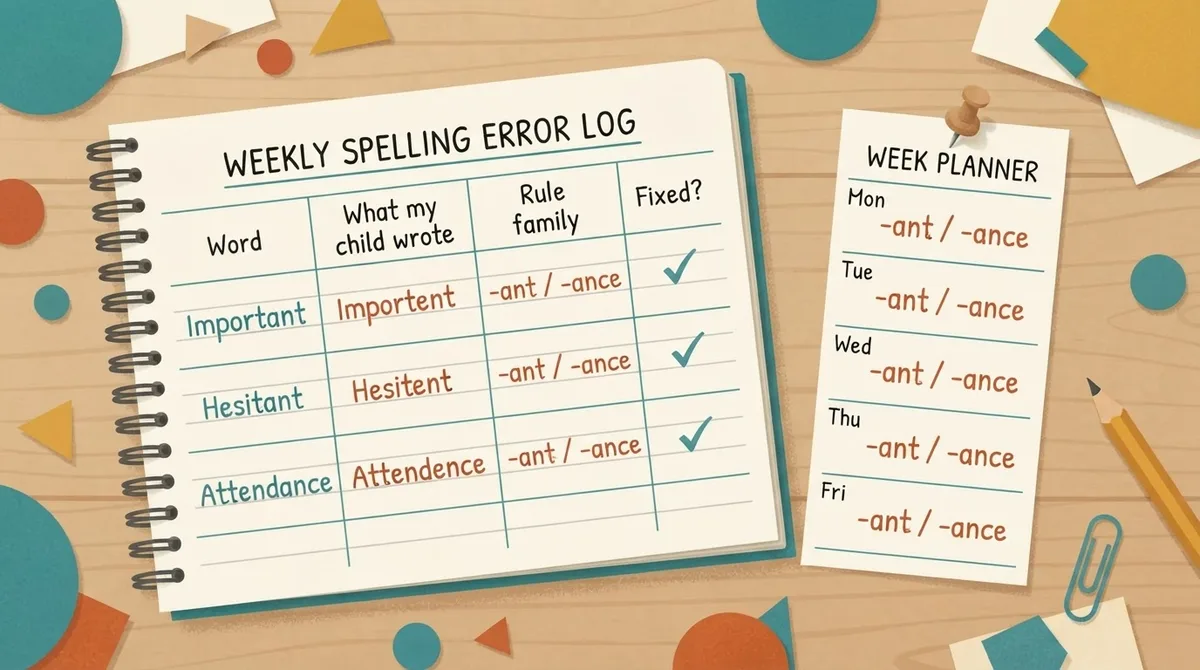
For example, you could introduce a pattern, sort sample words, try a proofreading exercise and revisit earlier words after a break. The days, pace and activities are suggestions, not a research-backed prescription.
An error log is one way to organise practice. You could record the word, the spelling your child tried, a relevant pattern if there is one, and whether they spell it correctly later. Similar errors can suggest a pattern to revisit, though a note cannot diagnose why a child made a particular error. A paper notebook is enough for this kind of record.
Balance practice against the format of your local test and your child's learning needs. If spelling is not tested, or if another area needs more attention, adjust the time you spend accordingly. Our 11 plus maths topics and question types guide covers the maths side.
11 plus spelling questions parents ask
Is it "11+" or "11 plus"? Both are used and both are correct. Councils and schools tend to write 11+; parents and search engines tend to use 11 plus. There is no difference in meaning.
Which words should we practise? The statutory Year 5 and 6 word list is a useful starting point, alongside words your child is learning at school and any spelling examples in your local test materials. There is no single list for every 11+.
How long should we spend on 11 plus spelling? There is no fixed schedule for every child. Use short practice that fits your child and the test, and revisit words or patterns that are still difficult.
Does spelling matter if our test has no spelling section? Spelling remains part of English learning, but whether it is directly assessed in your selection test depends on that test's format.
Do we need to buy a spelling pack? Not necessarily. You can begin with the free curriculum appendix, school materials and the examples in this article. Check a paid resource against your target test before buying it.
If you want the wider English picture, our 11 plus vocabulary guide covers word meanings and how to learn them.
Topics
- 11 plus spelling
- english
- spelling rules
- word lists
- gl assessment